
by Ava Wood
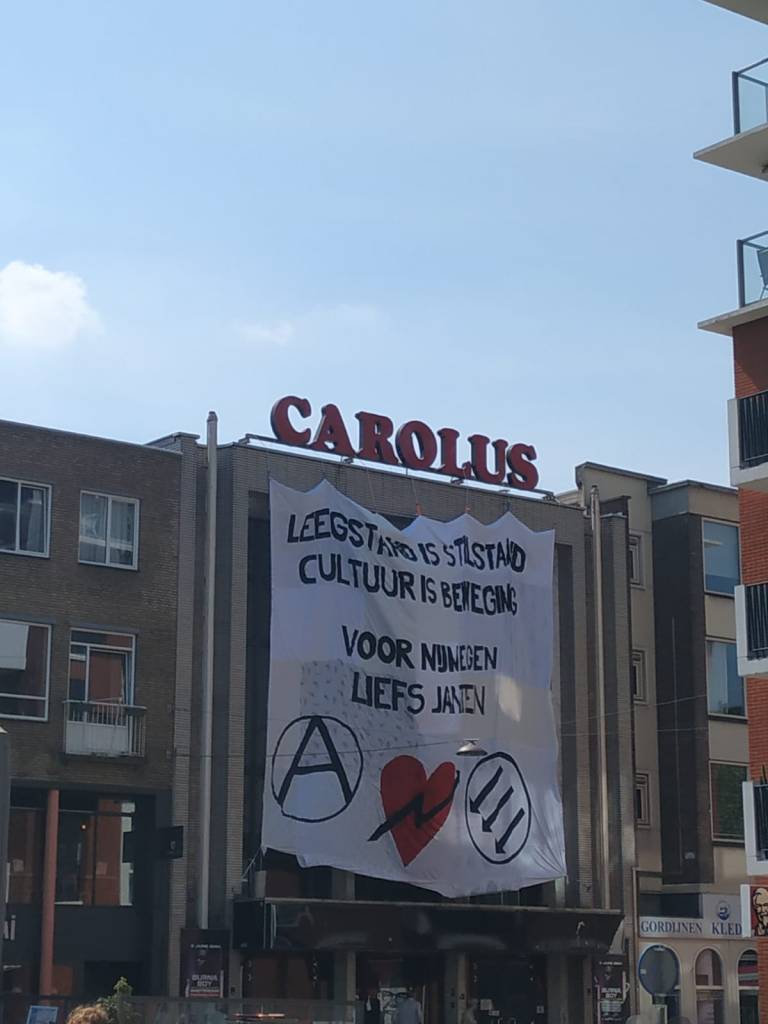
On the first May (Labour Day), a crowd had gathered around a stage on Plein 1944, sun beating hard and loud voices raised in unison, united against capitalism and for class liberation. Protesters sandwiched in between a Primark and a KFC, stark examples of worker exploitation at its best. The protest had started at the train station, passed by Kronenburgerpark and down the idyllic Hezelstraat; voices raised, waving anarchist banners, and compelling on-lookers to reconcile with their class consciousness. As the speeches ended, figures appeared on the roof of the Carolus cinema. They wore masks and waved Palestinian flags, as a banner the length of the building unfurled down its side. The cinema was squatted.
This year the May Day protest focused on the history of class liberation movements, the intersections between feminism, class and queer liberation, and also on the rights and power of migrant workers. Arguably, May Day has a ritual importance, of projecting the working class as a group with power in order to demonstrate their potential to themselves and to society.[1] That is what we did on Labour Day, confronting Nijmegen with the strength and unity of the working class for the first time in 5 years.

However, the protest also made a statement about the importance of the role squatting plays in class liberation, and demonstrated the power of the people to make space for themselves whilst the state leaves space to sit empty. This was also perhaps a show of the power of the working class. A ritual taking-back of the city.
Squatting in the Netherlands
Squatting has been integral in the Netherlands in fighting against vacant buildings since the 1960s. Squatters began occupying unused properties, destined for land reform, which had been left empty after tenants were moved out.[2] The movement aimed at providing homes at a time when tens of thousands were waiting for social housing, as well as to create spaces for alternative social organisations, and to make a political statement. A movement at first in relative harmony with the state descended into sour relations after tensions appeared in the 70s and 80s, resulting in police violence and tanks being sent in to evict a squat in Nijmegen in 1981 – to make way for a parking garage. A parking garage that was never built.[3]
Squatting also has a long and diverse political history, with variation in the intentions of squatting groups and their philosophies. Some squatted for individual necessity, some to make a political statement, others to make use of abandoned buildings or to preserve historic landmarks. Some squats include social centres, ‘which combine housing with sociopolitical workshops’ and more, whilst others ‘offer free housing for those who have been displaced’ or who choose an alternative lifestyle outside of the system.[4]
Squatting and Common Spaces
Squatting can be seen as part of an effort to build and preserve the anti-capitalist commons, and to create community in a capitalistic and individualistic society. Federici and Gaffentzis highlight the importance of protecting the anti-capitalist commons which are “autonomous spaces from which [we can] reclaim control over the conditions of our reproduction.”[5] They are third spaces besides the state where we can generate a true community based upon solidarity and communal sharing. They argue that these commons have always been essential, especially in times of “permanent crisis” in protecting against environmental destruction, ensuring the survival of the poor, creating spaces for art and discussion, and for survival itself.[6] Capitalism actively works against the anti-capitalist commons; it seeks to privatise and individualise and sell common spaces back to us for a price.
We can see this issue also reflected in the modern-day discourse of the third space. Third spaces are public areas which should be able to be accessed without a cost, but they are dying out. Anti-capitalist commons offers a solution to this – one that aims to create not just public spaces (still controlled by the state), but a truly communal area from which a counter-society can operate. In this way, the fight to preserve communal areas using anti-capitalist conceptions of the commons is a fight integral to class liberation. It seeks to create egalitarian and community-run spaces and therefore transfer agency to the people. It aims to provide the people with a space from which a non-capitalist world can be constructed.
Squatting, as a way to create anti-capitalist commons and involving the rejection of hierarchy and individualism, is therefore highly relevant and somewhat intertwined with the movement for class liberation. It makes sense then, why the protest and the squat made good company on May First.
Interview with Jantien
In Nijmegen, the main group behind the squatting community is Jantien, a collective started in 2022. I interviewed two members of the group, Michael and Goblin. Michael described the circumstances that led to Jantien’s creation:
“It was in late 2021 that we had housing crisis protests here in the Netherlands, including Nijmegen and Arnhem. I helped organise some of the protests and speeches in Arnhem and Nijmegen. And from the Anarchist group here we thought that we wanted to do more than just complain, and so in 2022 we started up a squatting group that at that point did not even have a name yet.”
“The first building that they/we ever did was the old Extase and that is next to Nijmegen Jopie, which is a very famous shop of military surplus. So the joke was that it is Nijmeegs Jopie and Nijmeegs Jantien, they are both very old school names, old school Dutch names. And that’s how it got started. And that would have been late 2022 and in 2023 we’ve had most of our actions.”
The group squats for a combination of reasons, particularly for activism but also to provide people in need with a home. This is one of the reasons that drew them both to the squatting movement.
Michael:
“For me the initial motivation was really to just try to practise what I preach, so to say. And then, when I got into that network and into those relationships with people who weren’t just in it because they believed it, but also were in it because they needed housing … I think that made it so much more personal and so much more important to me. Because now I’m not just doing it because I think it’s abstractly a good thing, I’m doing it because my friend needs a house.”
Goblin also highlighted that when they first came to the Netherlands, they were surprised by how normal squatting seemed to be. It was scary, but exciting. They also said that what was important was taking matters into their own hands:
“So then when you have your own building, it’s nice to be like ‘Okay, all of these things that we were thinking of before, that we want to do to help people, we are actually now able to do.’ In a much larger way.”
In this way, it is about taking agency over your place in the city.
Michael:
“It allows you to see places of the city that otherwise you would never see. And I think it gives you a sense of responsibility, and I’m going to say ownership but not like in a bad way – you know what I mean – it gives a sense of …. guardianship, communal ownership, of the city. When I walk through Nijmegen now I feel like I’m much more embedded in the city and its infrastructure than I would have been in any other city that I have lived in.”
This is an important theme in the discussion of squatting – the ability to take action and the opportunities and responsibilities that come with it. One of these opportunities is to create communal spaces, and once you have, the responsibility to make them accessible for the community. Jantien aims to build these ‘socio—cultural spaces’, where people feel empowered.
Goblin:
“Some people come to these spaces and suddenly they’re like ‘Ah, we can do these kinds of things.’, and then it gets them thinking and suddenly there’s a lot more people who actually want, and have the ideas and the time and space, to create these sorts of third spaces.”
These places can contribute to a realisation for some that it is possible to occupy space without having to pay money, where you are welcomed by a community and where you yourself can begin to make change, if you want. Empowering, perhaps liberating, and a lesson in taking agency.
In terms of class liberation, Michael argues:
“I think mainly it helps with changing the attitude that you have towards each other, towards theories of property. Frankly, theories of the city. I think it’s a small part of it; I don’t think we should inflate it too much, but then again I think that every part of large social change is ultimately a small part of everything that’s going on.”
Thinking back to communal spaces and anti-capitalist commons, squatting then integrates these principles of non-hierarchy, mutual aid, solidarity, and others that come with trying to create an alternative community. As above, this is empowering, and also demonstrates that there are alternatives to capitalistic society, perhaps to people who had not considered this before. In this way, squats can act as gateways to politicisation, introducing people to alternative living, and subsequently to the cause of class liberation.
According to Michael, squatting also teaches “a lot of skills, both social skills, organisational skills, technical skills, that come in handy and we should probably all have.” Goblin adds that “It’s also a way … to not have to really be dependent on the higher-ups. Like you have to be less dependent on landlords, or – owners of cinemas.”

I asked them both why Jantien chose the cinema to squat, and the answer was so that they can provide the housing and cultural space previously mentioned, but on a larger scale. To continue to do the social events that they had in their old squat, on the Burchstraat, but ‘even bigger’. Also, the state was not creating these spaces, so they took matters into their own hands.
Goblin:
“The local government also recently had a motion about wanting to have more cultural places, which would be perfect to have in that building. And so we thought we would go in there and then we would have all these cultural social … centres where people can come and do our film nights … or art gallery things. That was just kind of perfect for those purposes.”
They also told me that the government has “also been pulling cultural subsidies from a lot of places in Nijmegen,” and now they’re surprised by the lack of them. Michael added that the municipality has also acknowledged the homelessness problem in the city, as well as the large amount of empty buildings. They have been considering a plan to use these empty buildings for facilities for homeless people. This is something Jantien has already been doing.
“We are solving that on our own.”
Over the years, Jantien has seen more and more support from people in Nijmegen, and their approach to squatting has helped to change the way that it is viewed in the community. Michael says that, more importantly, “we’ve been able to give people homes, we’ve been able to have the homeless walk-ins.” They have been able to give homes to people and to homelessness charities to operate out of for their community programs. There have been concrete, direct effects of their action. Goblin adds that they have been able to act as a platform for people to get involved in the community and act on their ideas.
In addition, the group is increasingly consulted on issues of housing and sometimes on cultural spaces.
Michael:
“When there are particular decisions or motions made by the municipality, the newspaper now comes to us and asks Jantien ‘What do you think about this?’ We are in contact with multiple people in the city council, they visit us, we talk to them, we have discussions about how things should be done, how they can help us, how we can coordinate things.”
I wanted to ask about the practicalities of squatting, and how Jantien’s relationship with the police and municipality works. It seemed to be tentatively cooperative.
Goblin:
“We have a police liaison … we have a lawyer and we’ve been in court once or twice. But usually there’s the concept of house peace. So, when you get house peace then, technically, legally, they’re not allowed to go in. Doesn’t mean they don’t, but usually.”
Michael:
“Nowadays, we have a 24-hour period in which we have to be inside and basically be quiet and not let anyone notice.”
“Then after those 24 hours you semi-officially live there. And then you have house peace, and if you have house peace, you can’t just be evicted from the building. You can still be arrested for squatting, which is what happened once, when the police broke into our building and then arrested people there. But at the very least you can’t just be evicted, that has to go through the district attorney and the courts.”
So there are some legal protections, but it is precarious. Crucially, as Michael points out, “house peace is legally protected but not super strictly defined.” So there is room for confusion, disagreement, and abuse of the system. To avoid this, the squatters will attempt to make the squat look homely and “house-peace-y”, as Goblin says, and will call the police purposely after the 24-hours to get their confirmation of house peace.
Nevertheless, the legal uncertainty and dangers still exist. They told me there are several things squatters can be arrested for, including being caught in the act of squatting, breaking and entering, and maybe destruction of property if damage occurred. In addition, there is always a high risk of eviction, which creates instability and vexation, especially for those relying on the squats for housing.
Michael:
“We try to squat things that have been empty for a longer period of time. Both because that’s, sort of, philosophically what we’re trying to do, we’re trying to stop the vacancy, but also I think it’s just a strategic point. Because if we squat something that’s been empty for a longer period of time we are more likely to be allowed to stay there.”
The minimum for vacancy is one year – the cinema had been empty for around three, and the squat on Burchstraat for fourteen years.
For the cinema, Jantien also actively sought the support of the community, engaging with local homelessness, as well as social and cultural organisations, alongside academics and other members of the community. They published a two-page letter, signed by their supporters, explaining their philosophy and intentions (see below).
Right now, the plans for the squat are a work in progress. It is currently used as a space for events and meetings for the Palestinian cause, and the group also intends to run events for the community in the future, including a return of its Queer movie nights, and a lecture series on political theory. Updates are posted on their instagram.
Whether it be a gateway to alternative living, a ‘school of the revolution’, a radicalising space, or a building for helping the community and providing housing, squats and squatting have had a long-standing impact in the Netherlands, and particularly in our city. As with activism and organising, Nijmegen has a long and proud history to show.
When the police had evicted the Nijmegen squatters with tanks in 1981, from rows of empty worker’s houses on Piersonstraat, they had also used tear gas, helicopters, and a force over 2000 strong.[8] This led to the Pierson riots, with the community mobilising in support of the squatters. 17,000 people demonstrated, in one of the largest protests in Nijmegen’s history.[9] Perhaps the demonstration on May Day can be seen as building on this tradition of unity as, although peaceful, the protest and squatting aimed at being impactful and making a statement against the inaction of our government. It demonstrated the union and power of the working class and our own capacity to create change.
For me, this is the key point. To build lasting change we must create our own spaces, for sharing ideas, fostering actions, empowering each other and working towards our liberation. To, ultimately, build a society that is ours, and a city that we can all walk through, and feel is our own.
References:
[1] Fantasia R., (2016). Foreword. In Abby Peterson and Herbert Reiter (Eds.), The Ritual of May Day in Western Europe: Past, Present and Future. 2016.
[2] Prujit H., (2017). Squatting in the Netherlands: the social and political institutionalization of a movement. In F Anders and A Sedlmaier (Eds,), Public goods versus economic interests: global perspectives on the history of squatting. Routledge. <7https://pure.eur.nl/ws/files/68867808/Squatting_in_the_Netherlands_institutionalization_aut_vers.pdf> accessed 23 May 2024.
[3] Ibid.
[4] Marks A., (2015, May 2). Squatting, Alternative Spaces, and Anti-capitalist Commons A Socio-Spatial response to the Housing Crisis in Utrecht. Unusual Business. <https://unusualbusiness.nl/en/theory/squatting-alternative-spaces-and-anti-capitalist-commons/index.html> accessed 20 May 2024.
[5] Caffentzis, G. and Federici, S., (2014). Commons against and beyond capitalism. Community Development Journal 49(1), i92 https://www.jstor.org/stable/26166211 accessed 26 May 2024, i101.
[6] Ibid, i95.
[8] Into Nijmegen. The Red side of Nijmegen, rebellion and counterculture. Into Niimegen. https://en.intonijmegen.com/discover/history/historicaltimeline/the-red-side-of-nijmegen-rebellion-and-counterculture accessed 26 May 2024.
[9] Mijn Gelderland. Opstand in de Piersonstraat Nijmegen, 1981. Mijn Gelderland. https://mijngelderland.nl/inhoud/verhalen/opstand-in-de-piersonstraat accessed 26 May 2024.
Statement letter by Jantien
15/05/2024 te Nijmegen
Geachte lezer,
Op 29-04-2024 hebben wij als krakerscollectief Nijmeegs Jantien de oude Carolus bioscoop aan het Plein 1944 gekraakt, die wij nu 2 weken bewonen. In deze brief willen wij onze beweegredenen en plannen voor desbetreffend pand voor u uiteenzetten.
In 2015 is onze zorgstaat overgegaan in een “participatiesamenleving”. Dit ging gepaard met gigantische bezuinigingen in het sociaal domein en de zorg- en cultuursectoren. Voorzieningen die wij tot dan toe als vanzelfsprekend beschouwden zijn weggevallen of geprivatiseerd. Wij voelen ons als Nijmeegs Jantien genoodzaakt om deze gaten in te vullen met het opzetten van nieuwe vrijplaatsen zonder winstoogmerk. Deze hebben altijd een grote rol gespeeld in het motiveren van burgerparticipatie en wederzijdse hulp, zoals de Grote Broek, Paraplufabrieken, Doornroosje, en de NuNN hebben laten zien. Al deze plekken zijn oorspronkelijk begonnen als kraakpanden en hebben enorm aan Nijmegen bijgedragen op sociaal-cultureel, financieel, en maatschappelijk vlak.
Wij zien dat er in Nijmegen te weinig ruimte is om ongedwongen en laagdrempelig sociaal en creatief bezig te zijn. Zo zullen wij in ons pand jongeren een plek bieden waar ze zichzelf kunnen zijn en zich sociaal, cultureel en maatschappelijk kunnen ontwikkelen. De gemeente Nijmegen heeft zelf in hun notitie ‘Cultureel broedplaatsenbeleid’ (2024) aangegeven dat “broedplaatsen vaak geassocieerd worden met rafelranden, maar er steeds minder echte rafelranden zijn. Betaalbare ruimte om te experimenteren is schaars.” Jantien schept met deze actie zonder extra kosten voor de gemeente op Plein 1944 een extra culturele broedplaats die volgens de raad hard nodig zijn.
Ook voor andere (kwetsbare) groepen zullen wij de deuren openen, zoals dak- en thuislozen, vluchtelingen, en mensen met een laag inkomen. Voor al deze groepen is er de afgelopen periode minder geld, tijd, en aandacht beschikbaar gesteld, met alle negatieve gevolgen van dien. Ondanks pogingen en goede wil van verschillende partijen in onze stad, is het tot nu toe niet gelukt om deze problemen adequaat op te lossen. Sterker nog; al deze pogingen ten spijt stijgt het dakloosheidscijfer nog steeds onverminderd door, net als de wachtlijsten bij talloze loketten en voorzieningen. Een gebrek aan toewijzing van financiële middelen, te herleiden tot overheidsbezuinigingen, ligt vaak ten grondslag hieraan. Zodoende zullen wij in dit prachtige pand een sociaal-culturele bijdrage leveren die de gemeenschap geen geld kost, maar puur draait op vrijwilligers en de intrinsieke motivatie van betrokkenen.
Concreet betekent de ingebruikname van dit pand allereerst dat wij ons project De Sok opnieuw leven in kunnen blazen. Hier zullen wij een laagdrempelig podium bieden aan nieuw talent zodat zij zichzelf verder kunnen ontwikkelen. Voorbeelden hiervan zijn ‘open mic’ avonden, poëzie voordrachten en muziekoptredens, maar ook lezingen en discussiepanels. Hiermee maken wij optimaal gebruik van de twee theaterzalen in ons pand, die voldoende ruimte bieden voor publiek, en die het dankzij hun geluidsisolatie mogelijk maken om dit zonder overlast te organiseren.
Ten tweede hebben wij onze samenwerking voortgezet met De Steeg, een daginloop in zelfbeheer voor en door mensen van de straat. Zij verwelkomen (ex-)dak- en thuislozen met een warme plek, gezelschap, een kop koffie, en sociale hulp. Het initiatief wordt geholpen door sociale werkers, maar draait op een groep vrijwilligers die zelf uit het circuit komen en die samen de beslissingen nemen over de gang van zaken. Deze constructie geeft een gevoel van verantwoordelijkheid en zorg voor de ruimte en elkaar. In ons vorige pand op de Burchtstraat hebben wij eerder De Steeg met veel succes een plek kunnen bieden, waar zij vier maanden lang elke dinsdag en donderdag tussen de twintig en dertig gasten hebben ontvangen. In die tijd is er geen enkel incident in of rond het pand geweest. Een initiatief als De Steeg vermindert de overlast van mensen op de straat door ze een plek te bieden om hun dag te besteden in plaats van ze weg te sturen. Hier heeft heel Nijmegen baat bij.
Ten derde zijn wij in contact met verschillende kunst collectieven om hen ruimte te bieden in ons pand. Hierdoor wordt het mogelijk om met kunstcollectief Bel Zoekt Deur een open stadsatelier te faciliteren, en daarnaast openbare workshops en lessen te organiseren, modeshows, en kunstexposities te houden. Zo krijgen (jonge) artiesten een plek om zich te ontwikkelen, met elkaar in contact te komen, en de cultuur van Nijmegen voort te drijven. De Economische visie #KansvoorNijmegen (2019) benadrukt de waarde van verbindende creatieve broedplaatsen en ziet kansen in het verbinden van ondernemerschap, onderwijs en cultuur. In ‘Ruimte voor ontmoeting’ (2023) spreekt de gemeente de ambitie uit om ontmoeten en participeren te stimuleren, en betrekken daartoe ook ruimten van derden: “de plek is voor ons ondergeschikt aan de activiteit”. In dit pand kunnen wij creatieve ontmoetingen en samenzijn faciliteren, en ruimte bieden voor collectieven om zelf atelierruimten of broedplaatsen te scheppen.
Als laatste biedt het pand ruimte om te leven. Woonruimte is nog steeds noodzakelijk tijdens de huidige wooncrisis. Zolang er panden zoals deze blijven leegstaan, is het als samenleving niet te accepteren dat er mensen zonder woonplek zijn. Daarnaast gaan wij in samenwerking met andere collectieven in Nijmegen een wekelijks soepcafé opzetten waar mensen voor een kleine donatie gezond eten kunnen krijgen.
Wij delen deze concrete plannen met u om aan te geven dat wij serieus voorbereid zijn om dit pand en zijn ruimtes optimaal te benutten in het voordeel van Nijmegen en haar burgers. Uiteraard staan wij er voor open om hier verder met buurt en burgers over in gesprek te gaan; alle input is welkom. Nijmeegs Jantien is als groep gewijd aan horizontale organisatie en directe democratische waarden. Wij openen vandaag dit pand voor heel Nijmegen en hopen hierbij op ieders tolerantie, solidariteit, en wellicht samenwerking.
Lieve groetjes,
Nijmeegs Jantien
Getekend in solidariteit door:
De Steeg
Bel Zoekt Deur
Collectief Café De Opstand
Collectief Café De Plak
De Onderbroek
De Klinker
De Grote Broek
LUX
De NuNN
Het Kasteel
Proces Verbaal
De Stadsnomaden
COC Regio Nijmegen
Studentenvakbond AKKU
Anti-Kantine
Stichting Gast
Stichting Pontanus
Stichting Overal
Stichting Dar al Yasmin
IWW Arnhem-Nijmegen
Bond Precair Wonen
Paraplufabrieken
Vagebond
De Vlegel
Drift
Hubert
Extrapool
Knust
Stichting My Identity
Besiendershuis
Antillectual
Fort Beneden Lent
Zaaigrond
Cabaret de Gemeentereiniging
Celia Okoro, Nachtburgemeester Nijmegen
Jan-Wieger van den Berg, kunstenaar
Elisah Verbrugge, kunstenaar
Tim Tiemissen, sociaal werker
Michael Grooff, filosoof
Gaard Kets, universitair docent politicologie
Mathijs van de Sande, universitair docent politieke filosofie
Evert van der Zweerde, hoogleraar politieke filosofie
Lenneke van Maren, straatpastor

 Raffia