
by Marijke Naezer originally published in the Raffia Print Magazine Nr. 4 of 2009 – Translated from Dutch to English by Mara Wemmenhove
In her 50 years of existence, Barbie has had many adventures and worked in dozens of professions. She set foot on the moon before Neil Armstrong ever did, had access to parties where movie stars could only dream of, and saw more of the world than any other average citizen. The possibilities of Barbie seem limitless: she is the woman who can do anything. Behind this façade, however, hides a conservative woman who on all fronts is very privileged. At the same time, she unintentionally helps to denounce these privileges.
“A successful businesswoman, member of a rock band, a World Cup soccer player, and former presidential candidate. Who is this superstar? Barbie, of course!” Publisher Matter doesn’t doubt it for a second: their Barbie is a woman of the people. Despite her “modest” beginning as a teenage model, as Mattel likes to refer to it, she has built a rather impressive resume. She’s had internships in large cities such as San Francisco and New York and worked as a stewardess, teacher, movie star, clothing designer, nurse, astronaut, diplomat, vet, journalist, pilot, and surgeon. “We girls can do anything”, Mattel declared triumphantly in commercials.

In honor of her fiftieth birthday on March 9th, 2009, multiple papers published articles on Barbie. The journalists are in agreement with Mattel: Barbie represents the limitless possibilities for those who purchase her, especially girls. If anything, she is the blueprint; because in 1965 she was an astronaut, while the first man only landed on the moon in 1969. A further analysis, however, shows that these possibilities are not as limitless as they appear.
Porn doll
The most recognizable characteristic of Barbie is her utterly gorgeous appearance. For fifty years she’s been appearing with her hourglass waist, long legs, and large breasts as an example of the Western beauty standard. Not that this look would be healthy for any real woman, with these proportions she would have serious illnesses, not menstruate, and be confined to a wheelchair. Mattel sees no issues with these restrictions. The company has even hinted that they’d like for her weight to go down even more. In the book Barbies New York Summer, for example, Barbie learns how she can appear five kilograms lighter in front of the camera. One of the inclusions from Slumber Party Barbie was a scale that pointed to 50 kilograms, which is severely underweight for her supposed height of 1,80 meters. This Barbie, nonetheless is in possession of a book with tips on how to lose weight, one of which read “Don’t eat”. The Ken from this same series has as an accessory a glass of milk with a pastry.
Because of the way her feet are shaped, Barbie is unable to stand on her own unless she is wearing her heels, and her make-up is permanent. The message that looking ‘average’ is clearly not good enough, can be read in between the lines. Vicky Lee, a Barbie look-a-like, for sure has received this message, “If I didn’t look like Barbie, I’d just be another nobody”. She had three breast enlargement surgeries to look like Barbie, along with multiple other invasive surgeries. It appears that there are a lot of costs tied to gaining actual access to these limitless possibilities.
The fact that Barbie was derived from the sexy doll Lilli honestly tells us enough, though Mattel attempts to hide this origin as well as they can. The Lilli doll wasn’t made for children and was instead sold to adult men in bars or tobacco shops. They could choose between two outfits; both equally sexy. When Ruth Handler, the creator of Barbie, tested the doll on mothers and their daughters, Lilli received a lot of pushback from mothers because of her ‘adult characteristics’. Nonetheless, Barbie became the mirror image of Lilli due to the great success the porn doll had with the daughters. Mattel has managed to keep this piece of history from the general public with reasonable success, but Barbie’s appearance will always betray her roots.
Hetero accessory
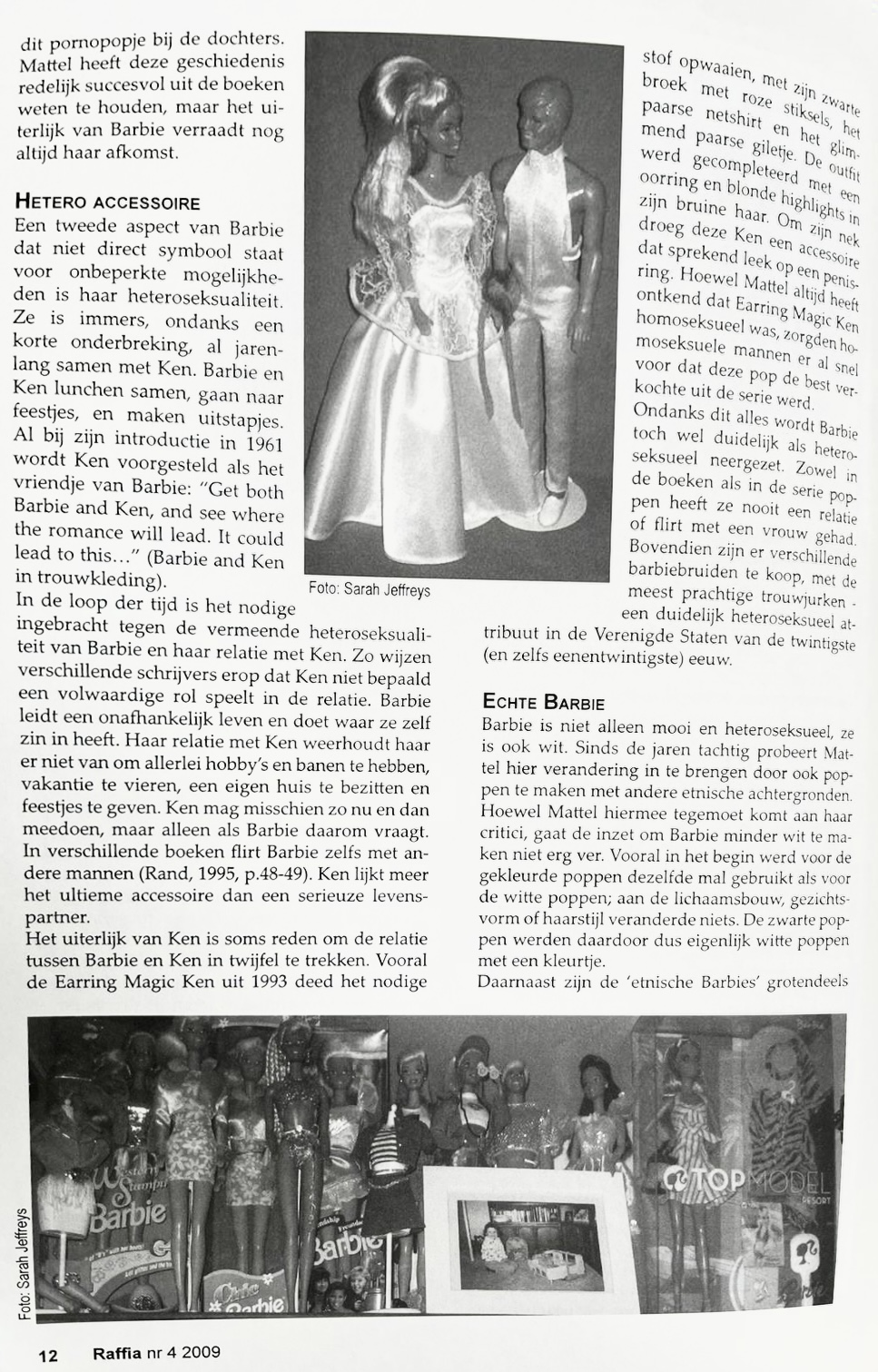
A second aspect of Barbie that doesn’t directly symbolize limitless possibilities is her heterosexuality. She has, after all, despite short breaks, been in a years-long relationship with Ken. Barbie and Ken go out to lunch together, they attend parties, and take trips. Even during his first introduction, Ken is known as Barbie’s boyfriend: “Get both Barbie and Ken and see where the romance will lead. It could lead to this…” (Barbie and Ken in wedding attire).
Over time the necessary input has been made against Barbie’s alleged heterosexuality along with her relationship with Ken. Multiple writers have pointed out that Ken doesn’t exactly have a full-fledged role in the relationship. Barbie lives an independent life and does whatever she pleases. Her relationship with Ken doesn’t hold her back from having many hobbies and jobs, nor does it stop her from going on vacation, owning her own house, and hosting parties. Ken is allowed to participate from time to time, but only when Barbie asks him to. In several books, Barbie even flirts with other men. Ken seems more like the ultimate accessory rather than a serious life partner.
Ken’s appearance is another reason for doubt in Barbie and Ken’s relationship. Especially Earring Magic Ken from 1994 caused a lot of speculation, with his pink-stitched black jeans, the purple fishnet top, and the shimmery purple waistcoat. The outfit was complemented by an earring and blonde highlights in his brown hair. Around his neck, Ken wore an accessory that looked similar to a cock ring. Though Mattel has always denied Earring Magic Ken’s homosexuality, gay men ensured that this doll became the best-selling one from the series.

Despite all of this, Barbie is clearly portrayed as heterosexual. In neither the books nor the series of dolls has Barbie ever been in a relationship ornor flirted with a woman. Moreover, there are several bridal Barbies for purchase, in the most beautiful wedding dresses – a definitive heterosexual attribute in the United States during the twentieth (and even twenty-first) century.
Real Barbie
Barbie isn’t only pretty and heterosexual, she is also white. Since the eighties, Mattel has been attempting to remedy this by releasing more dolls with different ethnicities. Although Mattel does respond to its critics, the effort to make Barbie less white isn’t that great. Especially in the beginning were the molds for white and ‘colored’ Barbies the same; nothing was changed about their build, facial structure, or hairstyle. The black dolls were in reality merely white dolls with a darker tint.
On top of that, ethnic dolls were largely based on cultural stereotypes. The standard outfit for the Japanese Barbie is a kimono, and the Hawaiian Barbie wears a straw hula skirt. The Dutch Barbie, which was released in honor of Barbie’s 35th birthday, is portrayed with her blonde hair in two braids, wearing white clogs, and traditional Dutch headgear. According to the package she lives in “Netherlands” and eats “rijsttafel” on special occasions. The clogs are apparently ideal for life in the Netherlands because they’re able to keep her feet dry even during bad weather. Cultures essentially are portrayed as almost absurd. Barbies of color are so stereotyped that “ordinary” things don’t seem to belong to them. The first white bridal Barbie, for example, was released in 1959, her black counterpart in 1989, and the Latina variant not until 1995.
White Barbie continues to be the norm. The number of black Barbies decreases the more we climb the social ladder; the more exclusive the Barbie the greater the chance is that she is white. The Barbies depicted on merchandise as lunchboxes, umbrellas, sleeping bags, and clothes are nearly always exclusively white. During the Miss Barbie elections, the blonde, white girls are invariably the winners. The white Barbie remains the ‘real’ Barbie. This becomes apparent from the term ethnic Barbie alone, which is reserved for non-white Barbies. The ethnicity of the white Barbie is self-evident; she owes no one any explanation.
Whiteness is not only presented as self-evident but also as superior. A striking example of this is described by Rand. In Barbie’s Hawaiian Holiday, Barbie travels by airplane to Hawaii. During the flight, her father teaches her the first principles of the country: the muumuu (a Hawaiian dress) is actually designed by the Americans; the Americans introduced written language in Hawaii; the Portuguese brought the guitar to the land which Hawaiians then transformed to the easier playable ukulele; the music from the indigenous community is ‘pushy and wild’; and going native means to enjoy without a care on the beach, without even having to think about school. During her stay, Barbie takes her schoolwork much more seriously than Apaki, an ‘indigenous boy’ who’d rather surf than work on his ‘mediocre grades’. The same situation occurs in Barbie New York Summer. Here, a young man of color named Pablo doesn’t work much nor does he have a sense of responsibility, as opposed to Barbie. Both books leave no room for doubt: Barbie’s way is the best one. At the end of both books, the young men become ‘enlightened’: Apaki decides to start taking school more seriously, and Pablo is going to work on his career.
Injustice
A last area where Barbie’s possibilities are far from limitless is that of political activism. “Barbie occasionally engages in a bit of environmental activism and animal rescue. […] But her political activism does not extend beyond these hardly controversial areas. Mattel accessories include no pro-choice buttons, no ANC T-shirts, and no Silence=Death stickers. Barbie is just not that kind of girl” Rand states. Barbie doesn’t take a stance against injustice even on a smaller scale. Take for instance the time her painting was chosen over that of her Asian-American friend Chris, who is a professional painter in The Heart of Art. Except for one short objection, Barbie does not protest her winning. If anything, the opposite could not be truer, seeing as Barbie hurries home to make even more paintings for the gallery. Whether racism might be at play here, it doesn’t cross Barbie’s mind, despite her paintings being clearly less artistic than Chris’.
Barbie herself has never had to fight against social exclusion. Sexism is not an issue for Barbie. She is one of the women who made it but doesn’t realize that other women often experience more difficulty in this. Capitalism is a non-issue as well: Barbie has plenty of money and buys whatever her heart desires. However useless or bad for the environment her careless spending is not discussed; as long as she’s having fun. The Barbie of limitless possibilities is actually just a highly privileged woman who stays within her established framework. She is conventionally attractive, white, heterosexual, and comes from an upper-middle class background: “a pretty picture of privilege”, Rogers calls her, that countless girls growing up took example to.
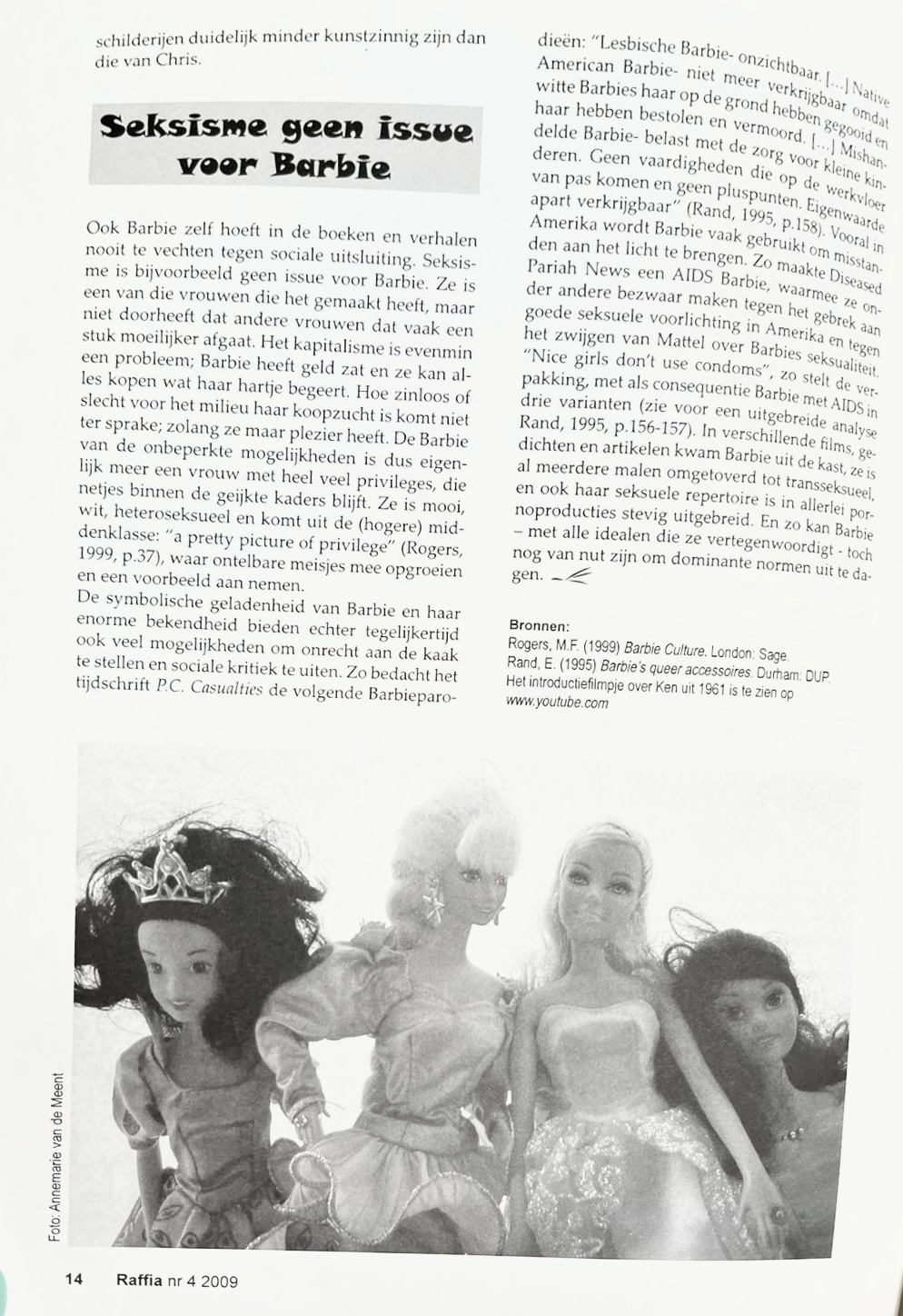
The symbolic demand of Barbie and her enormous fame offer at the same time many opportunities to speak up on injustice and express social critique. The magazine P.C. Casualties made some Barbie-related parodies: “Lesbian Barbie – invisible. […] Native American Barbie – no longer available because white Barbies threw her to the ground, robbed and murdered her. […] Abused Barbie – saddled with care for young children. No skills that are useful career-wise and no positives. Self-worth sold separately.” Rand. Barbie is often used as an example to bring misunderstandings to light, especially in the United States. Diseased Pariah News made an AIDS Barbie, to signify their objection to the lack of sex education in the US as well as Mattel’s silence about Barbie’s sexuality. “Nice girls don’t use condoms”, her package read, with the consequence of three variants of Barbies with AIDS. Barbie comes out of the closet in several movies, poems, and articles; she has several times been transformed into a transgender person; and her sexual repertoire has vastly grown through multiple porn productions. And like that – with all the ideals she represents – Barbie is still useful in challenging dominant norms.
References:
Rogers, M.F. (1999) Barbie Culture. London: Sage.
Rand, E. (1995) Barbie’s queer accessoires. Durham: DUP.
The 1961 introduction film about Ken can be seen at http://www.youtube.com



 Raffia