
by Aya Ahlalouch
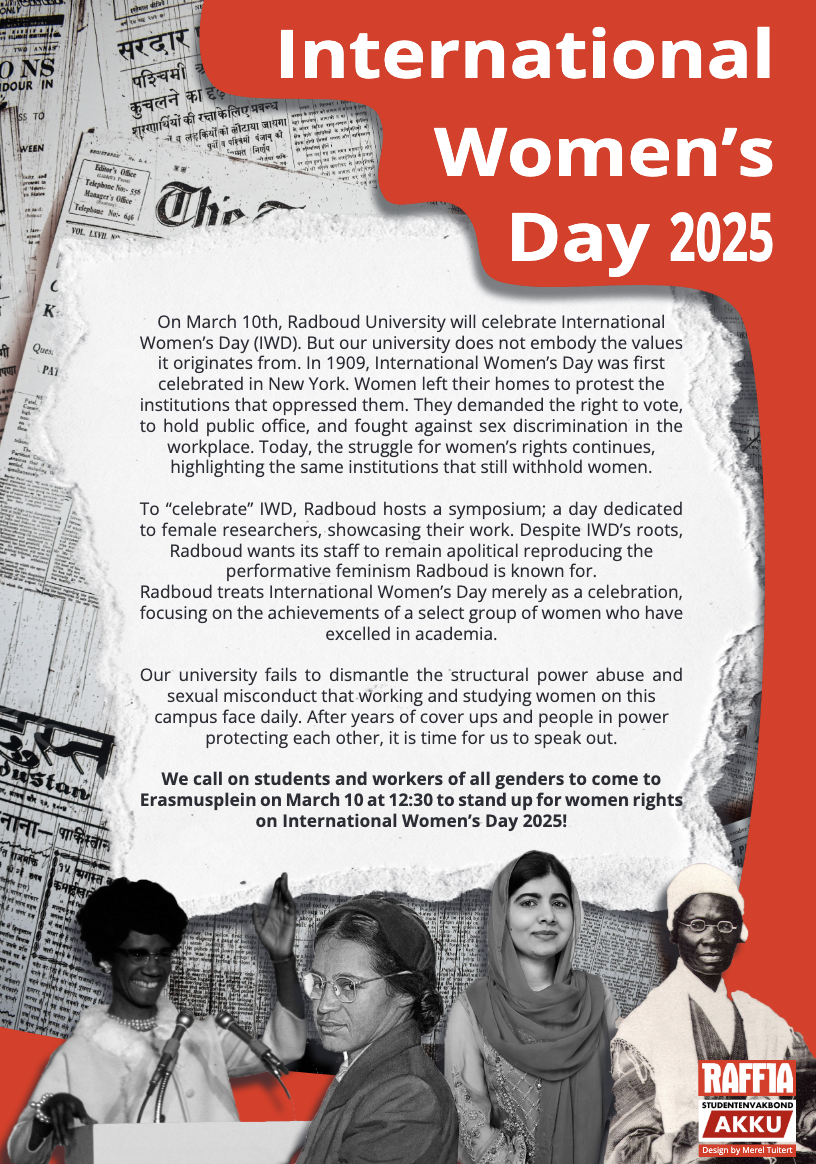
On March 10th, Radboud University will mark International Women’s Day with an afternoon program organized by the Radboud Network of Female Professors and the Halkes Women+ Faculty Network. The event aims to showcase the achievements of female researchers, including studies on testosterone’s impact on girls and innovative approaches to reducing greenhouse gas emissions. In essence, the university is giving women a platform to present their research – not necessarily because of its groundbreaking nature or its relevance to International Women’s Day, but simply because of the researchers’ gender.
While celebrating women in academia is important, this approach raises deep concern. The event highlights women’s work without addressing the systemic barriers they face within the institution. Thereby, International Women’s Day is reduced to a token gesture rather than a meaningful commitment to women’s rights and gender equality. Rather than confronting the structural issues impacting women at this institution, Radboud adopts a performative approach to showcase women while ignoring the underlying barriers they face. In doing so, Radboud becomes actively complicit in the perpetuation of sexist culture – their feminism is selective and performative, and only manages to reinforce the very inequalities it claims to challenge.
Accountability Gaps
Radboud University has a women’s rights problem. Behind its progressive image lies a toxic culture that protects predators and fails at protecting women within the institution: students, faculty members, research personnel, and other staff members.
Take the case of Paul Bakker, an instructor at the Faculty of Philosophy, Theology, and Religious Studies (Haverkamp, 2020). After allegations of inappropriate behavior, an internal investigation confirmed the accusations. Despite this, Bakker’s affiliation with the university remains intact. Radboud’s response was tepid at best: he was temporarily suspended, and his appointment as dean was revoked, but no substantial consequences followed . He kept his position, his power, and his platform. To no one’s surprise, Radboud kept it business as usual.
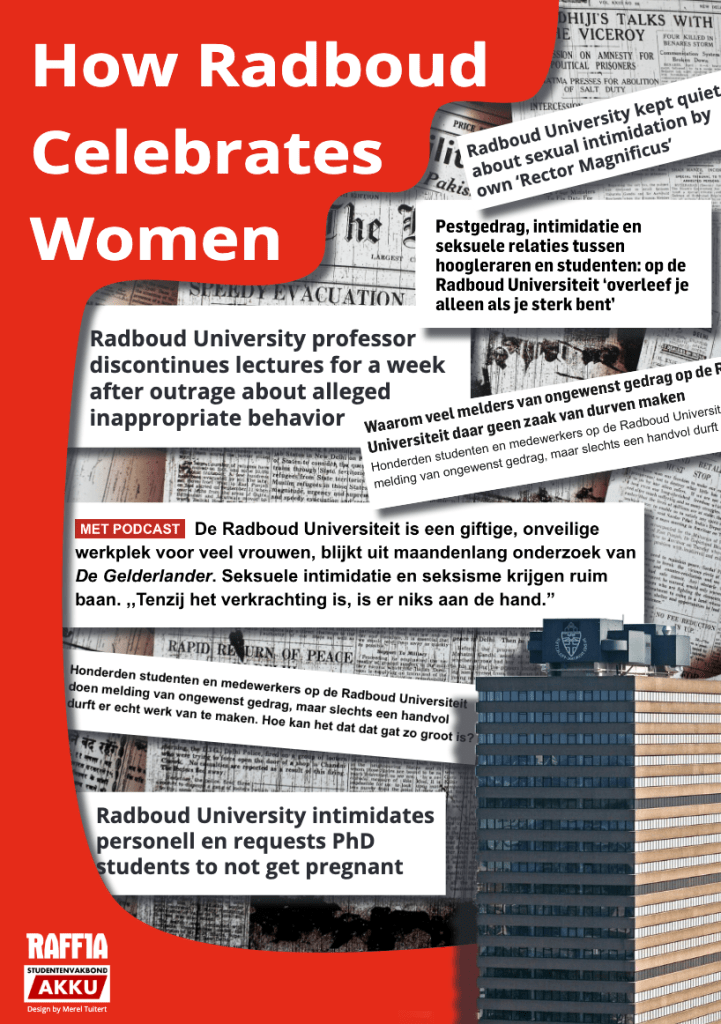
This was not the only case of sexual misconduct on campus. In 2017, Rector Han van Krieken made sexually suggestive remarks to a female colleague (Van Krieken, 2023). A year later, an independent committee validated her complaint. The university’s reaction? Silence. The incident was quietly pushed under the rug until journalists forced it to light. No public reckoning, no accountability: just damage control.
The University’s failure to properly react towards its employees sexual misconduct, its lack of action towards the discouragement of such behaviors and its insufficient show of support towards the victims of such transgressions actively contribute to the normalization of oppression and violence against women, both on and beyond campus ground. The trivialization of such offences also sends the dangerous message that violence is acceptable at Radboud. This implicit acceptance can and will discourage women from reaching out for help and further solidify the systemic oppression of women.
And the corrosion goes even deeper. At one of Radboud’s largest faculties, PhD candidates were explicitly advised not to get pregnant and warned that doing so would harm their career prospects (Jenness, 2024). Such behaviour feeds into the discrimination against women in academia and suggests that they must sacrifice their reproductive rights to be allowed access to vital career opportunities. Meanwhile, the climate of bullying, intimidation, and inappropriate relationships between professors and students remains unchecked. The university has seen a significant rise in reports of ‘undesirable behavior’, including intimidation and sexual harassment. In 2022 alone, there were 243 reported incidents (Opten & Wassenaar, 2025).
Problematic Partnerships and Moral Blind Spots
Radboud’s hypocrisy doesn’t stop on campus. International Women’s Day also raises critical questions about its international partnerships. The university actively collaborates with entities complicit in human rights violations, including severe abuses against women.
One particularly troubling aspect is Radboud’s association with corporations involved in mineral extraction in the Democratic Republic of Congo (DRC). The DRC’s mining industry, especially in regions rich in cobalt and coltan, is infamous for forced labor, sexual violence, and brutal working conditions. Reports indicate that armed groups controlling mining regions use rape as a weapon of war. Amnesty International highlights that entire communities have been displaced to make way for mining operations, with women bearing the brunt of these violations. UNICEF reported that in just one week, health facilities in eastern DRC documented 572 rape cases, over 170 of which involved children (Banchereau, 2025).
Who profits from this? Tech giants like Microsoft and HP – companies that Radboud proudly collaborates with. By partnering with corporations that benefit from exploitative practices, Radboud University aligns itself with entities that perpetuate systemic gender-based oppression. This exposes a moral inconsistency that undermines its credibility as an advocate for gender equality.
Radboud University further collaborates with Israeli academic institutions linked to the occupation of Palestinian territories. The Israeli occupation has disproportionately impacted Palestinian women, subjecting them to movement restrictions, a lack of access to healthcare, and economic hardships resulting from ongoing blockades and military control. Reports from the Women’s Centre for Legal Aid and Counselling (WCLAC) highlight that Palestinian women face violence, threats, intimidation, movement restrictions and discrimination from Israeli forces daily (Women’s International League for Peace and Freedom, 2018). A stark consequence of Israel’s policies is the impact on maternal healthcare. Pregnant Palestinian women face life-threatening delays at military checkpoints, and give birth under extremely unsafe conditions, with some forced to undergo C-sections without anesthesia. At the same time, essential healthcare remains largely inaccessible.
Despite continuous calls from staff and students to cut ties with Israeli institutions, which have been actively complicit since October 2023, Radboud has always refused to do so. It continues collaborating with institutions complicit in these violations, all while marketing itself as a champion of women’s rights.
What International Women’s Day Ought to Be
International Women’s Day is rooted in activism and the fight for social justice. It originated from socialist movements advocating for labor rights and suffrage, yet today, attempts are made to water down International Women’s Day into performative celebrations devoid of political substance. Now, more than ever, we must return to the day’s radical origins by emphasizing systemic change and institutional accountability.
A sincere celebration of International Women’s Day requires introspection and a willingness to address uncomfortable truths. It demands confronting structural inequalities at home before promoting gender equality on a public stage. It calls for cutting ties with institutions complicit in human rights abuses and ensuring a safe and equitable environment for women within its own community.
International Women’s Day should not be a convenient platform for corporate branding: it must be an opportunity to commit to transformative justice and systemic reform. Celebrating women’s achievements without confronting the power structures that hinder them is hypocritical and performative at best. Only when Radboud University actively dismantles the systemic barriers within its own institution, holds perpetrators of misconduct accountable, and cuts ties with entities complicit in human rights abuses, can it rightfully claim to stand for justice and equality – not just on International Women’s Day, but every day of the year.
References:
Banchereau, M. (2025, February 13). Armed fighters have raped scores of children in eastern Congo, UNICEF says. AP News. https://apnews.com/article/congo-children-rape-m23-congo-amry-66e7fc667ca022a02a3f37bf18f80776
Haverkamp, A. (2020, September 21). Investigation complete: Paul Bakker will not become dean and is not welcome at the faculty for the foreseeable future – Vox magazine. Vox Magazine; VOX. https://www.voxweb.nl/en/investigation-complete-paul-bakker-will-not-become-dean-and-is-not-welcome-at-the-faculty-for-the-foreseeable-future?
Jenness, M. (2024, May 20). Telling PhD Students not to get pregnant: What does this say about the Radboud School of Management’s commitment to other accommodations? Raffia. https://raffia-magazine.com/2024/05/20/telling-phd-students-not-to-get-pregnant-what-does-this-say-about-the-school-of-managements-commitment-to-other-accommodations/
Opten, N., & Wassenaar, S. (2025). DPG Media Privacy Gate. http://Www.ad.nl. https://www.ad.nl/nijmegen/honderden-meldingen-ongewenst-gedrag-radboud-universiteit-intimidatie-scoort-hoogst~ad039c4a/?referrer=https%3A%2F%2Fwww.google.com%2F&%3Bcb=a0ea415b-0d3c-4036-b94d-fc36a6bb91a3&%3Bauth_rd=1&cb=a2df49b4-a93b-4579-9476-fb0810f9e707&auth_rd=1
Van Krieken, H. (2023, September 23). Radboud University concealed incident of sexual harassment by rector for six years. NL Times. https://nltimes.nl/2023/09/23/radboud-university-concealed-incident-sexual-harassment-rector-six-years?
Women’s International League for Peace and Freedom. (2018). Palestinian Women under Prolonged Israeli Occupation.

 Raffia
1 Comment