
by Sorina Bularca
Reading has always been one of my ways to revolt against this fast-paced world. A cup of coffee, some fuzzy peaches (the flat kind), a big cup of water and 50 pages later, I am disconnected from the horror that my room is a mess, and that I should probably be studying. Usually, I like to tell myself that all this reading is going to transform me into a very well-versed person, but the truth is that I still stutter when I try to talk, and I still find it extremely hard to make sentences in which I don’t make grammar mistakes. However, I will not stop. One day I am eventually going to turn into the well-versed individual I tell myself I will be.
To provide you with a glimpse of my book-taste, I like diversity, engaging stories and essentially, anything that can make me sob and tear my heart out in public transportation. I hate love triangles, but I am a devoted lover of deeply romantic books and beautiful life stories. That being said, this year, Mornings in Jenin managed to get the exclusive title of “My favorite book of the year” (I was offered a tissue to wipe up my tears on the bus, twice). It is everything I love in a novel, and even though it follows the story of a singular family, it made me feel as if I was somehow reading the story of the entirety of Palestine. Susan Abulhawa captured the tale of a beautiful and resilient culture that fights against the harshest of conditions.
Moreover, Mornings in Jenin feels like a testimony to Palestinian identity and culture. It tells the story of a displaced Palestinian family, that lives in a refugee camp in Jenin, in the Israeli-occupied West Bank, that longs to return home. It has given me insight into the private world of a Palestinian family. The image of the culture, carefully painted and displayed in just around 300 pages made me feel like I was watching them unfold their lives in front of me. There is insight into a profound love that I think us Europeans need more of. Such rich stories about Palestine should be more present in the Western discourse, and not only in academic work, which is less appealing to the general public, but also in novels, in art and in music. In her book, Susan depicts the intimacy of her culture with so much depth, and rawness that her work hovers between being a novel or poetry. Her writing style is unmatched in meaningful descriptions, making it extremely difficult to put her books down and come back to reality. She builds characters that are complex, loving, and unpredictable.
“Soon Dalia recognized the quick curiosity in her growing child, whose remote black eyes seemed to have no bottom. The girl had an aspect of sorcery, as if she had materialized from the charms of alchemy and Bedouin poetry.” (p. 46)
Another special aspect of this book that I would like to highlight is the romance that we can find in all kinds of relationships. I often feel that romance is reserved for partnerships, but I think that romance could and should be found in multiple types of relationships. For example, I find the relationship between Amal and her father rather romantic. They had a loving father-daughter relationship, they read together and created a ritual of watching the sunrise. The whole dynamic is filled with the deepest parental love, and admiration. I find it inspiring to see how the two interact with each other, and what a great impact his love has on her, as an individual. I often keep thinking about this relationship, about Hasan and how much and how profoundly he loved his daughter. When I think about Palestinian men, who are often portrayed as barbaric and as savages, I think about Hasan, the most loving father, the Palestinian man who carried a love in his heart that was bigger than the whole universe.
“My life before the war returns to me now in memories bracketed by Baba’s arms and scented with the tobacco of his olive-wood pipe.(…) I have never known a place as safe as his embrace, my head nestled in the arch of his neck and stalwart shoulders.” (p.53)
Thus, Susan Abulhawa gives an in-depth view and humanizes the characters in a unique way. Western Media has continuously dehumanized and distorted Arab people, especially muslim Arabs. Mornings in Jenin creates the entry way into the world of a misunderstood culture. In my opinion, it even has the power to shift the Euro-centric narrative, and give the voice back to the indigenous people.
“No one can own a tree, he continued. It can belong to you, as you can belong to it. We come from the lands, we give our love and labor to her, and she nurtures us in return. When we die, we return to the land. In a way, she owns us. Palestine owns us and we belong to her.”(p. 54)
Race and ethnicity are pillars of this story. The life of the characters is so profoundly connected to their geography, who they are is inextricably connected to their Palestinian heritage. Their struggles for freedom, their strong desire for free cultural expression, everything is intertwined in the life of the people who are everyday fighting against brutal colonization. Mornings in Jenin inflicted a kind of pain on me that still lingers inside, months after I finished the book. What I noticed is that I particularly enjoy being hurt in this way, I want to feel this pain, I want to bear witness. Even though the story is fictional, it is inspired by the real stories of Palestinians, it tells a story of real collective suffering, the story of so many families whose lives are haunted by the horrors of the occupation. This book lives within me everywhere I go, all the time. Every time I wear a kufiya, I think about Susan’s book, about how many stories of the Palestinian people will remain untold, suffocated by the silence of the world. Mornings in Jenin will always remain within the walls of my heart, and it will always be one of the reasons I will continue to talk about the liberation of Palestine.
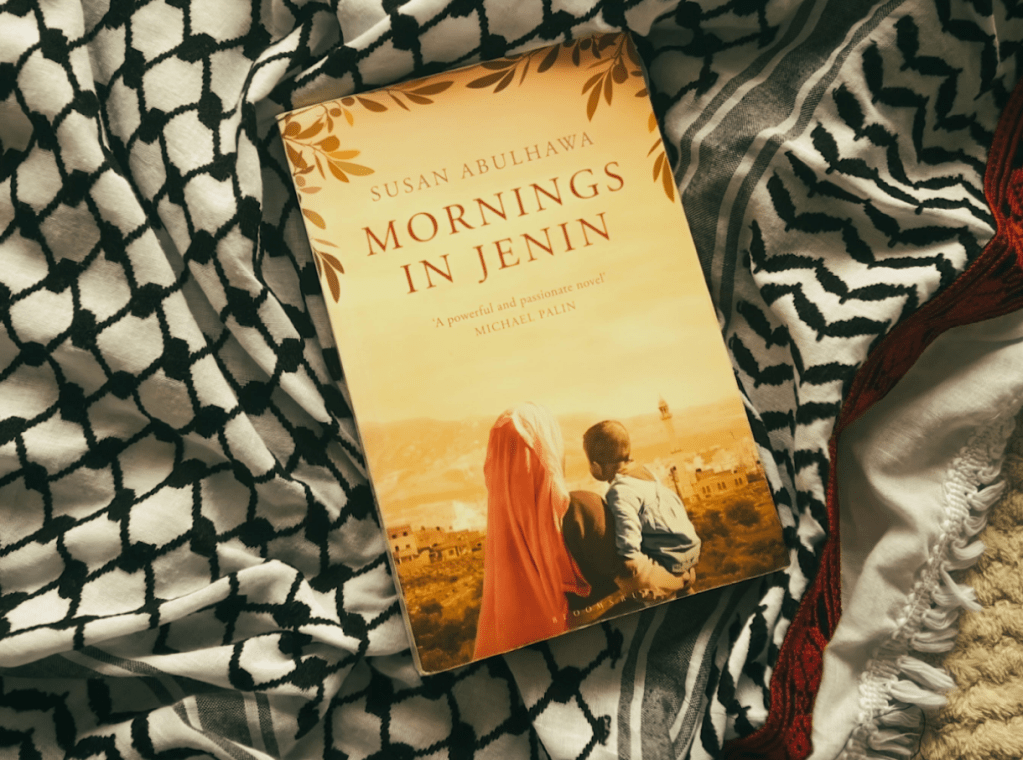
Abulhawa, S. (2010). Mornings in Jenin. Bloomsbury.
Sorina Bularca is a Bachelor student at Radboud University. Currently she is studying psychology, but her main interests are human rights, race, religion and intersectional feminism. She also has a passion for writing and photography.

 Raffia