
by Nanette Ashby
In the realm of contemporary art, few figures stand at the intersection of identity, culture, and photography as prominently as Cindy Sherman. Born in New Jersey in 1954, Sherman has carved a niche for herself through her pioneering photographic self-portraits. Her body of work challenges and deconstructs cultural norms and expectations, particularly those surrounding gender, celebrity, and the very medium she employs – photography itself. Her work Untitled #205 draws striking parallels to Raphael’s renowned Renaissance painting, La Fornarina (1518-1519). Sherman’s reinterpretation confronts and disassembles the conventions of beauty, maternity, and femininity in the original artwork. In this essay, the intricacies of Untitled #205 are dissected, examining how Sherman’s artistic choices provoke a dialogue on gender performativity, societal expectations and the representation of the pregnant body. By scrutinizing Sherman’s deliberate manipulation of symbols to cause the viewer to be disgusted and her bold confrontation of the viewer’s gaze, we aim to unravel the complex layers of meaning embedded within her artwork. As we navigate the intersections of art, gender theory, and cultural critique, this essay illuminates how Sherman explores the representation and self-representation of a maternal subject and challenges cultural expectations of the maternal body and the ideals attached to it.
Cindy Sherman (New Jersey, 1954) is known for her photographic self-portraits, which examine the manufacture of identity by interrogating and repurposing cultural symbols or signifiers and visual practices, gender, celebrity and her medium of choice, photography (MoMa). As a significant member of the Pictures Generation, a group of artists emerging during the 1970s, including Robert Longo, Louise Lawler, Richard Prince and Sherrie Levine, Sherman subverted images from advertisements, television, and film within her work to react to the evolution of mass media (MoMa). The series Untitled Film Stills (1977–80), based on cinematic and movie promotion practices, ignited discussions on representation, feminism and postmodernism and led to Sherman’s breakthrough (MoMa). She is known for using her body as a theatrical canvas to embody and showcase the diversity of identities and stereotypes. This process is intentionally left visible from the viewer. Even though some of the characters Sherman plays are seemingly glamorous, her interest has always been in the grotesque, for instance, in the Disasters (1986-89) and the Sex Pictures (1992) series. Her early work was created during the AIDS crisis which “added poignancy to her investigation of the grotesque and of various types of violence that could be done to the body” (MoMa).
As part of her History Portraits Series from 1988 to 1990, Sherman showcases the maternal figure multiple times in a historical context. She switches from small-scale 8-by-10 inch black and white photographs, as used in the Untitled Film Stills series, to large-scale colour photographs, which imitate paintings and try to conceal their mode of creation (Belting 99). Blurring the lines between portrait photography and painting reveals that fabrication and direction is possible in both mediums. Sherman exclusively uses her own body to slip into historical personas. Titian, Raphael, Goya, Ingres, David and Holbein lent themselves for direct copying, whereas the rest of the series reimagines old master’s work, mainly focusing on the Renaissance period. As Norman Bryson remarks regarding the series: “each step in the direction of enhancing, ennobling, aestheticizing the body is matched somewhere else by a step towards the grotesque” (Betterton 95). By using the comedic and, at the same time, grotesque potential of horror, Sherman questions the meaning of being maternal and having a maternal body.
This paper focuses on the photograph Untitled #205 (1989), which is part of the History Portraits Series. As discussed in Woods-Marsden’s article, the artwork shows a striking resemblance to the female nude painting La Fornarina (1518-1519), which has been attributed to Raphael. The name of the painting, translated to “Baker’s Daughter”, bore many titles throughout the ages. Other names included “a nude woman”, “a half Venus, nude”, and “prostitute” (Woods-Marsden 29). Female nudity was connected to beauty during the Renaissance period. The painting is said to be an early example of the Belle Donne genre (29). There is a strong possibility that the painting does not portray a specific courtesan woman but more an ideal. The focal point of the painting is the half-naked woman turned to her left, sitting in front of a dark background made up of dense foliage. The hands are placed in accordance with the body language of the modest Venus or Pudica (29). The right hand is trying to conceal the breasts and the left is covering the pubic area. However, this does the opposite and draws attention to the erogenous zones. Her skittish side glance does not meet the viewer’s gaze. Instead, the courtesan woman is averting her eyes reminiscent of “ochi biechi e lascivi” also sidelong, lascivious eyes, which were used to indicate nefarious women like Salome within Renaissance paintings (33). This counteracts the ostensible modesty indicated by her hand gestures and now resonates an aura of the risqué or illicit. The choice of drapery and garments reflects the connection between personal honour and financial status (33).
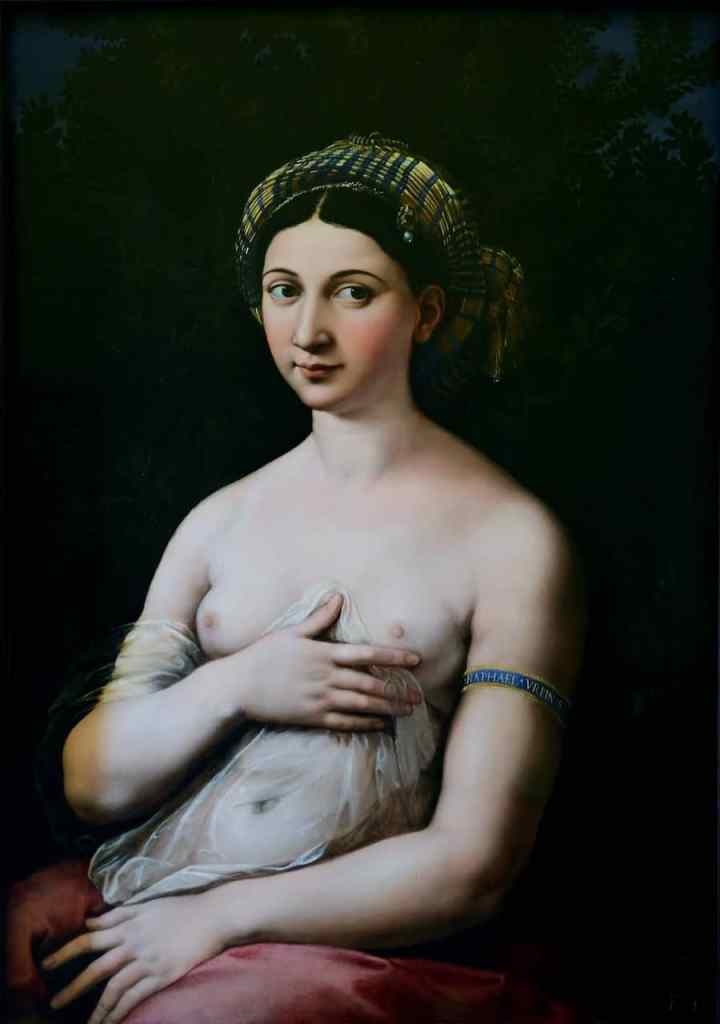
Sherman’s new rendition would have shocked the Renaissance viewer. The soft Renaissance breasts became “monstrous protuberances with hard fiberglass nipples” (33). The beautifully painted skin is now bulging due to pregnancy. The hand gestures which were supposed to indicate modesty are now safeguarding the womb and, at the same time, also leading the eye to the sexual zones of the body due to the parted legs and exaggerated erect red nipples. The headpiece has been exchanged for a worn, dishevelled dishrag, and the once delicate veil is now curtain netting (Betterton 93). “Within a masculine visual economy, female sexuality is displaced onto fetishized objects, often in the form of jewels or satins” which explains Sherman’s choices in garment adaptations (93). Another part of the accoutrement around the upper arm is now a purple garter, which is considered a fetish object. The starkest contrast is her pursed lips and red-rimmed eyes, which are directly, piercingly confronting the viewer. The wide eyes propose both complicity with the viewer and innocence at the same time. Looking at the figure glaring back at us creates a forced confrontation.

Sherman aggressively challenges the viewer’s gaze, possibly accusing them of being responsible for her current plight. This is the opposite reaction of the role she has chosen to embody, the stereotype of the compliant Renaissance Mistress. The visual connection between the two artworks was possible through mimicry, thus making the pose more recognizable and important than the person striking it within the portrait (Belting 101). At the same time, Sherman does not hide her methods of creating this copy. The fact that it is an illusion is flaunted through the visible makeup, creating a cosmetic mask and the prosthetic pregnant torso being fastened over her shoulders (Knafo 155). By leaving the seams on show, Sherman is making no secret that the identity she has slipped into is not her own.
As Judith Butler, a post-structuralist gender theorist, suggests, gender roles are socially constructed through repeating actions assigned to gender by and expected from the society one inhabits (Buikema 162). Continued repetition of actions creates the illusion that the behaviour constitutes a natural way of being (162). Gender performativity explains the idea that gender is not inherent but a cultural construction through selected features associated with femininity or masculinity within normative social discourses (Walton 301). Desires and expectations of society cling to the female body. Maternity can be considered the ultimate performance of femininity and womanhood. Historically, motherhood is the central task exclusively designated to women and provides a source of identification (Mirkin 19). Butler explains that “the body is a materialization of a norm, it is the performance of an ideal construct, which one has to comply with to ensure his or her subjectivity is as not to be abjected, excluded, and marginalized” however, they also admit that it is impossible to perfectly adhere to the norms assigned to your gender (Ross 154). Based on this, an abject performance of the female body is created when “the failing to reproduce the norm is made manifest” (154). Not being able to carry a baby to term qualifies as a failing of the expectations put upon female bodies. Pregnancies which do not have a happy ending due to miscarriages or stillbirths are the ultimate demonstrations of this perceived failure by creating a concoction of unmet societal expectations, sorrow, pain, and various kinds of excrements which are traditionally associated with the abject. Based on Julia Kristeva’s work, the term “abject” describes a human response (such as horror, nausea or vomiting) to a potential loss of meaning brought on by the inability to distinguish between the self and the other or between subject and object.
Sherman explores what the maternal experience entails by using the grotesque and comedic potential of horror. Sherman leaves the lines of the prosthetics and other parts of her transformation visible. This can be connected to the use of Butler’s notion of gender subversion, which “argues that parodic and hyperbolic practices like drag can serve to ‘denaturalize’ the body in such a way that what is commonly taken as the ‘natural’ characteristics of gender are exposed as the performative cultural constructs they are” (Walton 302). Thus, using the grotesque and comedic potential of horror, Sherman explores what the maternal experience entails and its role in defining femininity. During the Renaissance, pregnancy was rarely depicted, and if so, it was shown as the societal role of the wives, not a courtesan, as is the case of La Fornarina. “Feminism has revealed the inherent sexism of renaissance ideology, it is hard to imagine a more powerful visual deconstruction of the feminine mystique than this photograph” (Woods-Marsden 37). Sherman replies to the painting by going against the stereotypical depiction and expectation of the compliant Renaissance mistress and provides an “astute feminist comment on the profoundly patriarchal culture that both produced Raphael’s work and still widely survives today” (34).
By leaving the transformation visible, Sherman shines a light on the artificiality of her work, which is a metaphor for the artificiality of constructed identities. Her use of a prosthetic breastplate forming her large breasts and pregnant stomach shapes the interplay of seduction and repulsion and disturbs the categories of sexual and maternal identity. Untitled #205 demonstrates how signifiers such as a round abdomen can be moulded and twisted by presenting them as simultaneously grotesque and sexual (Betterton 96). This subversion of signifiers confuses the viewer and creates an abject reaction. In 1980, Julia Kristeva defined the concept of abjection in her essay Powers of Horror: An Essay on Abjection “an oral disgust, a refusal of the mother who is experienced as abject so that the child might expel itself from the mother-child dyad and become a subject” (Ross 149). During pregnancy, the mother and the fetus share one body, blurring the lines between the two subjects. Kristeva argues that drawing upon the abject can disturb subjectivity by challenging and questioning categories of identity (149). Utilizing the abject adds tension and complexity to the body represented in artworks and the encounter the viewer has with the image (154). Using “phantom or ‘fake’ pregnancies are one means of denaturalizing the maternal body” (Betterton 93). The process and reaction of breaking taboos and breaking the boundaries between the subject and object is the core of Julia Kristeva’s theory of abjection. This points to a lack of acceptance within Western cultures of “the materiality of the body, its limits and cycles, mortality, disease, corporal fluids, excrement, and menstrual blood”, all of which can be connected to pregnancy (Ross 149). The meshing of repulsion and seduction is intentionally inflated. “Sherman’s oscillation between what she sees as the two fixed modalities of feminine self-preservation within Western discourse: woman as a fetish or simulacrum and the feminine as mutable, castrated, monstrous” is reflected in her artistic choices (Betterton 95). Her reincarnation showcases the ambiguity of the sexual and maternal identity coexisting within the female body (93).
The canvas and the portrait painted on top of it provided a surface on which meaning could be placed and distributed (105). When self-portraits emerged, the self received closer examination, which was “constantly in revolt against the conventions of representation” (104). The act of creating a persona, which will be captured for the ages, can be connected to the idea of gender performativity since the way we present ourselves, depending on the societal conventions of the culture we inhabit, is part of the overall performance. Sherman demonstrated that dramatization and staging of portraits were not limited to paintings or genders. While searching for feminine subjectivity, photographic traditions are thrown overboard and replaced by the putative subjectivity encoded in fine arts painting (Phelan 68). Because she meticulously creates the personas, both male and female and their surroundings, her identity stays hidden (Belting 101). Using self-performance in self-portrait photography is a powerful tool for female artists “who struggle to articulate themselves, as “authors” rather than “objects” of artistic creation and to intervene in the structures of voyeurism by which women’s bodies are subordinated to a gaze that is aligned with male subjects” (Smith 69). Sherman eliminated all codes of conduct connected to portraiture yet still created a visual connection between her art and an art historical canon by attaching her photograph to the Renaissance painting La Fornarina. She uses her body as a stand-in, infiltrating someone else’s portrait without leaving a trace of herself. When female artists such as Sherman capture themselves photographically, “they speak themselves as subjects (creating their own visual narrative or autobiography of sorts) and thus unhinge the age-old tendency to collapse any image of a woman’s body into the status of speechless and dominated object” (69). Sherman confronts the viewer with the objectification of the female body and the requirements to perform the female gender by deforming signifiers of beauty and pregnancy. She raises the curtain for a new “configuration of the monstrous maternal” (Betterton 93).
Sherman is subverting the “visual shorthand we use to classify the world around us, drawing attention to the artificiality and ambiguity of these stereotypes and undermining their reliability for understanding a much more complicated reality” (MoMa). It can be concluded that the perceived purpose of a maternal subject is to use their body to produce a new life, which can be interpreted as the ultimate performance of gender. Motherhood is inferred to be the primary purpose of female bodies, which can be construed as “a source of identification and reconciliation” (Mirkin 19). Thus, maternity can be considered one of the most prominent performances of femininity. However, this does not consider individuals who are unable to or do not want to adhere to this gender performance. Sherman’s art interrogates the taboo of unsuccessful or unwanted pregnancies by being conscious of the “cultural anxieties that surround the maternal body” and providing a different set of symbolisms “that acknowledge the agency and potential power of the pregnant subject” (Betterton 97). The grotesque and comedic potential of horror allows Sherman to explore the full spectrum of what the maternal experience can entail. Through meticulous mimicry and deliberate subversion, Sherman thrusts viewers into a confrontation with their own preconceptions, inviting them to reassess the constructs of gender, pregnancy and identity. By analyzing Untitled #205 and reviewing the connections between Butler’s gender performativity and gender subversion and Kristeva’s work on the Abject, it can be concluded that not being able to conform to gender expectations, such as creating new life, creates an abject reaction not only from the viewer of the artwork portraying it but society at large.
References:
Belting, Hans translated by Thomas S. Hansen and Abby J. Hansen. Face and Mask, A double History. Princeton University Press, New Jersey, 2017.
Betterton, Rosemary. Promising Monsters: Pregnant Bodies, Artistic Subjectivity, and Maternal Imagination. Hypatia, Vol.21, No.1, Maternal Bodies, pp.80-100, Wiley on behalf of Hypatia Inc., Winter 2006. https://www.jstor.org/stable/3811079
Buikema, Rosemarie, Liedeke Plate and Kathrin Thiele. Doing Gender in Media, Art and Culture, A Comprehensive Guide to Gender Studies. Second Edition. Routledge Taylor & Francis Group, London and New York, 2018.
Mirkin, Dina Comisarenco. Images of Childbirth in Modern Mexican Art. Woman’s Art Journal, Spring – Summer 1999, Vol. 20, No. 1, pp. 18-24 , Woman’s Art Inc., 1999. https://www.jstor.org/stable/1358841
Phelan, Peggy. UNMARKED the politics of performance. Routledge Taylor & Francis Group, London and New York, 1996.
Ross, Christina. Redefinitions of Abjection in Contemporary Performances of the Female Body. Anthropology and Aesthetics, The Abject, Spring 1997, No. 31., pp.149-156, The University of Chicago Press, Spring 1997. https://jstor.org/stable/20166971
Smith, Sidonie and Julia Watson. Interfaces – Women / Autobiography / Image / Performance. The University of Michigan Press, United States, 2005.
Walton, David. Doing Cultural Theory. SAGE Publications Ltd, London, 2012.
Woods-Marsden, Joanna. Cindy Sherman’s Reworking of Raphael’s “Fornarina” and Caravaggio’s “Bacchus”. Notes in the History of Art, Vol.28, No.3, pp. 29-39, The University of Chicago Press, Spring 2009. https://www.jstor.org/stable/23208539

 Raffia