
by Chiara Silipigni
Taxation on tampons and pads? Thank you Giorgia Meloni.
This is happening at the hands of Italy’s first Prime Minister in history.For many years, menstruation products, such as sanitary pads and tampons, were taxed by the Italian government at 22% (taxation reserved for luxury items or non-essential goods, such as computers, cigarettes, alcoholic beverages, etc.). In 2022, the Draghi government lowered the taxation from 22% to 10%. In 2023, the newly elected far-right Meloni government surprisingly lowered it to 5% (VatUpdate, 2022). However, far less surprising, , in the 2024 budget, the government decided not to renew the cut of VAT (Value-Added Tax) on menstruation products, increasing once again the taxation on sanitary pads and tampons to its highest rate (ANSA, 2023). The expression “tampon tax” designates the VAT rate on some menstruation products, including tampons. This VAT rate on menstruation products is higher than of other products considered essential, such as milk, legumes, fruit, vegetables, and some editorial products, i.e., newspapers and magazines. The tax on menstrual products is even higher than that on truffles, which are taxed at 5%, clearly a matter of priorities (Bonamoneta, 2024)!
The severity of the “tampon tax” reflects a disregard for gender equality, economic fairness, and the protection of the rights of all citizens. By failing to consider the impact on vulnerable groups, such as women and low-income individuals, it undermines the principle that every citizen deserves equal treatment and access to essential products without facing financial discrimination.
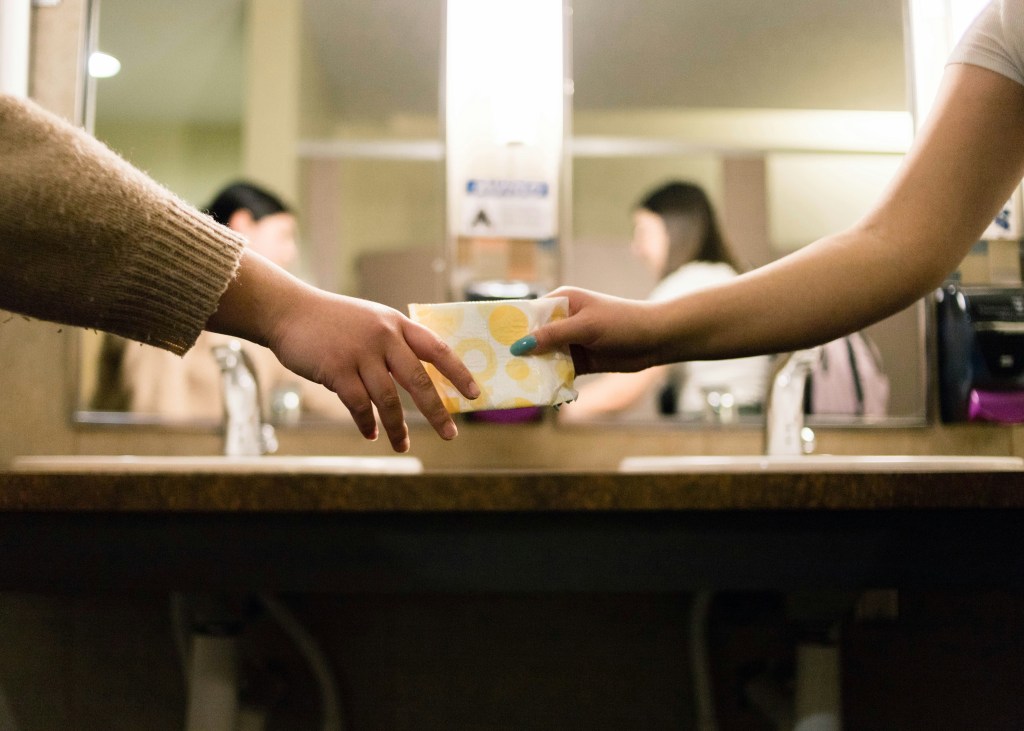
Menstruation does not only concern women, but also all people who do not necessarily identify themselves as such, but who, in any case, find themselves facing the problem of taxation on sanitary pads for the “sole fault” of menstruating.
During most of their life, people who menstruate consume on average between 10 and 14 thousand sanitary pads (Dente, 2021). In Italy, this translates into spending around 5 thousand euros for natural needs, which, however, are taxed as non-essential goods (Dente, 2021). What is frustrating is that sanitary pads and tampons are not regarded as essential goods even though menstruation is not a choice but rather a natural fact. The “tampon tax” represents a real form of economic violence, affecting every person who menstruates. Do people who menstruate choose to do so? They don’t. Taxing tampons is therefore an implicit taxation for the very fact of menstruating.
In Justice and the Politics of Difference, Iris Marion Young, a philosopher and activist, states that injustice, in societies, is not only due to unequal wealth distribution but also to social relationships and societal norms that make development and self-expression more difficult for some (Young, 1990). According to Young, group inequalities are the key to identifying structural inequalities. Structural inequalities refer to those social and institutional conditions that limit someone’s opportunities and actions. These conditions inhibit the ability of some people, making them oppressed. For Young, inequality leads a certain group to suffer conditions of oppression such as marginalization, powerlessness, and violence (Young, 1990). This is the case for people who menstruate. Indeed, the tax on sanitary pads and tampons is an instrument of oppression, a purely structural inequality which subjects this group to a condition of both social and economic injustice. For almost their entire lives, people who menstruate are obliged to pay a tax on products necessary for their personal hygiene. It is a systematic injustice which creates a condition of inequality for people who have periods compared to the rest. Furthermore, in the group of people who menstruate, there is also the subgroup of those who, given the poverty conditions in which they live, are economically unable to buy sanitary pads and tampons. For instance, in Italy, more than two million people who menstruate live in a state of poverty (Ferrante, 2021). For them, paying for menstrual hygiene products is disabling.In addition to the economic issue of not being able to afford basic menstrual hygiene products due to low income or financial instability, other consequences of menstrual poverty related to mental health should not be underestimated. Period poverty (the inability to afford and access menstrual products) has in fact also been associated with a greater incidence of anxiety and depression and, especially in school contexts, with a difficulty in concentrating (Ferrante, 2021). Thus, lowering the VAT (or even better abolishing it) on menstruation products with a fiscal intervention would be the right path for equal opportunities (Ferrante, 2021).
To date, Italy is one of the Western countries that has not yet intervened incisively to overcome this discrimination. To combat this injustice caused by the excessive price of sanitary pads and tampons, the University of Milan introduced tampon dispensers at tiered prices (LaStataleNews, 2020). This initiative takes inspiration from the exemplary model of Scotland. Scotland is indeed an archetype in the campaign to abolish taxes on menstruation products. The members of Parliament in Edinburgh voted unanimously to pass “The Period Products (Free Provision) Scotland Bill”, brought forward by Labor MP Monica Lennon (BBC, 2019). This introduced the legal right to free access to any menstruation sanitary pads for people in serious economic difficulties. Since 15 August 2022 in Scotland, feminine hygiene products have been distributed free of charge in public facilities, including schools and universities (ScottishGovernment, 2022).
However, limiting access to these products to schools and universities is not enough, as not everyone attends school, yet many still struggle with period poverty. The initiative of the University of Milan to provide free products is a positive step, but it remains more of an exception than the norm.
In conclusion, this is an invitation to the Italian government and to you Giorgia Meloni: do not turn your back on a concrete problem that every year involves millions of women and people who menstruate. Raising this issue is important for achieving gender and economic equality. The Italian government should indeed detach itself from economic morbidity and place foremost the primary rights of its citizens. This would overcome one of the major structural inequalities present today; no longer oppressing all those who menstruate, and ceasing to make them feel marginalized. This is a step forward for an improvement on a social and rights level that Italy can no longer postpone.
References:
Budget 2023 approved by Council of Ministers: VAT rate reduction baby products and feminine hygiene products, suspension plastic & sugar tax – VATupdate. (2023). https://www.vatupdate.com/2022/11/29/2023-budget-further-suspension-of-sugar-tax-and-plastic-tax-for-2023/
Budget raises tax on baby, female hygiene, tobacco products – Business – Ansa.it. (2023, October 24). Agenzia ANSA. https://www.ansa.it/english/news/business/2023/10/24/budget-raises-tax-on-baby-female-hygiene-tobacco-products_ce10d00e-1beb-45f1-8f5d-2b489baa291a.html
Dieci distributori di assorbenti e prodotti per l’igiene personale in Statale | La Statale News. (2020). Unimi.it. https://lastatalenews.unimi.it/dieci-distributori-assorbenti-prodotti-per-ligiene-personale-statale
Dente, G. (2021, May). Sai quanti assorbenti usiamo nella nostra vita, quanto ci costano e quanto inquinano? Donna Fanpage. https://donna.fanpage.it/sai-quanti-assorbenti-usiamo-nella-nostra-vita-quanto-ci-costano-e-quanto-inquinano/
Bonamoneta, G. (2024, December). Riduzione tampon tax bocciata, gli assorbenti saranno ancora tassati più dei tartufi. QuiFinanza. https://quifinanza.it/fisco-tasse/tampon-tax-manovra-2025/870376/
Young, Iris M. (1990). Justice and the politics of difference. Princeton, Nj Princeton Univ. Press [Erschienen Ca.
Period poverty, il volto nascosto della povertà. (2020). Gruppoabele.org. https://www.gruppoabele.org/it-schede-708-poverta_mestruale_volto_nascosto_della_poverta_assoluta
Scotland’s “period poverty” bill officially lodged at Holyrood. (2019, April 23). https://www.bbc.com/news/uk-scotland-scotland-politics-48027903
The Scottish Government. (2022, August 15). Period Products (Free Provision) (Scotland) Act 2021: Equality Impact Assessment. Gov.scot; The Scottish Government. https://www.gov.scot/publications/period-products-free-provision-scotland-act-2021-equality-impact-assessment/

 Raffia