
by Sorina Bularca
“Je bent nodig” (“You are needed”). Telling individuals they are important and welcome at university has been at the center of Radboud’s branding strategies. Social safety and inclusion have become a selling point, rather than a commitment to creating inclusive, safe, and equitable spaces. Each year, Radboud organizes a well-being week, where students are taught about mindfulness, meditation, and the importance of sports (Radboud University, 2024). This year, Radboud even brought a rage room to campus as part of the program. Despite these patchwork strategies to enhance well-being, Radboud has repeatedly shown that they are rather committed to performativity and deflection than to transformative and systemic change. Radboud University deliberately reproduces inequality.
Instead of addressing the many structural forms of discrimination and the way students become victims of policy, the university prioritizes events which are intended to function as a band-aid to these systemic failures. This absolves the administrative bodies of any responsibility regarding the hardships that the students are going through, and places the well-being of the students in the hands of each individual. Additionally, well-being events are not the only kind of events organized at the University. Radboud also allowed Rawan Osman, a zionist right-wing extremist to hold a lecture on campus. When students protested her presence, Rawan insulted them by calling them “monkeys”, and shouting “Palestine doesn’t exist” (Decates & Talsma, 2025; Nijmegen Student Encampment, 2025). This kind of hate speech was warmly welcomed on the grounds of our university, making Radboud complicit in racism, Islamophobia, and right-wing extremism. “Safety” remains a buzzword, weaponized to protect power and budgets.
While Radboud staff organizes events about mindfulness, the administrative executive board enables misconduct and protects the very people who cause these violations. According to Ahlalouch (2025), the only reason students are finding out about these violations is because journalists are working hard to bring these topics into the light. Radboud University is accused of asking its PhD students not to get pregnant if they want to continue working at the university (Jenness, 2024). This shows that Radboud enables intimidation from staff workers and tries to control the bodies of those able to give birth. Radboud has also been accused of covering up the transgressive behavior of Rector Magnificus Han van Krieken and intentionally leaving out the accusation against him in the 2018 annual report (Wassenaar & Winters, 2025). This puts into question the institution’s claim to take harassment cases seriously. Furthermore, the executive board of Radboud University used police force many times to suppress pro-Palestine protests on campus; in many of these instances, the students ended up brutalized by the police. Recently, after a protest on the 7th of May 2025, a student protester ended up severely injured and in need of multiple rounds of surgery after a police dog attacked and bit their leg (Vox, 2025).
Radboud’s own advisory committee documented their complicity in human rights violations by writing a report on Radboud’s external partnerships (Radboud University, 2025b). The advisory committee concluded that Radboud University upholds partnerships with institutions involved in gross human rights violations. However, weeks later, after receiving advice from their own advisory committee to cease these collaborations, Radboud University still holds ties with institutions involved in an ongoing genocide. This makes all staff and students complicit, even though many are actively opposing Radboud’s involvement with Israel (Vox, 2025). Radboud University quotes the following mission on their website: “Radboud University contributes to a healthy, free world with equal opportunities for all” (Radboud University, 2025a). However, Radboud cannot claim to be committed to safety or to a “free and healthy world” while continuing partnerships with entities that are highly involved in the ongoing genocide of Palestinians. The director of the research center NIOD Institute for War, Holocaust and Genocide Studies, has officially stated in an interview that what is happening now in Gaza is “genocidal violence” (Funnekotter, 2025). Amnesty International (2024) stated that Israel is committing genocide against the Palestinian people. Social safety and a free world can only be achieved with actions and commitment, not empty and false promises. A safe and free world should be for all people, including those in Palestine. Upholding partnerships with Israeli institutions directly contradicts Radboud’s stated mission, where they commit to freedom and well-being.
However, Radboud not only deflects and weaponizes social safety, but it actively fosters an unsafe environment by repeatedly relying on police force to intimidate and discourage students from protesting. By anticipatedly calling the police on campus and by closing off buildings before a protest even starts, Radboud creates tension and unsafety, for both activists and uninvolved students. The only reason that these protests are dangerous is that the executive board of Radboud University uses excessive violence instead of engaging in conversation with its own students. The executive board of Radboud is supposed to orient itself in the service of the people studying and working for this university.
In the most recent escalation, on Wednesday, the 7th of May 2025, two of the students were severely injured. After experiencing the traumatizing attack that caused serious flesh wounds, one student was taken to the hospital (Vox, 2025). Another student needed urgent medical care, after police injured their knee cap (Nijmegen Student Intifada, 2025). President of the executive board, Alexandra van Huffelen, does not acknowledge the harm that their response brought to campus. Instead, Radboud posted an article on their website in which they claim that their security personnel were attacked by protestors (Radboud University, 2025c). The Nijmegen Student Encampment refutes these claims and provides video evidence contradicting these statements (Nijmegen Student Intifada, 2025).
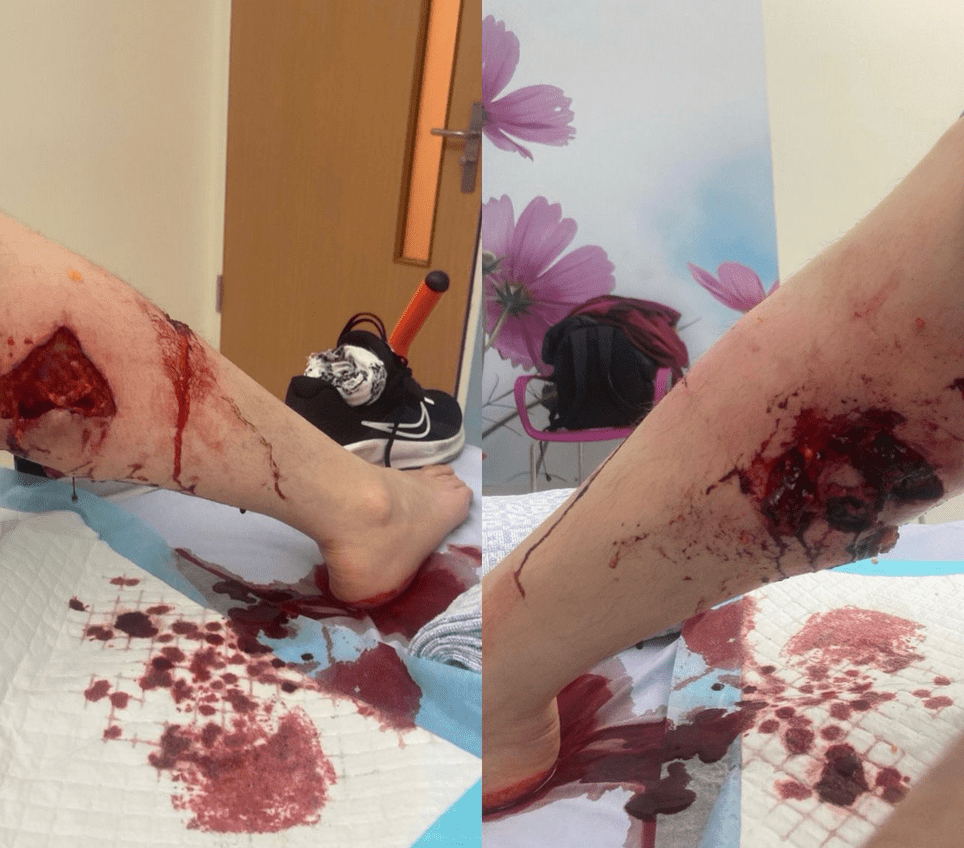
It has become increasingly evident by now that Radboud’s claims to social safety are rather illusory and conditional. Safety on the grounds of the university is highly dependent on obedience to authority and conformity. In this article, we want to shift the focus to the people who are suffering extreme consequences after engaging in protests on the campus of Radboud University. We had the pleasure to interview Miriam (real name known to the editors), who spoke about her real-life experience as an activist.
What does safety mean for Radboud University?
Miriam responds that the university uses the word “safety” as a justification to suppress political protests, and especially to maintain order. She argues that security does not truly care about students’ safety, but rather is used as a reason to suppress their voices, and the power that their voices hold. She points out many instances in which security personnel did not stop harassment or intimidation against protesting students, but rather enabled it.
“I remember the first protest we did. There was a guy there who told us that we are all Hamas supporters. He started threatening us. We also got death threats, and we were there with 30 or 40 people who were pro-Palestine, and this one guy was just threatening us. Security was there…”
Miriam then expands on how she felt during the encampment, where the university security employees and police presence grew significantly. She claims that rather than protecting the students, security was making sure that they would go away as soon as possible, by using physical force against them.
“So, the people who are supposed to keep the students safe, these were becoming our enemies. Security was not there to protect us, the students sleeping outside, of course, but they were there to make sure that we would go away as soon as possible. Legally, they are not even allowed to touch us, yet we have seen them pushing, beating and brutalizing students time and time again. Radboud University has never even held them accountable. At the same time, we have seen multiple times now how security tries to help the police by getting students arrested.”
How safe do you feel on campus?
Miriam states that she does not feel safe on campus at all. She expresses how she feels that showing solidarity with Palestine is putting her at great risk. Walking around with a keffiyeh was made into a criminal offence. By criminalizing one clothing item, it opens the door to discrimination of other forms of racist behaviors. Tembo (2024) highlights the notion of “raceless racism,” in which cultural practices are stigmatized as a result of racist ideologies. Thus, any other forms of distinguishable arab-muslim identification become a target.
“Someone literally tried to rip my hijab off on campus and called me a Hamas sympathizer. I don’t feel safe wearing a keffiyeh, let alone a hijab.”
In 2024, all forms of pro-Palestinian protests were banned on campus. An article by (Willems, 2025) states that campus demonstrations were severely restricted, to only a parking lot square, and only during certain hours. Due to this, the students were not allowed to walk around wearing keffiyehs or displaying the Palestinian flag in other campus areas. Miriam mentioned that on one occasion, when she was studying with a group of her friends in the library, the police were called to their location. They were studying next to a displayed Palestinian flag when they were approached by the police, demanding that they present their IDs. That was a form of intimidation, allowed and welcomed by Radboud University.
“They called the police on us. We were identified by the police. We were completely criminalized just for having a flag. Over a flag. A fucking flag. We didn’t even do anything.”
In March of 2025, at another protest, Miriam shared that she felt extremely endangered when Radboud called the police to campus, even before a protest began. She says that the police were deployed on campus, accompanied by a police dog. She emphasizes that she felt extremely frightened that the police brought a police dog with them, without any indication that any violence would begin from the side of the protestors. They gave the students a 10-minute ultimatum to leave, otherwise everyone would get arrested. Despite following the instructions, she says that one protester still got arrested, without an explanation. The students tried to impede the police from going through with the unjustified arrest by holding onto the arrested person, which resulted in people being attacked by the dog. She expresses that this event was extremely traumatic.
“It’s our right to protest, and protests can be disruptive. You can be disruptive. That’s within our right, within our legal right. So, I know I am not doing something wrong. I am protesting Radboud’s policy, and their response is police force. I feel very unsafe. You start to feel like a criminal even though you’re just protesting.”
Miriam opens up about another instance of injustice, when six other protestors, including a Radboud lecturer, were arrested in December 2024. She explains that six students were heading to the city center after they had cancelled a demonstration due to another surprising encounter with the police. Concerned about police presence before the demonstration, activists decided that it was safer to leave. When they arrived at the central station, police told everyone to leave, except the people wearing keffiyehs. All people wearing keffiyehs were arrested and detained for 30 hours, despite not having any evidence that would incriminate them of any illegality.
“They chased these people to the city. Then, a Radboud staff member, the head of campus security, told the police to arrest those people. They ended up in jail for thirty hours, even though they had done nothing wrong. They were proven not to have done anything wrong, and they had no connection to the damage that Radboud accused them of.”
Miriam expresses her concern over the increased surveillance on campus. With cameras all over campus, she feels like she is being invasively recorded. She feels like this is not out of a genuine concern for students’ safety. Video cameras on campus are used to intimidate and discourage campus protests. She points in the direction that this surveillance infrastructure can be a form of power abuse from the part of the university board.
“It’s crazy because they’re saying it’s for our safety, but it’s not for our safety. It’s literally to find out who is wearing a keffiyeh or who is part of the protest. And I know that they know my name. I know that they know who I am. I know that they know who a lot of us are. I feel like when I’m walking on campus, whether it’s just hanging out with friends, I’m being recorded. Security knows who I am. If I took a bus to the city and something had happened on campus, I could have been arrested. It doesn’t matter if I was involved.”
Miriam suggests that Radboud is not only endangering pro-Palestine students, but all students. Radboud’s lack of accountability and responsibility creates a hostile and polarized environment. By responding so violently, it puts students against each other, and uses other students for their own interest. Miriam reveals that Radboud is using zionist students as a human shield to discourage campus protests. By twisting the conversation around these students’ safety, the executive board distracts people from what matters: the demands to cut ties to Israel.
“So I don’t know if the real issue is that Radboud genuinely wants to protect the zionist students, or the Jewish students, as they call themselves. Obviously, this isn’t about Judaism, it’s about Zionism. I think Radboud is using them to suppress us. So, no, I don’t believe it’s a genuine concern for their safety. I think it’s a strategic move to make sure the conversation doesn’t focus on what we actually want: cutting ties with Israel. They don’t want to cut ties because there is political and economic interest in having those ties with those universities. And what they’re doing is they’re using the zionist to sort of suppress us further and to criminalize us and try to make the conversation about our tactics and how we are supposedly making them feel unsafe.”
How does Radboud protect its muslim students?
Miriam suggests that everyone wearing a keffiyeh becomes a target for the university. Simply wearing symbols that show solidarity with the Palestinian people makes students a target for the police and security of Radboud University. It becomes even more difficult when you are part of the same culture, it is even more intense when you are a muslim student and an activist.
“I think it’s very easy for a white person to engage in a protest and then later that day take their keffiyeh off and everything is okay. For me, that doesn’t happen, you know…”
Miriam explains how she is first expected to state that she does not support terrorism before she can speak about the genocide in Palestine. She mentions that Radboud always expects her to talk about October 7th and condemn Hamas, before she can even address any human rights violations.
“They are amplifying the whole frame that all Muslims are terrorists.”
The scope of this interview was to highlight the injustices happening on the grounds of Radboud University. Miriam is not an isolated case, rather, she tells the story of many students who are committed to fighting against Radboud’s complicity in genocide. Social safety at Radboud University remains a privilege. All those daring to challenge the approaches of the university, who are “disobedient,” are punished, watched closely, arrested, or mauled by police dogs. The executive board of Radboud University works to protect its economic and political interests at the cost of students’ safety, well-being, and bodily integrity. Until the executive board, led by Alexandra van Huffelen, decides to stop these collaborations, students will remain committed to the fight against the university’s involvement in gross human rights violations. Radboud cannot state that they value social safety while protecting institutional ties with entities that participate in ethnic cleansing. Being mauled by police dogs should never be the price paid for standing up for justice. By ignoring and delaying their decision to cut ties, Radboud University only further reinforces that they value performative discourses over ethics and students’ safety.
References:
Ahlalouch, A. (2025, March 6). Hiding abuse behind celebration: International women’s day at Radboud University. Raffia. https://raffia-magazine.com/2025/03/06/hiding-abuse-behind-celebration-international-womens-day-at-radboud-university/
Amnesty International. (2024, December 5). Amnesty International Concludes Israel Is Committing Genocide against Palestinians in Gaza. Amnesty International. https://www.amnesty.org/en/latest/news/2024/12/amnesty-international-concludes-israel-is-committing-genocide-against-palestinians-in-gaza/
Decates, V., & Talsma, D. (2025, March 11). Demonstranten verstoren lezing van pro-Israëlische spreker, onrust bij het Spinozagebouw – Vox magazine. Vox Magazine; VOX. https://www.voxweb.nl/nieuws/demonstranten-verstoren-lezing-van-pro-israelische-spreker-onrust-bij-het-spinozagebouw
Funnekotter, B. (2025, May 7). In Gaza is sprake van genocidaal geweld, zegt de directeur van het NIOD. NRC. https://www.nrc.nl/nieuws/2025/05/07/in-gaza-is-sprake-van-genocidaal-geweld-zegt-de-directeur-van-het-niod-a4892423
Jenness, M. (2024, May 20). Telling PhD Students not to get pregnant: What does this say about the Radboud School of Management’s commitment to other accommodations? Raffia. https://raffia-magazine.com/2024/05/20/telling-phd-students-not-to-get-pregnant-what-does-this-say-about-the-school-of-managements-commitment-to-other-accommodations/
Nijmegen Student Encampment. (2025). Nijmegen Student Encampment on Instagram. Instagram. https://www.instagram.com/reel/DHF6jw4IHDz/
Nijmegen Student Intifada. (2025, May 8). Student in hospital after Radboud CvB calls police to silence students. Substack.com; STUDENT INTIFADA. https://studentintifadarapport.substack.com/p/student-in-hospital-after-radboud
Radboud University. (2024, November 19). Save the date: Wellbeing Weeks 2025 | Radboud Universiteit | Radboud Universiteit. http://Www.ru.nl. https://www.ru.nl/studenten/nieuws/save-the-date-wellbeing-weeks-2025
Radboud University. (2025a). Mission | Radboud University. http://Www.ru.nl. https://www.ru.nl/en/about-us/mission-and-strategy/mission
Radboud University. (2025b, April). Advies internationale samenwerkingsverbanden | Radboud Universiteit | Radboud Universiteit. http://Www.ru.nl. https://www.ru.nl/over-ons/nieuws/in-gesprek-over-het-advies-van-de-adviescommissie-internationale-samenwerkingsverbanden#msdynttrid=Ws0Arjzalg2dsr-2oPur5pyFvJSo7vlH52oz3rZlYSo
Radboud University. (2025c, May 6). Physical violence during pro-Palestine demonstration | Radboud University. http://Www.ru.nl. https://www.ru.nl/en/about-us/news/physical-violence-during-pro-palestine-demonstration
Tembo, J. (2024). Entanglements of Race and Religion: A Post-Colonial Sub-Saharan African Perspective. Handle.net. https://doi.org/9789464699494
Vox. (2025, May 9). Shocked staff in open letter: “Executive Board must apologize for violence against students” – Vox magazine. Vox Magazine; VOX. https://www.voxweb.nl/nieuws/shocked-staff-in-open-letter-executive-board-must-apologize-for-violence-against-students
Wassenaar, S., & Winters, B. (2025). DPG Media Privacy Gate. Gelderlander.nl. https://www.gelderlander.nl/nijmegen/radboud-universiteit-hield-seksuele-intimidatie-door-eigen-rector-magnificus-stil~a9c1c038/Willems , G. (2025). DPG Media Privacy Gate. Gelderlander.nl. https://www.gelderlander.nl/nijmegen/bruls-perkt-palestinademonstraties-bij-universiteit-drastisch-in-alleen-protest-op-parkeerplaats-en-een-avondklok~a109ca78/

 Raffia
This is an incredibly well-written and useful piece. I am so glad others see and understand we go through on campus, write about it so eloquently, and document what is happening. In 10 years when everybody will say they always agreed with us, the author can look back and know for real that she stood on the right of history. Thank you.
LikeLike