
by Nanette Ashby
You push yourself off the heavy entrance door to the exhibition Tilda Swinton – Ongoing at the Eye Filmmuseum in Amsterdam, like a swimmer diving into silky water. Gurgling sounds echo through the space, greeting new visitors. Eerie music emanates from multiple projection screens to your left. Tilda Swinton’s voice slithers into your ears from the dark unknown whilst strings build to a chilling climax. The sound of a tram passes you by as you dare to step into the exhibition dedicated to the British actress’s friendships with fellow collaborators Derek Jarman, Joanna Hogg, Apichatpong Weerasethakul, Luca Guadagnino, Olivier Saillard, Jim Jarmusch, Tim Walker and Pedro Almodóvar. In an attempt to break the common mold of a retrospective exhibition, Tilda Swinton only agreed to bring this project to life if she could turn it into a celebration of collaboration and human connection.
She meets you on the first screen, seemingly ushering you to join her in walking into the space, her carrying a ladder and you holding in a breath in anticipation. The Super8 film fragments captured by Derek Jarman, which were exclusively released for the exhibition, conjure an air of nostalgia and youthful naivete, surrounded by the soft carpet of bluebells. Yet the operatic singing which is becoming more fearful and pained emanates from another screen opposite, giving the clip of Swinton covering her face with her arms and hands a menacing aftertaste. The sirens of a passing ambulance seem to answer the bone-chilling screams from the excerpt of Jarman’s film The Last of England (1987).
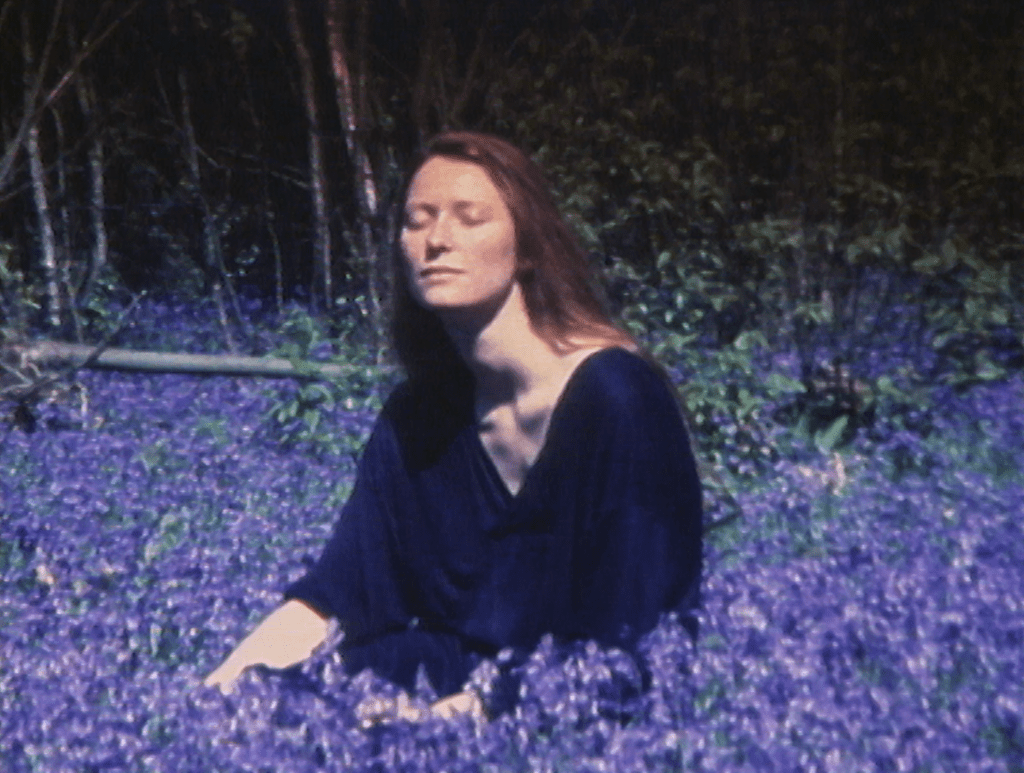
Still from Derek Jarman’s Timeslip, 1988/2025. Commissioned by Eye Filmmuseum, co-produced by Onassis
Stegi. Courtesy James Mackay © Basilisk Communications Limited
The imagery used in The Last of England (1987) alludes to a successful witch hunt accompanied by the rhythmic bangs of machine guns. You tear your eyes from the flames on one screen just to be captivated by a young Tilda Swinton crawling towards you, baring her teeth like a wild animal on the prowl. Instead of positively coming out of the screen grasping you, she decides to writhe on the pebble beach near Prospect Cottage located in Dungeness, Kent, UK, Jarman’s home from 1987 till his death in 1994. Personal polaroids and mixed media artworks by Derek Jarman from Swinton’s Collection lie next to a copy of the October 1991 Issue of Sight and Sound Magazine. She readily poses on the cover embodying the title “murdering passion”. All together the objects are resting on a bed of those same pebbles in the accompanying vitrine.
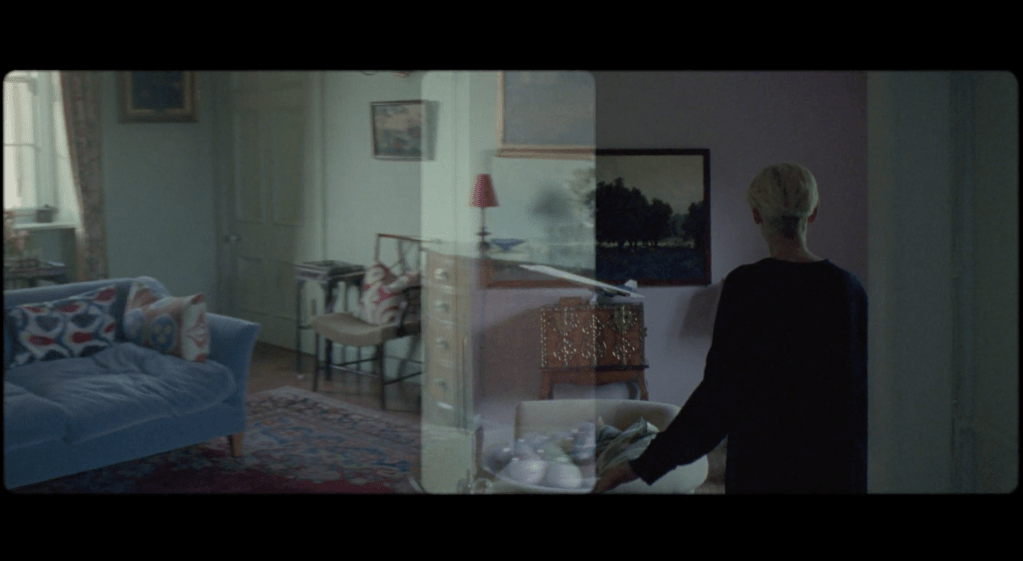
You follow the honking horns to the stoop of Flat 19, a life-size reconstruction of Swinton’s first apartment in London created by the actress herself and the British film director and lifelong friend, Joanna Hogg. A dog starts barking, announcing your arrival. As you step onto the soft carpet in the reconstruction of the actress’ home for 15 years, you hear feet running through you up the stairs. The ghosts of her young twins are followed by the floor vibrating from the Tube passing under the house.
The apartment is stripped of all possessions as if Swinton and her family just finished packing up and left before you arrived. However, each room still holds a memory it is eager to tell. Swinton describes the hallway as a runway for those returning home, coming into land, to touch down and dump their bags in the living room. This slice of the apartment was the threshold between solitude and company.
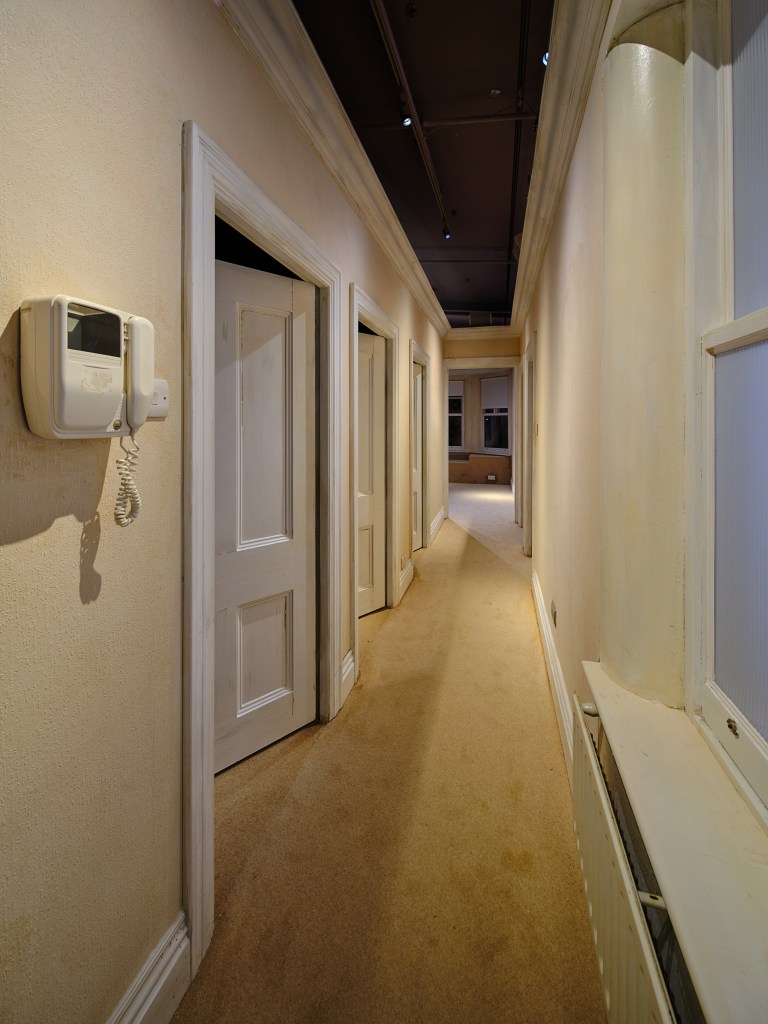
You lean in the doorway of the first room listening to her train of thought, recounting a memory associated with this personal space, reminiscent of moments spent listening to a close friend’s voice message. From the babies bouncing in the kitchen doorway, descriptions of the contents of her fridge to her suspicions of a one-shoe-eating monster living under her bed, Tilda infuses the mundane everyday moments with wonder and nostalgia.
In 1986, Swinton spent an evening lying in her bathtub contemplating how to break into the British Film Institute (BFI), surrounded by piles of magazines including Filmmaker Magazine, Vogue Italia, Time Out and Sight and Sound. Her goal was to steal the rolls of film documenting her first proper debut as an actress. She did not go through with the heist, so the British science fiction drama written and directed by Peter Wollen, Friendship’s Death, was released a year later, propelling her career.
In another room, she reveals to you that there has always been a certain mystery attached to this flat. On the night she gave birth to her twins, her former partner, John Byrne, came home to find the door slightly ajar. When he walked in, he discovered a young woman lying in their bed and justifying her presence by murmuring, “I’ve been here for parties.” However, there had not been parties of the sort. A sergeant arrived to remove the unwanted guest. Yet, when Byrne called the police precinct the next day to find out what happened to her, there was no sergeant by the same name nor a record of the events of the previous night.
All that remains of the 15 years lived in the flat, are the bare bones, beige carpet and cream walls which provided the backdrop for childhood memories and family anecdotes. You become a witness of the last remnants of memories, whispered to you from behind doors. A pang of homesickness pokes you between the ribs, as you are reminded of the places you have left behind. What stories could they tell about you? Witnessing the last words of a place, so significant to a person’s life fills you with heavy melancholy.
Still lingering in your own past, you wander into the next section of the exhibition, where the contribution of filmmaker Luca Guadagnino shows Tilda Swinton walking through a wide open field. The moment you sit down to watch Camaraderie (2025), she turns around abruptly, as if catching you sneaking up on her.
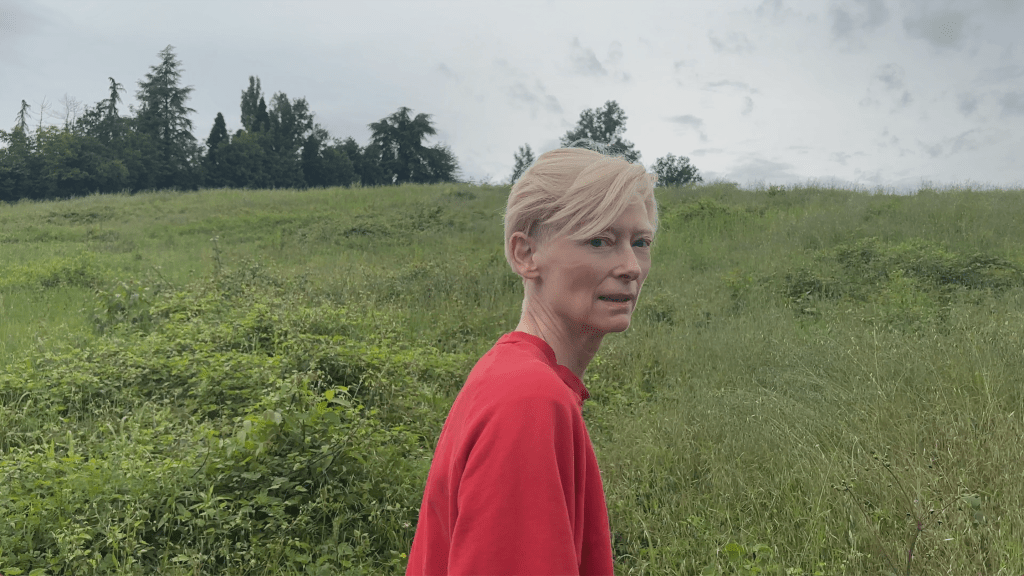
Still from Luca Guadagnino’s Camaraderie, 2025. Commissioned by Eye Filmmuseum, co-produced by Onassis
Stegi. © Luca Guadagnino
You follow her through grassy hills, catching her glancing over her shoulder. It is unclear if you are an invitee or an oddity on this gander through nature. Luca Guadagnino also contributed a silver bust of Swinton emerging from a wooden box, as if her ghost is gliding out of it. The silver incarnation of her head echoes the cover of her first book Tilda Swinton: Ongoing, published alongside the exhibition in September 2025. By being able to creep up on her, you have regained a sense of confidence walking through the dark exhibition space.
Colourful red carpet dresses begin to dance, rising and falling like restless spirits. The black hangers dissolve against the darkness behind them. Cherished clothing items from Tilda Swinton herself and family members, as well as friends, seem to float in the darkness. Her father’s wooden leg is standing at attention, waiting for its owner to return. Derek Jarman and Swinton shared a jumper, one that they kept exchanging when they saw each other, and that now hangs in the exhibition. The signs of wear and tear were never fixed. The sweater was in her care when Derek Jarman died, and remains a quiet testament to their friendship. The embrace of a jumper or jacket becomes the hug of a lost loved one.
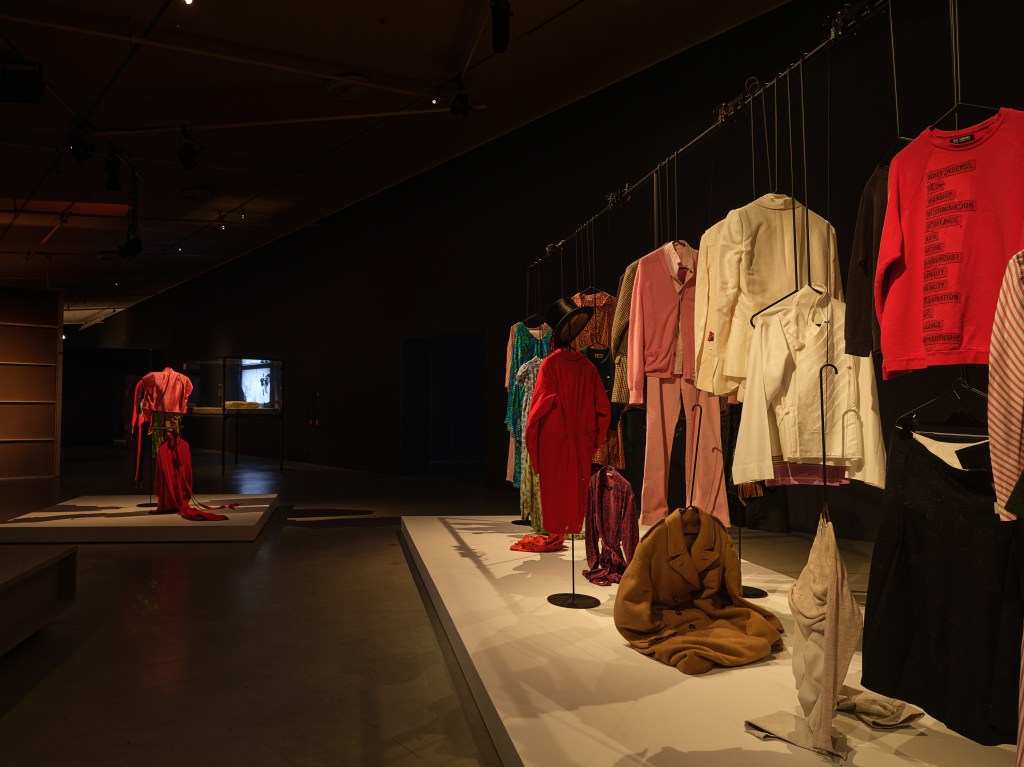
The recording of Olivier Saillard and Tilda Swintons performance A Biographical Wardrobe (2025) lets you take part in the unpacking and unveiling of film costumes, family heirlooms to red carpet outfits. During this vulnerable performance, you see her seated, speaking softly to a coat resting on her knees, as if soothing a child. The jacket slumps under its own weight, whilst a top hat begins to float behind you.
Thunder rumbles and the sounds of rain start pouring in. “The house has more rooms than I remember.” A line echoing from Apichatpong Weerasethakul’s contribution. Both he and photographer Tim Walker visited Swinton at her home to create new work for the exhibition, capturing her connection to her ancestry and the place she and her family have called home for generations.
Still from Apichatpong Weerasethakul’s double-channel video installation Phantoms, 2025. Commissioned by
Eye Filmmuseum, co-produced by Onassis Stegi. © Apichatpong Weerasethakul, Kick the Machine
Tim Walker’s photographs reveal Swinton’s shape-shifting ability, letting her embody her ancestors. Beneath a larger-than-life moustache, her mischievous eyes betray her presence as she slips into the role of what appears to be a general. Memories are constantly reshaping themselves. You must not let them know they are being watched, or they might shift, startled by attention. Managing grief can mean compartmentalising your life, locking memories and other parts of yourself away, only to be approached with caution.
Birds chirp, indifferent to the dark forest of hauntings you are journeying through. “I waited for you, and you came back.” The dog’s whines and strings pull insistently at your heart. “You always came back — until three days ago.” The hammering grows louder and doors groan on their hinges.
Tilda Swinton’s eye, captured by her partner and artist Sandro Kopp, draws you in, offering shelter from the stabbing incarnation of the actress behind you in Pedro Almodóvar’s short film The Human Voice (2020), through her iris into her Scotland. However tempting a detour through the Scottish countryside would be, your time in Tilda Swinton’s universe is coming to an end. As her final act, Tilda Swinton leaves you with her instructions for radical living. “Head to the light!” With your last steps, you push through the dark bottleneck of the exhibition space to be reborn into the light of the Eye Filmmuseum. Rejuvenated and moved from your dive into Tilda’s mystical world, you hear her whisper into your ear: Breathe!
The exhibition is still open to visitors at EYE Filmmuseum in Amsterdam till the 15th of March 2026.
Nanette Ashby is currently pursuing a Research Master’s in Art and Visual Culture at the Radboud University. Her academic interests span across the intersections of gender, sexuality, sex and disability in arts and culture. She specialises in the curation and archiving processes of marginalised communities, specifically of the queer and sex worker community. She researches how heritage institutions can support human rights struggles of minority groups through curating with care.

 Raffia