
By Noa de Kievit
Introduction
In classical Greek epics, heroism is traditionally defined through martial glory, public recognition, and the pursuit of immortal fame (Germain, 1983, pp. 22-23). In The Song of Achilles (2011), however, Madeline Miller reimagines this tradition by shifting the focus of the Trojan-war myth from battlefield triumph to emotional intimacy and queer desire. Told from Patroclus’ first-person perspective, the novel foregrounds tenderness, care, and relational vulnerability, transforming moments of domestic closeness and emotional dependence into central elements of the narrative.
This article argues that Miller’s retelling queers the epic tradition by redefining heroism through vulnerability and same-sex intimacy. Drawing on the work of Judith Butler and Jack Halberstam, both prominent scholars of queer theory and gender studies, I examine how the novel’s depiction of masculinity as performative both enables transformation of heroic ideals and simultaneously exposes the limitations of that transformation. Although Achilles embodies a softened and emotionally expressive masculinity, his mythic privilege and heroic status remain central to the narrative, while Patroclus’ quieter masculinity—grounded in care, loyalty, and devotion—receives less prestige. The Song of Achilles therefore produces a productive tension: it queers the epic from within while remaining partially bound to the hierarchical structures of classical heroism.
Shifting the Epic Focus
In The Song of Achilles, Madeline Miller doesn’t just retell an ancient myth—she lovingly dismantles it. Instead of centering war, conquest, and immortal glory, she builds her version of the Trojan-war saga around longing, tenderness, and emotional vulnerability. As Italian literary scholar Maria Antonietta Struzziero argues, told through Patroclus’ intimate first-person voice, the novel reframes heroism not as a performance of dominance, but as an experience shaped by queer desire and relational vulnerability (2021, p. 134). In this sense, the story does not simply ‘‘give voice to a forgotten character.’’ Rather, Miller reorganizes the entire value system of the myth. Where classical epics reward violence and spectacle, The Song of Achilles lingers on shared meals, quiet conversations, and stolen moments of physical closeness. Heroism, in this version, is measured less by how many enemies you defeat and more by how deeply you can love. As Guy Hedreen, scholar of Greek literature, notes, Achilles’ greatness lies not only in his actions, but in his awareness of the costs, his devotion to another, and his capacity for moral reflection (2009, p. 39). For example, in Miller’s version, when Patroclus prepares to enter the battlefield, Achilles’ tension and anxiety reveal the depth of his protective concern, underscoring that his heroism is defined as much by care as by martial power (Miller, 2017, 308-309).
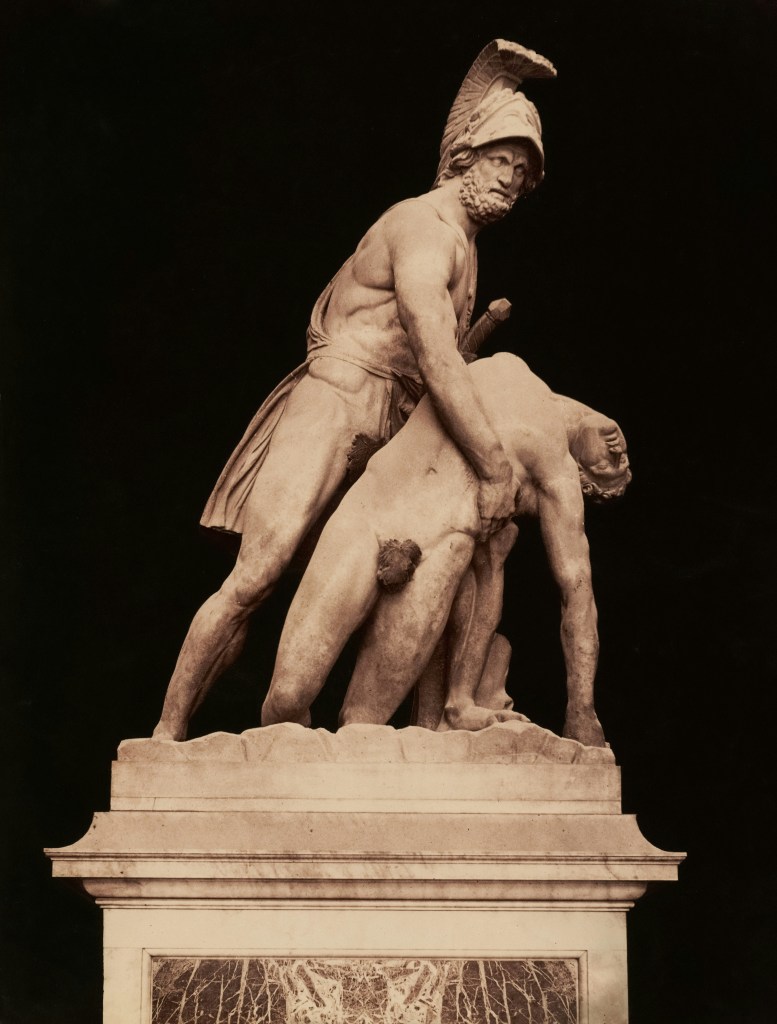
To understand what’s happening here, it helps to turn to Judith Butler and her landmark work Gender Trouble (1990). Butler argues that gender isn’t something we are—it’s something we do. Masculinity and femininity are produced through repeated acts that create the illusion of something natural and stable (1999, p. 23). In epic tradition, Achilles becomes “the best of the Greeks” by constantly reenacting a script of aggression, fame-seeking, and public dominance. But Patroclus’ narration in Miller’s version keeps interrupting that script. Instead of heroic grandstanding, we see Achilles hesitate, soften, and depend emotionally on another man. Through this lens, masculinity looks less like an innate trait and more like a role Achilles is struggling to perform convincingly. His legendary status depends on repetition, and Patroclus keeps on breaking the rhythm. In this sense, Patroclus’ love functions as more than romance—it becomes a way of knowing and organizing the world. His desire shapes what matters in the story. Battles blur into the background, while moments of care and connection come into sharp focus. Domestic intimacy becomes as significant as military triumph. The epic is thus quietly queered from the inside.
This tension between love and legend crystallizes when Achilles admits: “Name one hero who was happy… You can’t… They never let you be famous and happy… I’m going to be the first’’ (Miller, 2017, p. 98). Here, Achilles imagines a future that classical myth refuses to allow. Traditionally, male heroism is bought with early death and eternal suffering. You can be remembered, or you can be content—but never both. Achilles’ dream of happiness with Patroclus gestures toward a queer futurity that resists this tragic economy. His desire is not only for another man; it’s for a life that exceeds the brutal logic of epic masculinity.
The Limits of Queering Heroism
Yet Miller’s queering of heroism is not without limits. This is where Jack Halberstam’s Female Masculinity (1998) becomes especially useful. Halberstam argues that masculinity becomes most visible when it deviates from dominant norms. Alternative masculinities expose how power is unevenly distributed and how certain bodies are authorized to represent “real” manhood (1998, p. 2). In Miller’s retelling, Achilles embodies a softened, emotionally expressive masculinity that includes same-sex desire. But this masculinity remains exceptional. He is still beautiful, divinely favored, and mythically privileged. His vulnerability is allowed precisely because he is already extraordinary. Patroclus, by contrast, represents a quieter form of masculinity: grounded in care, loyalty, and self-sacrifice. He cooks, heals, supports, and loves without demanding recognition. Yet this form of masculinity rarely earns the same narrative prestige. That is, much of its value derives from its contribution to Achilles’ legend. This dynamic is evident even in intimate, playful moments, such as when Patroclus times Achilles’ training run along the beach: ‘’I watched him race across it [the beach], as swiftly as if the beach had been flat. ‘Count for me,’ he shouted, over his shoulder. I did, tapping against the sand to keep the time’’ (Miller, 2017, p. 131).
This asymmetry can be further understood through Julia Kristeva’s concept of the ‘‘ideal Other’’ (1987, p. 59). That is, Patroclus’ identity remains partially oriented toward Achilles as an object of idealization: ‘’I could recognize him by touch alone, by smell; I would know him blind, by the way his breaths came and his feet struck the earth’’ (Miller, 2017, p. 126). Even when this dynamic seems to recede, it resurfaces at crucial moments, confirming that emotional vulnerability becomes fully admirable only when attached to mythic prestige. Care work becomes heroic mainly when it sustains someone else’ greatness.
This raises an uncomfortable question: does The Song of Achilles truly dismantle classical heroism, or does it simply repackage it in the language of romance? The discomfort lies in the novel’s ambivalence. On one level, the novel undeniably challenges ancient norms. It insists that tenderness belongs in epic space. It places queer love at the center of mythic history. It invites readers to see vulnerability as meaningful rather than weak. These are radical gestures in a tradition built on blood and bronze. On another level, however, the story remains shaped by the inherited structures of the novel, as well as contemporary publishing and genre expectations. The romance plot softens the violence of myth without fully escaping its hierarchies. Achilles remains the sun around which everything orbits. Patroclus still burns up in his light, even if he ultimately gains recognition as the figure who restores Achilles’ humanity—especially through his mediation with Achilles’ mother, Thetis (Struzziero, 2021, pp. 148-9).
Fandom as Extension of Queer Mythmaking
Perhaps this fragility is why the story, in contradiction to the novel, refuses to end on the final page. The very limitations of Miller’s story–its partial adherence to heroic hierarchies, its ultimate tragic framing–evidently invites readers to continue the narrative themselves: Across social media platforms grief is shared, remixed, and transformed into possibility. Fan-created alternate endings, modern ‘‘Alternate Universe’’ romances—in which familiar characters are placed into settings that differ from the original story—and viral memes do not merely express attachment to the story; they function as quiet, perhaps even unconscious, acts of resistance against the idea that queer love must culminate in loss. Fandom, in this sense, becomes an extension of Miller’s queer mythmaking. Where classical epic insists on sacrifice and finality, readers insist on continuation. Through collective mourning and imaginative reconstruction, they refuse the tragic economy that equates love with death. Private devastation is converted into communal ritual, and vulnerability becomes a basis for connection rather than isolation. What emerges is a participatory form of storytelling in which readers, like Patroclus himself, reorganize the narrative around devotion and emotional survival.
Conclusion: A Productive Tension
Seen this way, The Song of Achilles is not only a retelling of an ancient myth, but a living cultural text—one that responds to contemporary hunger for tenderness in an emotionally scarce world. Its enduring popularity suggests that many readers are searching, like Achilles, for a way to be both visible and happy, both devoted and whole. The novel does not fully resolve that desire. But in its pages, and in the communities that form around it, it makes space for imagining that such a life might be possible. Miller’s retelling, then, is best understood as a productive tension rather than a total revolution. It queers the epic form while remaining partially bound to it. It exposes masculinity as performance while continuing to reward certain performances more than others. It imagines new emotional possibilities inside an old narrative architecture. In doing so, The Song of Achilles offers something both beautiful and complicated: a myth where men are allowed to love each other openly, to ache, to dream of happiness—and where that love is powerful enough to reshape history, even if it cannot entirely escape it.
Works Cited:
Butler, J. 1999. Gender Trouble. New York and London: Routledge.
Germain, G. 1983. ‘‘Kleos and its Ironies in the Odyssey.’’ L’Antiquité classique, 52. pp. 22-47.
Halberstam, J. 1998. Female Masculinity. Durham: Duke University Press.
Hedreen, G. 2009. ‘‘Achilles Beyond the Illiad.’’ In Heroes: Mortals and Myths in Ancient Greece. Ed. Sabine Albersmeier. New Haven: Yale University Press. pp. 39-49.
Kristeva, J. 1982. Powers of Horror: An Essay in Abjection. Trans. Leon S. Roudiez. New York: Columbia University Press.
Miller, M. 2017. The Song of Achilles. London: Bloomsbury Publishing.
Struzziero, M. A. 2021. ‘‘A New Voice for an Ancient Story: Speaking from the Margins of Homer’s Illiad in Madeline Miller’s The Song of Achilles.’’ Anglica, 30(1). pp. 133-152. https://doi.org/10.7311/0860-5734.30.1.09.
Noa de Kievit is currently pursuing a research master’s in Literary Studies at the University of Amsterdam, where her work explores how literature engages affect, embodiment, and relationality to imagine social transformation. Her research examines the ways texts create possibilities for solidarity, agency, and resistance across diverse social and geographical contexts. She has a particular interest in feminist methodologies, gender- and class-based inequalities, and the practice of knowledge production and dissemination.

 Raffia