
by Rosa Floris
In her 2006 conceptual artwork Cimbra Formwork, Teresa Margolles incorporates real clothes from women who were victims of gendered violence and feminicide in Ciudad Juárez. She is thereby responding to the phenomenon of feminicide, but what exactly does her artwork communicate? By applying insights from theoretical texts on feminicide and comparing the artwork to other artworks with a similar visual language, I attempt to decipher the artwork and offer possible interpretations of its meaning. I will first briefly contextualise Cimbra Formwork and the concept of feminicide, before moving on to a close analysis of the artwork.
Introducing Cimbra Formwork
Cimbra Formwork (fig. 1) is a 2006 conceptual artwork by Mexican artist Teresa Margolles. It consists of wooden formwork, filled with 546 pieces of clothing (“Teresa Margolles”) submerged in grey cement.
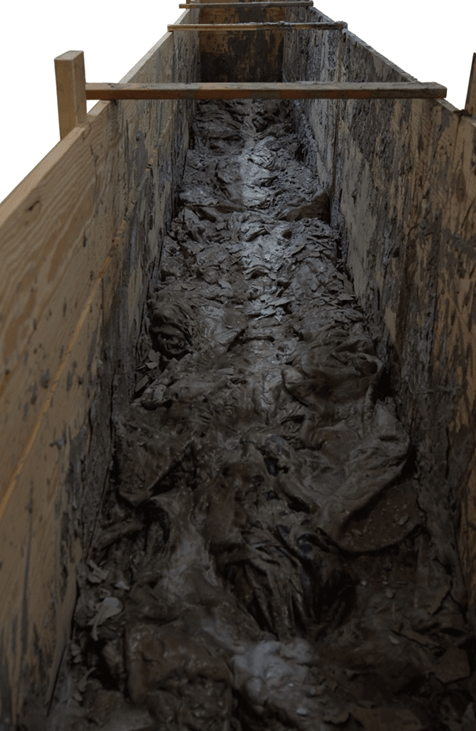
The clothes belonged to women from Ciudad Juárez who experienced violence and threats or were murdered. Violence and death are central themes in Margolles’ oeuvre, and the incorporation of material traces of victims and crime scenes is a strategy she often employs. As part of her exposition What else could we talk about? at the 2009 Venice Biennale, for example, a janitor mopped the palazzo floors with water mixed with blood from murder victims (“Report Prince Claus Awards”). Margolles’ artistic engagement with violence and death stems from her time as a mortician in Mexico City in the 1990s, during which she encountered the bodies of many nameless victims of drug-trafficking violence (“Teresa Margolles” James Cohan). By incorporating materials from specific places and people, Margolles foregrounds the locality of specific kinds of violence and the structures surrounding it. Often exploring “the relationship between violence and marginality, especially in the light of gender” (“Teresa Margolles” James Cohan), Margolles has produced several artworks responding to the phenomenon of feminicide.
Why feminicide instead of femicide?
Femicide is generally understood to be the killing of women because they are women, a definition that stems from the work of sociologist Diana Russell (Finnegan 3). The concept of femicide suggests that there is a political dimension to the killing of women (Finnegan 3). It asserts that murders of women are not simply caused by private altercations or the actions of exceptionally violent individuals (Finnegan 3), but that they are caused by a broader, gender-biased structure. While femicide is a global phenomenon, a generalised view of it does not take into account the specific geographical, economic and cultural factors of femicide as it occurs in specific locales. In the context of Latin America, a different term has been coined, namely feminicidio or feminicide (Finnegan 3). Because the focus of this essay lies on an artwork by a Mexican artist, and because the artwork responds to gendered violence in Ciudad Juárez specifically, I have chosen to use the term feminicide in my analysis. The term feminicide contains not merely a linguistic alteration, but it crucially comes with attached theory. Feminicidio emphasises the systematic nature of and state involvement in the killing of women as it occurs in Latin America (Finnegan 4). Under this strain of theory, Rita Laura Segato argues that the feminicides in Ciudad Juárez should be understood as the result of a coalescence of the economic and political circumstances of the region with a patriarchal system of sociality. Ciudad Juárez is “the frontier of the world’s most lucrative traffic – in drugs; in bodies” (Segato 78) and because it borders the U.S., this frontier is highly patrolled (78). Those carrying out illicit business in this area must be a cohesive group that preserves rigorous silence about its actions (Segato 78). Furthermore, Segato writes that unrestricted neoliberalism has caused inequality to become “so extreme that it allows for absolute territorial control at a sub-state level by certain groups and their webs of support and alliance. These webs establish a true provincial totalitarianism and come to mark and express, without a doubt, the regime of control in force in the region” (Segato 84). Thus arises a ‘second state’ run by mafia groups, and within patriarchal sociality, feminicide becomes a tool for producing cohesive and secretive mafia brotherhoods and expressing the sovereignty and territorial control of the ‘second state’.
Metonym and metaphor
The first thing that stands out about Cimbra Formwork as a response to gendered violence and feminicide is that it does not show bodies. Instead, it shows the clothes of victims piled on top of each other and doused in cement. The victims are thus metonymically alluded to: the clothes serve as substitutes referring to their owners. This strategy of visualising victims of violence is also used in other artworks, and these artworks can help to understand the metonymic visual language employed in Cimbra Formwork. Take for example the bronze shoes on the Danube bank in Budapest (fig. 2), created by Can Togay and Gyula Pauer.
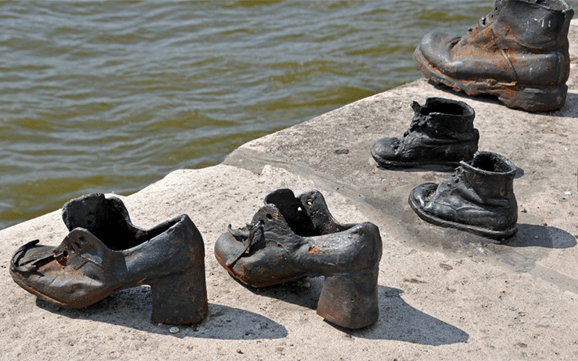
These shoes memorialise the Hungarian Jews who were shot into the river by members of the fascist Arrow Cross Party during the winter of 1944-45 (Ochayon). Often, victims of these mass murders were made to take their shoes off before being killed, as shoes were a valuable commodity (Ochayon). Togay and Pauer’s bronze shoes stand along the riverbank as if their owners had just stepped out of them, a sign of the victims’ presence even though they are nowhere to be seen. The shoes thus refer to the victims and memorialise their tragic, violent deaths without explicitly depicting the victims or the violence. Instead, the shoes function as a metonym, a stand-in for the victims, and offer remembrance without showing graphic violence or spectacularising the victims’ violated bodies. Similarly, the use of metonymic reference in Cimbra Formwork allows for addressing gendered violence and feminicide without directly reproducing the violation of victims’ bodies. That is not to say that Cimbra Formwork steers clear of visualising violence: if the clothes represent the victims’ bodies, then dousing them in cement represents the violent treatment of these bodies. Submerging them in cement ‘kills’ the clothes; they can never be worn again. This use of metaphor instead of literal imagery is especially fitting when one considers that, as Finnegan writes, “in many of the responses to [feminicides in] Juárez – journalistic, legal, public and popular – there has been a rather pronounced and problematic commodification, eroticisation and in some cases sexualisation of the women involved” (Finnegan 9). By metonymically referring to the bodies of victims and metaphorically re-enacting violence, Cimbra Formwork addresses feminicide artistically and exposes the phenomenon to viewers without falling into the trap of aestheticising the dead female body.
Visualising invisibility
Moreover, metonymically visualising victims of violence foregrounds their absence. Truly exemplary of this effect is the REDress Project, an ongoing art Project conceived by Métis artist Jaime Black. It is an installation art piece, consisting of red dresses collected via community donation (“The REDress Project”), hung from ceilings and trees on clothing hangers (fig. 3).
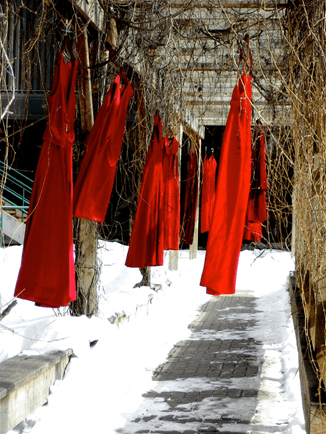
The dresses have been installed in many public spaces in Canada and the United States in order to call attention to the issue of missing and murdered Indigenous women (Black). Black employs the strategy of metonymic visualisation, with the dresses serving as “a visual reminder of the staggering number of women who are no longer with us” (Black). Crucially, the emptiness of the dresses visualises that the women they are referring to are absent. In this way, Black aims to “evoke a presence through the marking of absence” (Black). As the REDress Project shows, the use of metonymic representation is a strategy that simultaneously makes victims of violence visible and stresses their absence. This same dynamic is present in Cimbra Formwork: the pile of clothes confronts viewers with the reality that there are many victims of gendered violence – the artwork contains a staggering 546 pieces of clothing from victims – and makes them wonder what happened to them. These bodiless clothes mark the absence of their wearers and thereby foreground the disappearance of victims of feminicide. This disappearance is double: first, by their deaths, and second because they are “rendered invisible in a public sphere in which the police, the judiciary and the local and national political system denigrate and degrade them” (Finnegan 1). Thus, in addition to metaphorically representing gendered violence, Cimbra Formwork comments on the invisibility of this violence in public discourse.
The dead female body as a waste product
In her examination of feminicide in Ciudad Juárez, Segato departs from the idea that misogyny is undoubtedly a prerequisite for feminicide, but not its dominant factor (77). She observes that gendered violence is a dialogue across two axes: between the aggressor and the victim, but also between the aggressor and his peers – other men (Segato 76). Gendered violence is a way for the aggressor to express his power and thereby acquire access to “the virile brotherhood” (Segato 76). It is this expressive property of gendered violence that makes of feminicide in Ciudad Juárez a tool for communication. Feminicide serves to assure loyalty within mafia brotherhoods through shared complicity, to express cruelty and death power, to produce the sovereignty of those ruling the sub-state totalitarian regime by signaling that they are above the law (Segato 79), and to signify the sovereign’s territorial control (83). Segato thus argues that the victims of feminicide are simply the waste product of a language of violence spoken between men. “The language of feminicide”, Segato writes, “uses women’s bodies to indicate what can be sacrificed for a higher good, a collective good, such as the constitution of a mafia brotherhood. The woman’s body is the supreme index of the position of she who renders tribute, of the victim whose sacrifice and consumption will be most easily absorbed and naturalised by the community” (82). With Segato’s theory in mind, another meaning comes to the fore in Cimbra Formwork. The clothes, which as previously established symbolise the victims, have been dumped in wooden formwork filled with cement. They look unappealing, they look dirty, but most of all it looks like they have been disposed of, like the ‘waste product’ Segato describes. Moreover, cement is a building material and formwork is a tool used to mold it into shape. The clothes have thus not only been disposed of, they have been sacrificed in service of building something else. Cimbra Formwork is a perfect visual analogy for the ‘language of feminicide’ that Segato writes about, in which the role of sacrifice is forced upon the female body for the aggressor to obtain something else – masculinity, brotherhood, sovereignty.
Conclusion: power in ambiguity
In conclusion, Cimbra Formwork is open to many possible interpretations in the context of feminicide. Comparisons with other, similar artworks showed that it employed a strategy of metonymic and metaphorical representation. The clothes call to mind their wearers and become their stand-ins. As such, the submerging of the clothes in cement – a violent way to treat them – becomes analogous to gendered violence and murder. This way of representing feminicide is especially poignant because it refuses to aestheticise the dead female body, something that Finnegan observes occurs frequently in discourses on feminicide. According to this reading, Cimbra Formwork emphasises the violent nature of the crimes committed and primarily serves to confront viewers with the phenomenon of feminicide in an ethical way. At the same time, it was possible to discern critical commentary in the artwork. Because the clothes are without wearers, they emphasise the absence of the victims. This does not only foreground the deaths caused by gendered violence but also offers a comment on the invisibility of this kind of crime in the public sphere. Lastly, viewing Cimbra Formwork through the lens of Segato’s theory offered the possibility of reading the artwork as a comment on the patriarchal system that renders female bodies disposable sacrifices for the greater good of men. In summary, Cimbra Formwork remains an ambiguous artwork. However, the power of the artwork lies in this ambiguity: it invites viewers to consider many possible angles and thereby forces them to truly engage with the topic of feminicide and the gruesome reality of real women’s deaths. Though the cement has solidified their clothes forever, Cimbra Formwork ensures a continuous dynamic discourse around the real victims it represents and prevents the solidification of narratives about their deaths.
References
Black, Jaime. The REDress Project. Installed in multiple places since 2011. Black, Jaime. “The REDress Project.” Jaime Black, http://www.jaimeblackartist.com/exhibitions/. Accessed 25 Jan. 2024.
Finnegan, Nuala. “Introduction: No nos cabe tanta muerte [Unbearable Deaths].” Cultural Representations of Feminicidio at the US-Mexico Border. Routledge, 2019, pp. 1–15.
Margolles, Teresa. Cimbra Formwork. Station Museum of Contemporary Art, Houston, 2006. Station Museum, http://www.stationmuseum.com/past-exhibitions/frontera450/teresa-margolles/.
Ochayon, Sheryl Silver. “The Shoes on the Danube Promenade – Commemoration of the
Tragedy.” Yad Vashem: The Holocaust Remembrance Center, www.yadvashem.org/articles/general/shoes-on-the-danube-promenade.html. Accessed 25 Jan. 2024.
“Report from the 2012 Prince Claus Awards Committee.” Prince Claus Fund, princeclausfund.org/laureate/teresa-margolles#. Accessed 25 Jan. 2024.
“Teresa Margolles.” James Cohan, http://www.jamescohan.com/artists/teresa margolles2?view=slider#17Accessed 25 Jan. 2024.
“Teresa Margolles.” Station Museum, http://www.stationmuseum.com/past-exhibitions/frontera 450/teresa-margolles/Accessed 25 Jan. 2024.
“The REDress Project.” Smithsonian National Museum of the American Indian, americanindian.si.edu/explore/exhibitions/item?id=973. Accessed 25 Jan. 2024.
Segato, Rita Laura. “Territory, Sovereignty, and Crimes of the Second State. The Writing on the Body of Murdered Women.” Terrorizing Women: Feminicide in the Americas, edited by Rosa Linda Fregoso and Cynthia L. Bejarano. Duke UP, 2010, pp. 71–92.
Togay, Can and Gyula Pauer. Shoes on the Danube Bank. Budapest. 2005.

 Raffia