
by Noemi Chiavassa
Going to the library has long been part of my routine. It is a space where I can focus – where ideas settle and take shape. Wherever I am – whether in the Netherlands, Italy, or Spain – I find myself drawn to the small exhibitions that line the library walls, quietly offering something to anyone willing to pause.
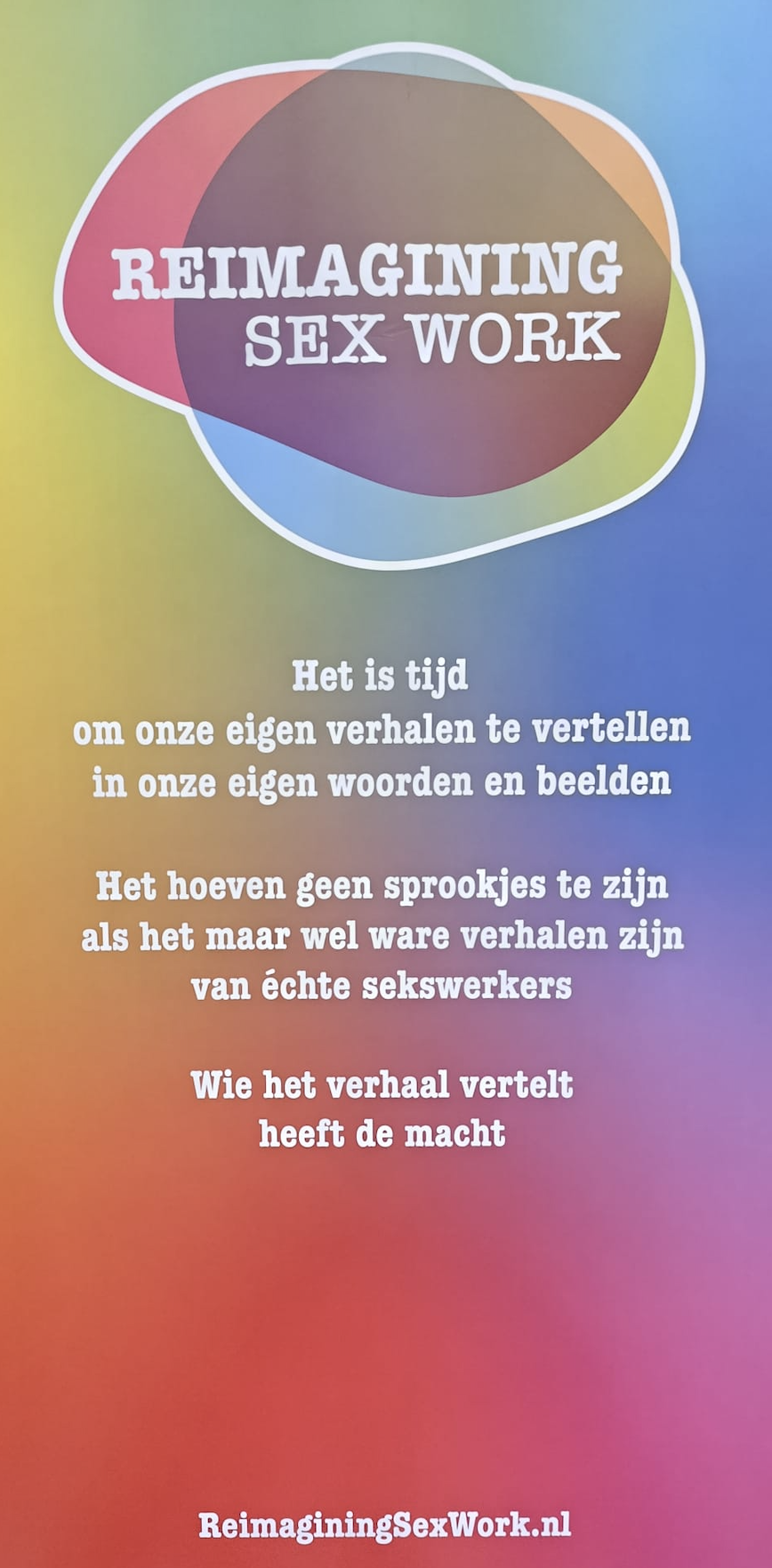
Returning to Utrecht for a few days, I walked into my favourite library, the Neude Bibliotheek, and stopped almost immediately at the entrance. A billboard in front of me read: “Reimagining Sex Work”. Beneath it, a short, manifesto-like text (translated from Dutch) stated:
It is time
to tell our own stories
in our own words and images
They don’t have to be fairy tales
as long as they are real stories
of real sex workers
Whoever tells the story
holds the power
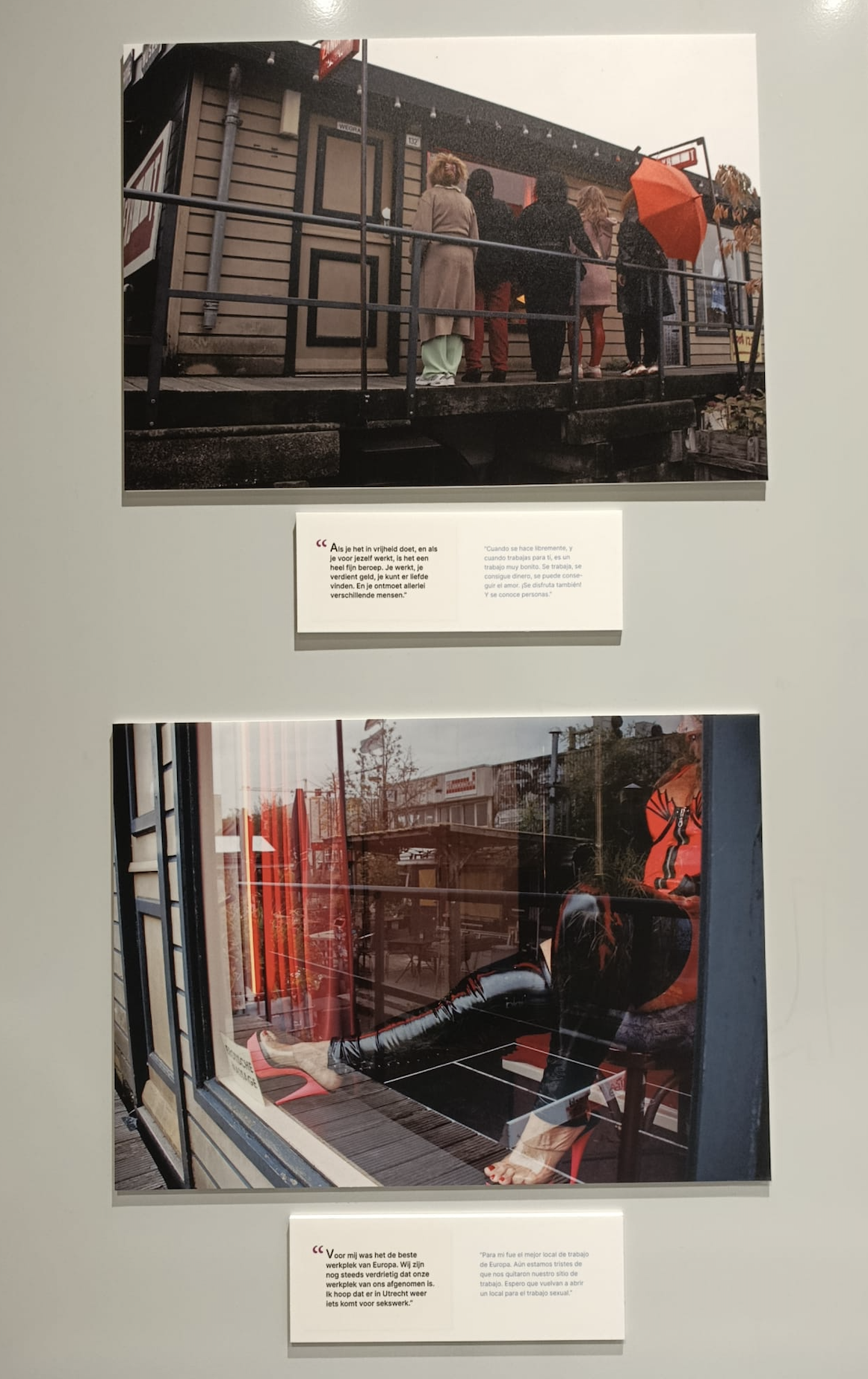
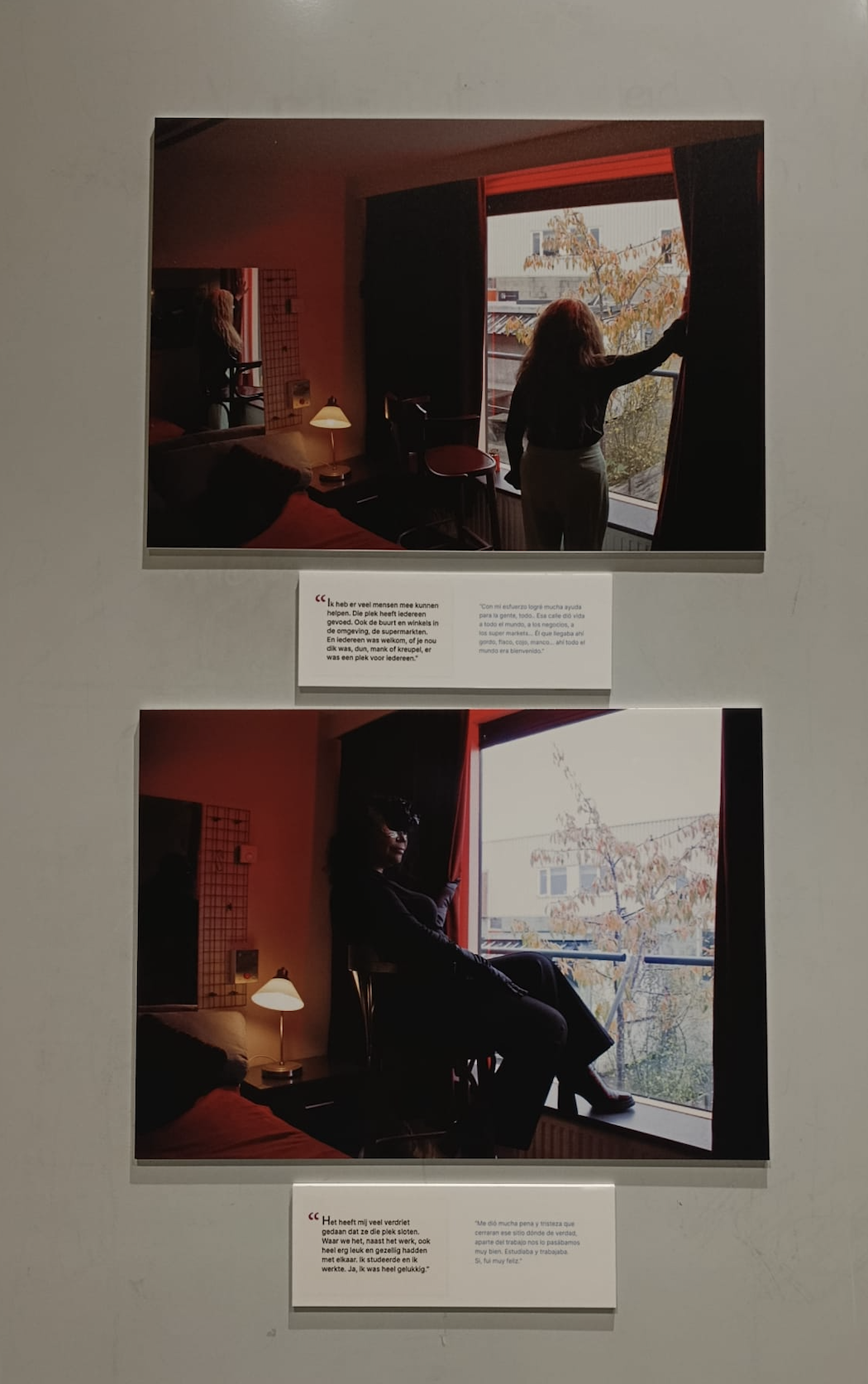
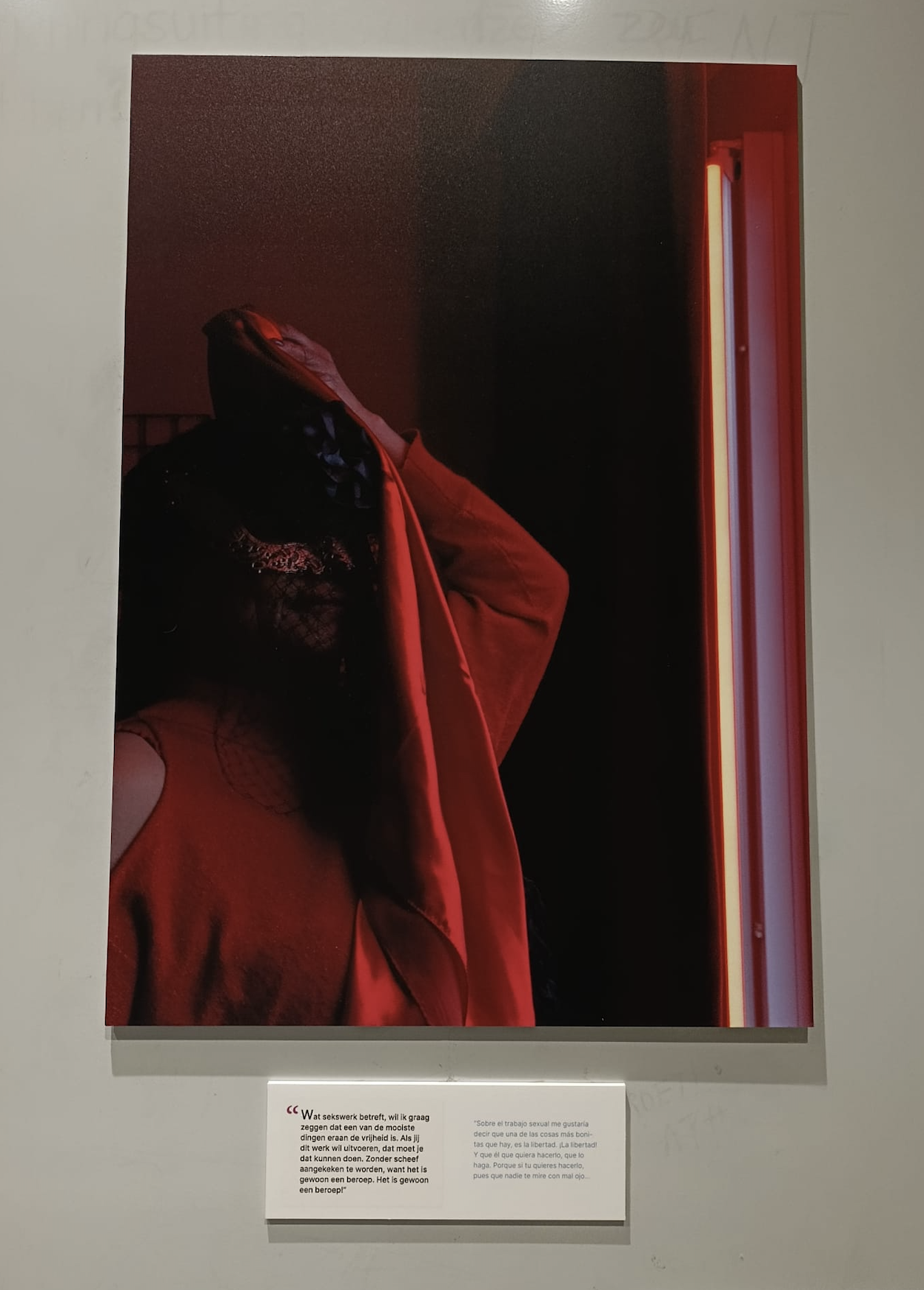
Around it were photographs of sex workers’ everyday lives, paired with their own words and perspectives drawn from interviews. I stood there for a while, struck by the unusual sight: sex workers’ testimonies in the largest library in Utrecht.
I approached the images and read a small banner explaining the origins of the exhibition. Apparently, in 2013 the city’s main sex work area along the Vecht – the Zandpad – was closed. Nearly seventy years of a stable workplace and community for 334 sex workers vanished overnight. Promises of reopening were made, only to be broken soon after. Sex workers lost income, social networks, and stability. This rupture serves as the exhibition’s starting off point.
Photographer and sex worker Moira Mona collaborated with Utrecht-based sex workers at the Zandpad to document their experiences of the site, the meaning of their work, and their return to the location – capturing not only the loss of a physical workspace but also the wider economic and social impact the closure had on their lives. Presented as part of the Week of Sex Work and held in the library from 1 to 7 March, the exhibition grew out of the Reimagining Sex Work project, which brought together sex workers and journalists to develop a media guide and expand a journalistic image bank with alternative representations of sex workers. The resulting photographic collection evolved into a travelling exhibition, with a dedicated section on Utrecht-based sex workers photographed by Moira Mona, and was realised through a broad institutional collaboration involving Belle, the Municipality of Utrecht, Queer Red, SWAD, Reimagining Sex Work, and SAVE – all united in the effort to promote more inclusive and diverse representations of sex work.
Because the Zandpad closure had been justified on the basis of accusations of human trafficking, attempts by sex workers to simply relocate proved challenging. In other cities, operators – licensed brothel owners or managers responsible for running legal sex work establishments – sometimes refused to take on sex workers who had been displaced, due to fears of losing licenses or legal protections through association with them. This reaction may be understood as a fear of “contamination”.
“Contamination” is, in fact, a historically loaded term frequently associated with sex workers, who have long been perceived as carriers of disease. The legal framework surrounding sex work in the Netherlands continues, in some ways, to reproduce these associations. While sex work is legal, it is subject to strict regulation: one can work, but only under specific conditions defined by the state. Among these, as the exhibition explains, are mandatory medical checks imposed within the regulatory regulatory body governing sex work. Rather than allowing space for autonomy and professional self-regulation, such measures reflect a system of control that may be experienced by sex workers as intrusive or disciplinary, even if framed as protective.
As I walked further, I quickly understood that these pictures and words did not quietly offer something to anyone willing to pause; rather, they loudly screamed. What they expressed was the ordinariness of sex workers’ lives:
Sex workers walk the dog in the morning, exercise, cook for their families, update their paperwork, look for a birthday card for a grandchild, and go to work.
Maybe today we were standing next to you in the supermarket, on the school playground, or at the hairdresser.
We are just like you.
And the next label reads:
Sex workers are mothers, and fathers
Sex workers are someone’s child
Sex workers have known love
and felt sorrow for it
We are just like you
The normality of sex workers, as well as of their lives, disrupts common dichotomies: sex workers are often cast as either victims or perpetrators, as either sexually liberated or morally suspect. Yet this tendency to simplify is not new. It reflects a long history of regulating women and feminized bodies, of deciding who is “good” and who is “bad,” who deserves protection and who does not.
But these representations do not emerge in a vacuum. They are shaped by overlapping systems of power – religion, science, the economy, and the law – that have long defined how sex work is understood and controlled.
When it comes to religion, sex work has historically been discussed in moral terms. Institutions such as the Catholic Church have condemned so-called “deviant” sexuality while promoting strict norms around family and reproduction. Within this framework, sex workers have been cast as figures of sin and excess, thereby justifying both the stigma inflicted upon them and the multiple forms of intervention and regulation they have to face.
Building on earlier moral structures, nineteenth-century positivist science, known for its faith in reason, measurement, and empirical data as the basis for understanding human behaviour, recast these judgments in a new, “scientific” language. Criminologists like Cesare Lombroso claimed that criminality – including prostitution – could be read on the body itself (Selmi 2016). For example, Lombroso argued that certain physical features, such as skull shape, facial asymmetry, or a pronounced jaw, could reveal an individual’s “criminal nature”. From this perspective, sex workers were not shaped by circumstance but marked as inherently deviant. What had once been moral condemnation was reframed as objective truth.

At the same time, sex work is deeply embedded in the economic system. As feminist scholars have shown, activities often seen as “intimate” or “private” are central to how economies function (Federici 2004; Gago, Cavallero, Mason-Deese 2024). For example, domestic and care work – such as cleaning, childcare, or elderly care, often performed within households or through informal arrangements – illustrates how forms of labour that appear personal or affective are in fact essential to economic reproduction. Sex work makes visible how blurred the boundaries between work and personal life can be, and how much labour, especially gendered labour, remains informal and precarious.
These moral, scientific, and economic rationales are ultimately enforced through law and government policy. Different legal frameworks – whether regulation, criminalisation, or decriminalisation – determine who can work, under what conditions, and with what protections. Even where sex work is legal, as in the Netherlands, strict regulations continue to shape and constrain workers’ autonomy. For example, requirements such as municipal registration or formal work authorisation mean that those without legal residency status are unable to comply with these conditions, effectively pushing them into informal or illegalised forms of work.
Seen from the walls of the library, these systems of oppression reveal themselves not as abstractions, but as forces shaping real lives.
For this reason, walking into the library and encountering sex workers speaking for themselves becomes more than just visiting an exhibition. It becomes an act of reclamation of space and the narrative around sex work: a central space occupied by a group so often pushed to the margins. It disrupts the long-standing tendency of institutions to speak for sex workers without consulting them. In its simplicity, the photographs are powerful – a reminder that sex workers are real people, living ordinary lives, navigating structures that judge and regulate them at every turn.
In the centre of Utrecht, I encountered sex workers’ desire – the desire to return to what they once had, to a place like the Zandpad, described by one interviewee as “the best workplace in Europe.” It was not only a site of labour, but of community. As another sex worker recalls: “Truly, aside from work, we had a really good time. I studied and worked. Yes, I was happy.”
At the Zandpad, one day work was permitted; the next, it was erased. The exhibition makes this reality visible, showing that the sensationalism surrounding sex work is not incidental – it fuels the stigma that, in turn, informs the laws and institutional decisions that directly shape sex workers’ lives. Walking through the Neude Bibliotheek, their voices fill the space, reclaiming narratives that are usually created without them, rather than by them. In doing so, the exhibition asserts their presence, their agency, and the importance of listening to stories that are too often silenced.
Reimagining sex work exhibition at the Neude Bibliotheek: https://bibliotheekutrecht.op-shop.nl/8469/tentoonstelling-reimagining-sex-work/01-03-2026?disable_filter=1
Reimagining Sex Work: https://reimaginingsexwork.nl/
Noemi Chiavassa is currently pursuing a PhD in Social Anthropology at the University of Barcelona. She is particularly interested in informal and gendered economies, sexual and reproductive rights, and the relationship between everyday life violence and resistance. Her current research explores how sex work, gender-based violence, and urban space intersect in Rio de Janeiro, Brazil.
Works Cited:
Gago, Veronica, Lucía Cavallero, Liz Mason-Deese. The Home as Laboratory: Finance, Housing, and Feminist Struggle. New York: Common Notions
Federici, Silvia. 2004. Caliban and the Witch. New York: Autonomedia.
Selmi, Giulia. 2016. Sex Work. Il Farsi Lavoro della Sessualità. Bologna: Bébert Edizioni.

 Raffia