
by Nele Brinkmann
In the tumultuous aftermath of World War One, Germany found itself in times of uncertainty and upheaval. The Weimar Republic, Germany’s first democracy, challenged the old order with its progressive constitution and blooming cultural scene. The “New Woman” embodied this transformation and transcended previous gender expectations. Let us go back in time and explore societal transformations of the Weimar period and how they were reflected in the arts, with a focus on morality. Through Hannah Höch’s photomontage Das schöne Mädchen (1920) and Josef von Sternberg’s film Der blaue Engel (1930), the portrayal and evolution of the New Woman archetype will be examined, while considering implications of gender and culture.
The following works engage with this analysis: Maud Lavin’s article “Androgyny, Spectatorship, and the Weimar Photomontages of Hannah Höch”, and Richard McCormick’s essay “From ‘Caligari’ to Dietrich: Sexual, Social, and Cinematic Discourses in Weimar Film”. Lavin examines many of Höch’s artworks, with a focus on gender and sexuality. She contextualizes the emergence of the New Woman within the Weimar Republic, explaining how androgyny is often linked to queerness. Richard McCormick extends this exploration, connecting the demonization of the new women to societal anxieties of the post-war era. He analyses the fetishized gaze directed at Lola, the female main character of Der blaue Engel. Both authors base their analysis on the concept of the New Woman, offering insightful perspectives on her depiction in media.
Firstly, an impression of the socioeconomic landscape of the Weimar Republic, Germany’s first democracy, established in 1918: The 1920s saw economic growth and rising wages, fostering a comfortable bourgeois class. This era was characterized by industrial development and a capitalist-driven consumer culture. The Weimar constitution introduced legal equality to men and women, resulting in increased visibility and autonomy of women. “Die Neue Frau”, the New Woman, would join the workforce, vote, and be strongly associated with consumerism due to her penchant for fashion, mass entertainment, and hedonistic lifestyle. Larger cities, like Berlin, enjoyed a relatively open queer scene. However, the Versailles Treaty’s reparations strained the economy. The military was significantly reduced, humiliating the proudly masculine “fatherland” (McCormick 644). The societal upheaval of the Weimar Republic led to the marginalization and scapegoating of newly emancipated women, along with socialists, Jews, and queer individuals, by the rising political right. These women were seen as a threat to the bourgeois domestic fantasy. Their “masculinized” clothing style and short hair destabilized traditional gender roles (McCormick 641-8; 664).
An artist who captured the ambivalent expectations on women was Hannah Höch. She moved to Berlin to study applied arts, designing wallpaper, embroidery, textiles and glass. In 1915, she began a relationship with the artist Raoul Hausmann, through whom she was introduced to the circle of leading expressionist artists and writers. This connection led Höch to become a part of the Berlin Dada group (1918-1922). Dada first emerged in Zürich and arrived in Berlin by 1918 as young artists, traumatized by war, sought to express their dissatisfaction with politics and aimed to bridge the gap between traditional art and modern life. Known as the “good girl” of Berlin Dada, Hannah Höch specialized in photomontages (Makholm 19; Lavin 67). She used existing photographs from periodicals and assemble them into provocative compositions to create new meaning and capture the “hectic pace of modern urban life” (Makholm 21).
Simultaneously, she designed embroidery and lace patterns for Ullstein’s women’s magazines. Through these seemingly contradictory pursuits, Höch not only combines handiwork and non-traditional artforms, but also challenges the “boundaries between traditionally masculine and feminine modes of form and expression” (19). Her relationship to Hausmann enabled her to become the only woman of the Berlin Dada group. Simultaneously, she struggled being recognized as an independent female artist in the male dominated avant-garde space (Lavin 65).

In Das schöne Mädchen (“The Beautiful Girl”), Höch juxtaposes female figures with depictions of machinery (fig. 1). Central to the image is a female body in a swimsuit holding a parasol, symbolizing both activeness and promiscuity. Connecting her neck to a fashionable short hairstyle, a lightbulb is often used to symbolize that a character is struck by an idea. Furthermore, it alludes to the technical and scientifical advancements of the time. The figure’s face is made up of a page from an advertisement, stripping her from any identity. She is surrounded by a car wheel, steel girder, and a “phallic crankshaft” (Adamowicz 59). These mechanical items symbolize both modernity and masculinity. When placed in contrast with a stylish woman, they embody the concept of the New Woman, a figure that was promised social mobility, yet ultimately demonized for it (McCormick 662). “Here she remains an attractive faceless commodity, constrained by male symbols of power and industrialisation” (Adamowicz 59). Höch utilizes imagery from fashion magazines and advertisements to underscore the connection between consumerism and the New Woman. She is depicted not only as a consumer but also as the object of consumption, effectively transforming into a commodity herself (Adamowicz 59). Through this portrayal, Höch critiques the societal status of women and the widespread misogyny they encounter.
The upper right corner shows a female face, one eye being replaced with an oversized, cut-out eye. The background consists of a dense collage of BMW logos, possibly serving as a commentary on excessive consumerism. A hand holding a watch symbolizes the fast-paced consumer culture. Inside of the wheel appears a boxer. Boxing was an immensely popular sport in the 1920s, enjoyed by both men and women (Nero 40). The post-war period left many men feeling “emasculated”. Consequently, boxing, with its inherently masculine connotations, was used to reinforce national strength. Modern women, such as Marlene Dietrich, participated in the sport, reflecting changing societal roles (41). Boxing was often portrayed in art and used to deconstruct clear indications of gender (46). This portrayal contributed to male anxieties regarding the perceived masculinization of women. Androgyny in women, during the Weimar period, was interlinked with questions of sexual identity (Lavin 79). Given the context of Höch’s personal life, with her being in several prolonged queer relationships, her portrayal of the New Woman challenges conceptions of gender and heteronormativity.
The Wall Street Crash of 1929 marked the end of the roaring twenties. A sudden collapse of the stock market in the United States caused a worldwide economic disaster and led many German industries into an economic depression. A large part of the population became unemployed, and politics saw a radicalisation to either the far left or right. In the midst of the downfall of the Weimar Republic, Der Blaue Engel (“The Blue Angel”), a comedy-drama directed by Josef von Sternberg and produced by UFA (Universum Film Aktiengesellschaft), aired. Born in Austria and raised in the United States, Sternberg successfully established himself as a director in Hollywood. He was then commissioned to produce the first German major sound film to improve the economic status of Weimar’s film industry. The UFA was in dire need of a hit following the financial failure of Fritz Lang’s Metropolis in 1927. Der Blaue Engel is loosely based on Heinrich Mann’s novel Professor Unrat (“Professor Filth”, 1905) and follows Professor Immanuel Rath (Emil Jannings), as he falls in love with the seductive cabaret performer Lola Lola (Marlene Dietrich), leading to his social downfall and transformation into a cabaret clown.
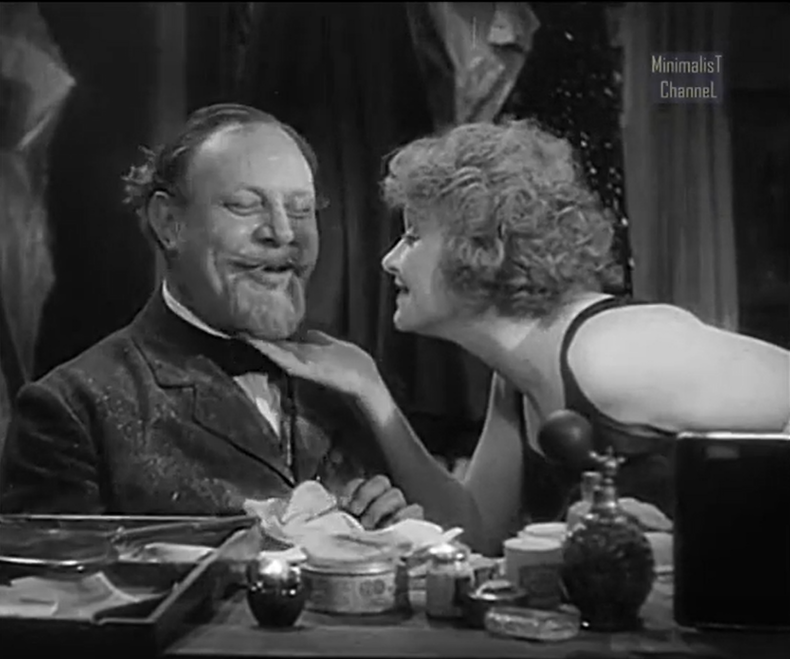
The story set in the Weimar Republic portrays a bourgeois tragedy, with Professor Rath embodying the era’s moral and social dilemmas (Smith 54). The Professor undergoes a transformation, seeing his name evolve from “Rath” resembling “Rat” (“advice”) to “Unrat” (“filth”), reflecting his moral decay and loss of societal respectability. He performs authority in the classroom, while in the presence of Lola, he turns into a sensible, soft-spoken man (fig. 2). This “feminization” of the Professor correlates with his loss of social power. Additionally, he regresses to childlike behaviour, hugging a doll in Lola’s bed after a night of drinking. McCormick describes how economic, social, and political changes during the Weimar period triggered a perceived threat to the bourgeois stability, an anxiety often projected on women (645). Lola, as the assertive, “masculine”, counterpart, is later blamed for the Professor’s downfall.

Lola initially appears through static images (fig. 3), like a poster and postcard, gradually building up to her full reveal (Smith 54). In the first poster, she is shown with Cupid clinging onto her leg. Cupid is the god of desire, representing the taboo relationship of the Professor and Lola. She is financially independent and sexually liberated, embodying the New Woman. Her songs express her freedom to select her romantic partners, a choice she boldly makes by pointing a headlight upon the Professor. She openly presents herself masculine, wearing cylinders and sitting with open legs. Throughout their relationship, she consistently challenges traditional gender norms.
The Professor’s love for Lola makes him emotionally dependent on her, which evolves into a financial dependency after losing his job. On the day of his dismissal, students draw him as a Cupid, referencing the Cupid on the cabaret poster. It underscores his dependency and submissiveness towards Lola. While she continues her career, the Professor starts selling her postcards, betraying his moral principles. The Professor’s desire for Lola ultimately leads to her transformation into the vamp archetype (McCormick 656). Lola initially appears with an innocent looking, oversized bow. In her iconic song, “Ich bin von Kopf bis Fuß auf Liebe eingestellt”, Lola sings about how she seductively captivates men. In her last performance, she sings it more harshly, sitting on a chair backwards with her legs open, marking her ultimate transformation into the femme fatale (657; fig. 4).

Even though Lola is fetishized and sexualised to please the male gaze, the film was celebrated in Berlin’s lesbian community, in part, to Marlene Dietrich’s status as a queer icon (McCormick 662; Lavin 84). When considering a female spectatorship, Lola is an androgynous figure that uses her commodified sexuality to generate income. She is a woman that exudes independence and authority over men, making her desirable to those who seek an emancipated life (McCormick 662-4).
In conclusion, both artworks show how economic, social, and political insecurities affected the portrayal of women during the Weimar Republic. Hannah Höch, an understanding yet often overlooked female Dada pioneer, offers a feminist critique of the media’s construction of the New Woman. Celebrated and simultaneously demonized for her autonomy, the New Woman reveals the double standard that is placed on women. This is embodied by Höch herself: As the first woman in Dada, she is attributed new freedom and possibilities, but ultimately plays a subordinate role in the male dominated movement.
Der Blaue Engel, created an eventful decade later, serves as a “cautionary tale” about the New Woman. The story of the bourgeois Professor, who is ruined by a seductive woman, reflects male anxieties about the perceived emasculation and loss of control following the defeat of the First World War. However, Lola’s character also offers a powerful commentary on the importance of challenging traditional gender roles. By defying societal expectations and embracing her independence, Lola encourages modern audiences to reflect on the progress made in gender equality and the ongoing struggle for women’s rights. If we turn our attention to the current economic, social, and political situation in Germany, we can find many similarities. Our society is experiencing ever-growing modernization and technical advancements. However, challenges like inflation, financial insecurities, and migration persist. As Germans face increasing difficulties in maintaining previous lifestyles, right-wing politics are gaining traction. From my personal experience, racism and misogyny have become somewhat fashionable again, with such views being expressed more openly and gaining support. Additionally, social media platforms are witnessing a resurgence of traditional views on womanhood. In light of these developments, it is crucial for us to address these issues proactively and foster spaces for open dialogue.
References:
Adamowicz, Elza. “Hybrid Bodies (I): The Impossible Machine.” Dada Bodies: Between Battlefield and Fairground, 1st ed., Manchester University Press, 2019, pp. 70–91. JSTOR, http://www.jstor.org/stable/j.ctvnb7kgv.8.
Höch, Hannah. Das schöne Mädchen. 1920. http://www.artsy.net/artwork/hannah-hoch-das-schone-madchen-the-beautiful-girl. Accessed 25 March 2024.
Lavin, Maud. “Androgyny, Spectatorship, and the Weimar Photomontages of Hannah Höch.” New German Critique, no. 51, 1990, pp. 63–86. JSTOR, doi.org/10.2307/488172.
Makholm, Kristin. “Strange Beauty: Hannah Höch and the Photomontage.” MoMA, no. 24, 1997, pp. 19–23. JSTOR, http://www.jstor.org/stable/4381346.
McCormick, Richard W. “From ‘Caligari’ to Dietrich: Sexual, Social, and Cinematic Discourses in Weimar Film.” Signs, vol. 18, no. 3, 1993, pp. 640–68. JSTOR, http://www.jstor.org/stable/3174861.
Nero, Julie. “Engaging Masculinity: Weimar Women Artists and the Boxer.” Woman’s Art Journal, vol. 35, no. 1, 2014, pp. 40–47. JSTOR, http://www.jstor.org/stable/24395362.
Smith, Jeffrey P. “‘It Does Something to a Girl. I Don’t Know What’: The Problem of Female Sexuality in ‘Applause.’” Cinema Journal, vol. 30, no. 2, 1991, pp. 47–60. JSTOR, doi.org/10.2307/1224978.
Thompson, Bordwell, et al. Film History: An Introduction. 2021.
von Sternberg, Josef. Der blaue Engel. 1930. archive.org/details/the-blue-angel-1930-restored-movie-720p-hd/the+blue+angel-1930-restored+movie-720p-hd.mkv. Accessed 25 March 2024.

 Raffia