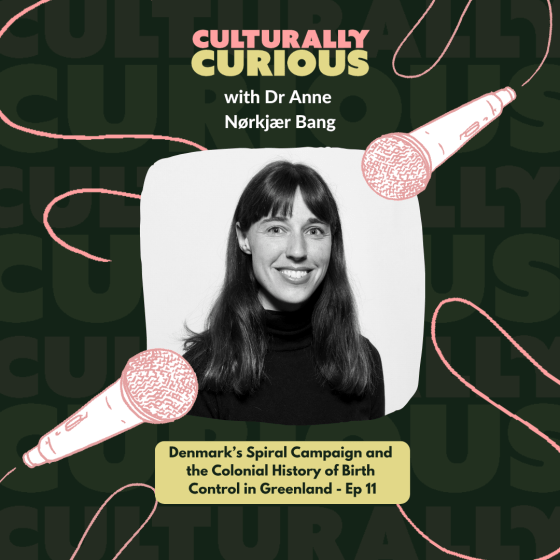
Denmark’s Spiral Campaign and the Colonial History of Birth Control in Greenland with Dr Anne Nørkjær Bang – Culturally Curious Ep.11

In this episode, Nanette Ashby is joined by Anne Nørkjær Bang, a postdoctoral researcher at the University of Southern Denmark. Her work is situated within cultural studies and feminist science studies, looking at the intersection of reproduction, gender, technology, environment, and contemporary culture. Together, we discuss her project Endocrine Economies: the Cultural Politics of Sex Hormones and her take on the birth control pill as more than just a contraceptive technology, but a cultural phenomenon. We immerse ourselves in the so-called “spiral campaign” led by the Danish government in the 1960s and 70s in Greenland, and the debates around the administration of Depo-Provera injections that followed.


A Phoenix Without Fire: Affective Infrastructures and the Politics of Mobility at Rotterdam’s Fenix Museum

by Martine Mussies
A museum named Fenix promises rebirth. I expected flames, wings, ascension. Instead, I encountered porcelain treaties thin enough to fracture at a touch, documents that regulate belonging, and images of movement structured by permission.

Reflections of a Feminist – International Women’s Day 2023

By Elna Schmidt I am resisting the urge to begin with a quote by Virginia Woolf. It seems too cliché to start writing an article in a university magazine concerned with gender equality, feminism and diversity in this way. And yet, I could not help but think of “A Room of One’s Own” when entering Theaterzaal C of the Elinor Ostrom building at Radboud University, one of the only buildings on our huge campus named after a woman. The sight of a room full of women taking up space always is a sight for sore eyes…

The Colonial Legacy in France’s Citizenship Dilemma

by Roisin Moreau France’s history and the daily experiences of French people of colour (a primary example described above) proves that this fetishization of citizenship does not play out on an even playing field for many of its subjects. In reality, many ethnic minorities experience a lack of social acceptance, and are denied “cultural citizenship” (Rosaldo, 1994), proving that identity papers are not always sufficient.