
by Nanette Ashby
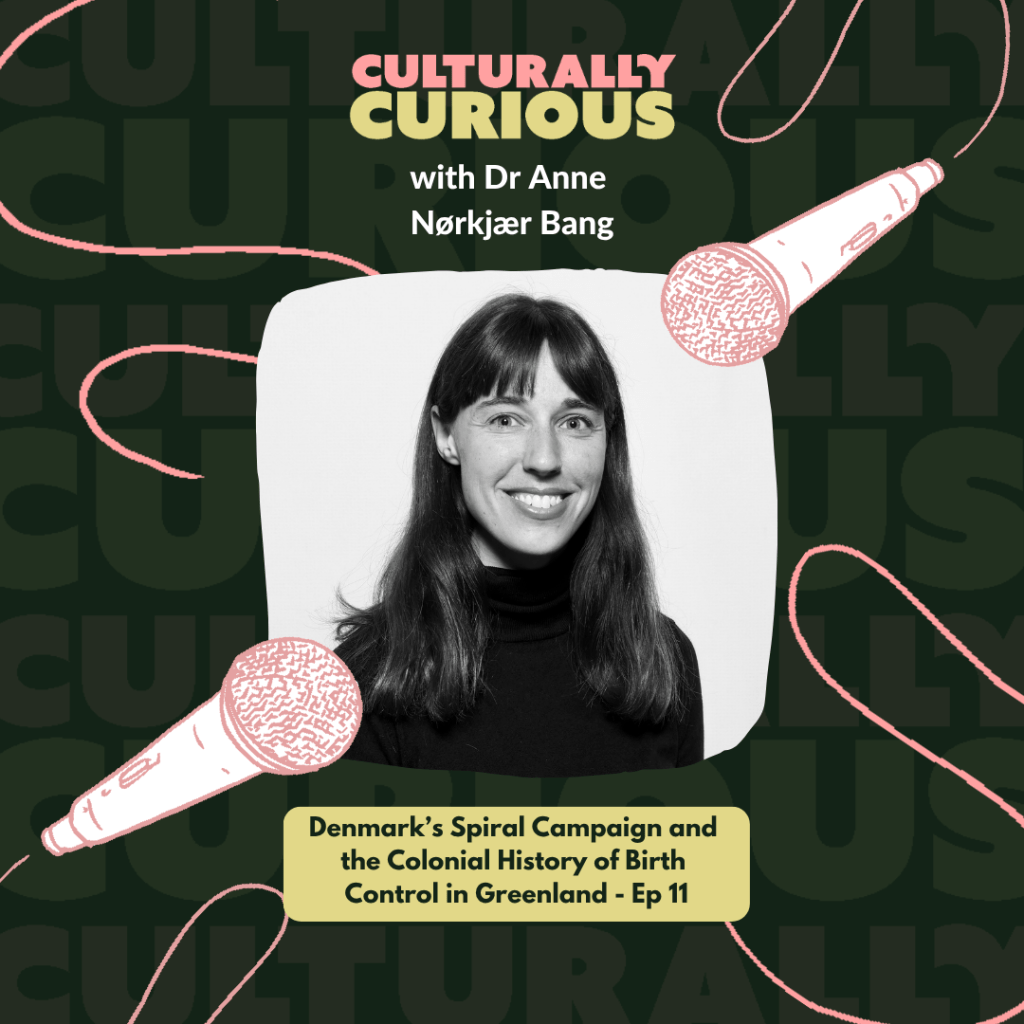
In this episode, Nanette Ashby is joined by Anne Nørkjær Bang, a postdoctoral researcher at the University of Southern Denmark. Her work is situated within cultural studies and feminist science studies, looking at the intersection of reproduction, gender, technology, environment, and contemporary culture. Together, we discuss her project Endocrine Economies: the Cultural Politics of Sex Hormones and her take on the birth control pill as more than just a contraceptive technology, but a cultural phenomenon. We immerse ourselves in the so-called “spiral campaign” led by the Danish government in the 1960s and 70s in Greenland, and the debates around the administration of Depo-Provera injections that followed. This journey takes us back to the colonisation of Greenland by Denmark and some of the more insidious aspects of forced assimilation, or “Danishisation”, of the Greenlandic people. Racistly motivated population control is one aspect which led to the forced sterilisation of many Greenlandic women. Stay tuned to find out more about the history of hormonal birth control and an essential part of Denmark and Greenland’s not-so-ancient history!
Please let us know your thoughts over on our instagram page @raffia_magazine // https://www.instagram.com/raffia_magazine/
If you like this episode please leave us a rating and review on Spotify – It is really appreciated! https://open.spotify.com/show/60ROIuvNmpqYrAYDOVLp8Y
Mentioned during the episode:
Contact Anne Nørkjær Bang: https://portal.findresearcher.sdu.dk/en/persons/annenb/
Her article “For sled dogs and women: Hormonal contraception and animacy hierarchies in Danish/Greenlandic Depo-Provera debates”: https://portal.findresearcher.sdu.dk/en/publications/for-sled-dogs-and-women-hormonal-contraception-and-animacy-hierar/ (contains link to Open Access Version)
Endocrine Economies Project: https://portal.findresearcher.sdu.dk/en/projects/endocrine-economies-the-cultural-politics-of-sex-hormones/
Depo-Provera debates (news): https://www.bbc.com/news/world-europe-63863088 // https://sfg.media/en/a/in-the-1960s-70s-in-greenland-girls-and-women-were-subjected-to-coercive-birth-control/ // https://www.anapolweiss.com/blog/a-guide-to-the-history-of-depo-provera
Denmark-Kalaallit Nunaat Greenland case: https://www.justiceinfo.net/en/150175-denmarks-apology-to-greenlandic-women.html
Episode Transcript:
Nanette Ashby
Welcome to the Gender and Diversity Podcast Culturally Curious, where arts and culture have never been more titillating with me you host, Nanette Ashby.
In this episode, I am joined by Anne Nørkjær Bang, a postdoctoral researcher at the University of Southern Denmark. Her work is situated within cultural studies and feminist science studies, looking at the intersection of reproduction, gender, technology, environment, and contemporary culture. Together, we discuss her project Endocrine Economies: the Cultural Politics of Sex Hormones and her take on the birth control pill as more than just a contraceptive technology, but a cultural phenomenon. We immerse ourselves in the so-called “spiral campaign” led by the Danish government in the 1960s and 70s in Greenland, and the debates around the administration of Depo-Provera injections that followed. This journey takes us back to the colonisation of Greenland by Denmark and some of the more insidious aspects of forced assimilation, or “Danishisation”, of the Greenlandic people. Racistly motivated population control is one aspect which led to the forced sterilisation of many Greenlandic women. Stay tuned to find out more about the history of hormonal birth control and an essential part of Denmark and Greenland’s not-so-ancient history!
Could you please introduce yourself to our listeners and tell us a bit about your background and who you are?
Anne Nørkjær Bang
Yeah! I am a cultural studies / feminist science and technology studies scholar. I’m currently affiliated at the University of Southern Denmark, where I’m part of a big research project called “Endocrine Economies: the Cultural Politics of Sex Hormones”. And I’ve been working a lot with hormones, hormonal drugs, especially birth control, in particular, the birth control pill. So my take on that is sort of roughly that I see it as a cultural phenomenon, just as much as a biological one. So that would mean that while I’ll acknowledge that, of course, technologies like the pill does real work in our bodies, I also see it and see its effects as something that is sort of produced within social and political, economic, cultural contexts which quite importantly shapes the way that we can think about and also experience these drugs.
Nanette Ashby
What specifically made you interested in the Depo-Provera debates in Denmark? And I think you looked at the debates during the 1970’s, 1980’s, is that correct?
Anne Nørkjær Bang
Yes, that’s correct. And that was sort of when the big debates were. So that’s why… I think what actually sparked my interest was a discussion I had with my mother, who is a doctor. So I was born in 1991. So I’m a bit too young to have kind of experienced this conversation myself at that time. But I had this conversation with my mother, who is a doctor. She and I, we had both heard this podcast about the IUD campaign. And I was like, you know, being white and Danish and pretty much schooled in sort of too strong… And at this time, quite depoliticised narrative, which is that of Denmark as a sort of a good coloniser and also that of contraception as something that sparked, sort of, women’s emancipation universally. So being really schooled in these narratives, I was actually, and I’m a bit embarrassed to say so, but I was actually quite shocked about that podcast. And to hear these women’s stories and their experiences. My mother was also shocked, but a bit less surprised than me because she actually remembered, as a young doctor, having heard about, not the coil, but these Depo-Provera shots and having sort of experienced these debates. And at the time I was sort of myself moving a little bit into the terrain of the birth control pill and studying that. So I just knew when she said that and mentioned these shots…they were really called it “the shot” at the time…When she mentioned that, I was just like, I have to to look into this and also like, just a bit interested in the way those stories sort of didn’t really sediment into the cultural memory. So she was actually the one who got me on track.
Nanette Ashby
Oh, nice! That’s a fascinating story! Because so much has changed, but on the other hand, not that much has changed. So it’s always fascinating. Could you tell us a bit more about what the Depo-Provera shot is specifically? Because when I read your article, that was one thing that I hadn’t necessarily heard much about before.
Anne Nørkjær Bang
Yeah, so it is a birth control injection, which is quite similar to the birth control pill in that it’s a hormonal technology, right? But different hormones used. And also like the thing that really sets it apart from the pill is that it is injected, of course, but it’s injected like once and then it lasts for three months. You cannot immediately stop it. For instance, if you have side effects, then you actually have to wait quite a long time before you can discontinue the injection.
Also, the injection has to be given at a clinic, so it’s not sort of self-administered. So that really sets it apart from the pill as well. The hormonal technology is somewhat similar to the pill and the side effects look like the pill side effects as well.
Nanette Ashby
And for people outside of Denmark, who’ve never heard about any of this before, what’s the context or what was the discourse on the Depo-Provera shot at the time?
Anne Nørkjær Bang
It makes sense to see it kind of as part of this whole sort of golden age of contraception. In the sort of mid 20th century, it came around approximately at the same time as the birth control pill. And this was really sort of the golden age of many things, right? The golden age of medicine and the golden age of the welfare state and also a golden age of family planning. So I think it’s really adequate actually to see the injection as sort of co-produced with a very widespread cultural imaginary at this time of controlling reproduction, which was a central aim of very many different actors. Sort of something that they could unite around, this idea about controlling reproduction.
So we had feminists struggling for women’s right to reproductive autonomy. We have the sort of white elitist population control lobby seeking to stop what they perceived as this sort of threatening growth in population numbers in poor and socially marginalised or racialised communities and nations. And we have politicians and health care workers who were specifically worried about high rates of illegal abortions, worried about teenage mothers or single mothers. And we have the medical sciences and the pharmaceutical industry…they’re there for obvious reasons, right? And we have the agricultural industry also actually wanting to better control crop and stock animal fertility and growth.
So really a lot of actors at this time wanted something that could easily and conveniently be used to gain control over reproduction. And in that space, hormones became quite central. And of course like, many different companies and actors were kind of attracted to this space and helped sort of developing hormonal drugs for controlling reproduction. And the pill was obviously like the sort of most famous outcome of particular coming together of interests and forces, right? But the birth control injection was actually another.
And now you have asked about like, what is the difference between the pill and the injection? I think it’s actually a quite important question because this thing about the injection having to be administered by authorities became a little more handy for those who were specifically interested in this population control perspective. So this thing about, you know, users can’t really discontinue it. The critique there was really about the injections being used as a sort of population and control technology.
Nanette Ashby
As you said, there were a lot of people involced and a lot of parties who had stakes in it. Was this as obvious or known at the time as it is now looking back? And how was that discussed in the media?
Anne Nørkjær Bang
This was very much discussed at the time. And I think that is actually quite important to note because we tend to think about this moment as sort of…contraception just came, right? It just came and then everybody wanted it and suddenly everyone was on the pill and they were very happy and a lot of people were sort of really…had new opportunities due to these technologies. So I think it’s quite important to remember, really sort re-remember actually, there was quite a lot of critique already at this moment also.
Like a lot of feminist groups mobilised against these technologies. A lot of women also were quite skeptical. And so too, with like…mostly with the pill, that’s sort of the big story, but very much with the injections also. And that’s what the Denmark-Kalaallit Nunaat Greenland case also shows: that a lot of people actually really didn’t want the shot. But a lot of people also wanted it to be continuously distributed.
Nanette Ashby
So how was Depo-Provera developed and how did it cross borders?
Anne Nørkjær Bang
So Depo-Provera was developed by the American company Upjohn. They kind of thought it to be a smart alternative to the pill. They thought it was nice that it shouldn’t be taken every day, it could just just be given like this one time in the clinic and then it would work for a long time. And that is perhaps where you can sense also how it’s very handy in a population control perspective.
But Upjohn, they did some clinical tests. And these were sort of quite shady… A lot of the test subjects dropped out along the way. Follow-ups were not really conducted on these. Test subjects had not usually been very adequately instructed about what they took. And in some cases, they were not instructed at all. There are also some racialised dimensions of this. They chose some hospitals connected to some specific racialised communities and mental hospitals as well…a strange way of seeking out specific patients to test on.
The injections gave a lot of immediate side effects such as irregular bleedings, weight gain, nausea, fatigue. And they were also quickly expected to heighten risk of certain cancers. So the FDA in America, they concluded several times, actually, during the 80’s and 70’s that Depo-Provera could not be sort of proven safe and should not be put to market in America. So instead, Upjohn took advantage of the fact that, in Europe, several countries had approved Depo-Provera. Via a subsidiary company in Europe…I think it was Belgium, they shipped the injections to countries in the Global South, enabling a shift in status of this contraceptive from this dangerously risky drug for American women to a form of aid, a helping hand to poor women. As history shows, these women, they did not always see these injections as a helping hand. They were not entirely aligned with this whole sort of contraceptive push coming from the West. And there were quite a lot of controversies around almost all of these contraceptives, but also Depo-Provera.
Depo-Provera was legal in Denmark and thus also in Greenland.
Nanette Ashby
Okay, that makes sense. Especially the care aspect is very interesting.
Anne Nørkjær Bang
Yeah, it really is. And I think it matters a lot in a Danish context because it is so, like, closely related to this welfare state way of thinking that the state sort takes care or it’s the states’ responsibility to provide care, right? It’s a very, sort of, prevalent way of framing contraception in Denmark, at least. Besides this new Malthusian framework, which was like the international, dominant one.
Nanette Ashby
I was very interested in your article, especially because it was focusing on the situation in Greenland. And we will link the article in the show notes below for people to read it as well. Could you give us a bit more historical context, maybe, to the relationship between Denmark and Greenland and how colonialism plays a role in your research, especially when looking at the use of birth control?
Anne Nørkjær Bang
So Greenland is a former Danish colony, which is actually still a part of the Danish realm. In this space that I am mostly interested in, Denmark was actually in sort of a process of decolonising Greenland due to a call from the United Nations, but they did it in in a somewhat weird manner, because instead of sort of working to make Greenland independent, Denmark chose to include Greenland into Denmark, as a region. So this meant, of course, that Greenland had to be sort of standardised with Danish ways of life.
Nanette Ashby
Oh, okay!
Anne Nørkjær Bang
That’s what we call the Danishation, Danishering. And this was sort of at the core of this quite top-down modernisation project that was carried out in Greenland in the mid-20th century, where we have relocations, closing down of indigenous campsites, centralisation, new infrastructures, restructuring of the economy… And of course, like this also came with changes in sort of the more intimate parts of life as well, including family life, of course. So the nuclear family was quite enthusiastically promoted as this ideal family form. That was also the case in Denmark…a lot of promotion of the nuclear family. But in this process of remaking Greenland in this image of Denmark, contraception was kind of thought to be a bit of a nice tool. Of course, there is…probably also important to mention that, with this modernisation process, came a lot of social issues and contraception was also, sort of from the healthcare worker position, thought to be a helping hand or sort of a technological fix to those kinds of problems as well.
Nanette Ashby
Okay.
Anne Nørkjær Bang
This process of sort of making Greenland similar to Denmark, it also entailed kind of highlighting or, to some degree also, maintaining difference and hierarchies. And I think, as the IUD case also showed, hormonal birth control, or the pill specifically, which was sort of the first choice contraceptive in Denmark…that was not the first first choice for the Danish health authorities in Greenland.
So the pill relies on user commitment and a lot of these debates about the injections, the doctors were sort of…they would say sort of a bit curious things like…Greenlandic women…they would just, you know, they would forget to take the pill…they don’t really live lives that align very well with the pill regime…they do not brush their teeth or have like fixed meals so they can remember the pill…
Nanette Ashby
Oh yeah.
Anne Nørkjær Bang
So it really became a lot about differences in lifestyle. So it’s not only making Greenland similar to Denmark, it’s also like really looking for those differences. And contraception sort of also highlighted those differences…that some people could align with the pill and some people could not and would then have the shot.
And I think Depo-Provera…it probably was seen as sort of a middle ground between the IUD and the pill, providing this longer period of infertility while still not being as permanent as the coil.
The thing about always comparing contraceptives, especially with the pill as the sort of…the main, the good choice…and then you have all these other, like…”if you can’t do this…” then you were not clever enough or able enough or mature enough or self-disciplined enough to take the pill, then you could have sort of the second rate or substandard contraceptive. And that would be, for instance, the injection. And that was sort of underlined by this discourse of highlighting how, especially these injections, were also given to dogs. And that’s probably true, like dogs…they did actually get Depo-Provera. I don’t have a dog, so I don’t know much about this, but there are some medicines that apparently work for both humans and dogs. It’s not so weird actually. But of course it’s a bit weird to highlight it in this sense. The sort of journalistic way of thinking that…they had quite a bit of fun with these headlines, I guess, and sort of comparing Greenlandic women with dogs.
What I want to also say about that debate, which was quite big and was influential in that a lot of people discontinued the injections after hearing this…
Nanette Ashby
Okay.
Anne Nørkjær Bang
But it also was kind of a way of sort of deflecting attention a little bit away from what was really central. Because it did become sort of a debate about whether dogs actually had Depo-Provera or whether humans and dogs should be given the same medicine or whether Greenlandic women were sort of irrational…rather than really discussing, like…we have a group of people here who actually feel degraded in this healthcare care system, feel treated like dogs, literally.
That could have been what the conversation was about, but it really came to be about this sort of more like…it’s very irrational that they would sort of panic so much about having the same contraception as dogs.
Nanette Ashby
I’m thinking about the fact that through the decolonisation and modernisation, the healthcare system in Greenland was still under Danish…I don’t want to say “control”, but it was the Danish welfare system. And from what I read, most of the doctors were Danish, and also the journalists were often Danish or adhering to Danish standards in Greenland. I remember very vividly the point in your article that…because Greenlandic women did not speak Danish, they were not provided as thorough information as the Danish women because it was assumed, because of the language barrier, they would not understand the medical details.
Could you tell us a bit more about the way…maybe the doctors interacted with Greenlandic women or the logistics of accessing welfare in Greenland at that time?
Anne Nørkjær Bang
Yeah, so I can only speak from this specific case of Depo-Provera. What was criticised was that the doctors would usually…yeah as you say, give information in Danish or give relatively little information…maybe have some ideas about like what people could bear to hear and could understand so…especially one doctor was very vocal about this sort of…that he didn’t give the women a lot of information when really they couldn’t really process it anyway. And that the injection was probably good because…you didn’t have to explain that much. You could give an injection and it would help them for three months and then the next, while the pill, they would have to explain…like it’s very important that you take it at the same time every day…and also, of course, the question of side effects is important.
Nanette Ashby
Oh yeah.
Anne Nørkjær Bang
The reason why women would want to discontinue the injection as well as the pill would usually be like experiencing side effects. And that would also, like, be something that would…okay, we can perhaps mention it, but maybe they will not understand anyway, so… A bit sort of this idea that the doctor knows best. And I think it’s not…of course, this is sort of in a neocolonial setting, right? So it has these sort of specific power hierarchies there. But this was also a way of thinking about doctor-patient relationships in Denmark that, the doctor knows best.
Nanette Ashby
Okay. One thing I was wondering was, especially when it comes to the IUD campaign, which we might talk about a little bit more in a second, what legal or mischief basis did the Danish state have to… enforce their enthusiasm for birth control? Let’s put it like that.
One point that you just made is not providing enough information, taking away agency from the patients. That’s one effective way to do it. And because Denmark was in charge of the welfare state, that might’ve been a big point, but is there anything else that gave them the power to do this?
Anne Nørkjær Bang
So at least one change in legislation that has been discussed a lot in these cases about contraceptive coercion is that, in 1970, legislation was changed so that the doctors in Greenland…they could advise young people from 15 years and up about contraception without the consent of their parents. That would be quite a shift, having to speak to the parents and have them agree that this is a good way of doing contraception or just like speaking to a 15-year-old or maybe just, you know, meeting them in the school system and having them in and then say “yeah you know, here’s what we can do for you”. So that has really been criticised, that change in legislation, or at least the way that doctors would then advise these very young kids without the consent of their parents, and maybe in Danish, which wasn’t their favourite language… So that has really been up for debate. And then, you know, as you yourself mentioned, that Denmark did oversee the healthcare area in Greenland at this time, so it would be very much aligned with sort of Danish norms. And the norm in Denmark was to promote…very heavily promote contraception at this time so that would just be a logic that you would bring into this whole other context, right?
Adding to this, people would come with their Danish preconceptions and discourses about what Greenlandic people…what sort of levels of understanding they would have and how they could perform reproductive responsibility…that would also be put into practice there. So I think a mixture of legislation that would help, but also just coming with the Danish norms that would sort of shape that meeting between patients and healthcare workers. The fact that healthcare workers were also just grounded in some concrete or immediate issues that they saw with the eyes that they had and tried to tackle… And they saw high abortion rates and they saw teenage pregnancies and they saw high infant mortality and single mothers and they believed that contraception would actually be a good way of fixing this.
And of course, we can come with a bit more critical approach, right? And we could say, like, “okay, maybe we should ask: why do we have these problems”? Like what structural reasons there have been? and also like we could we could also say, like, “would these necessarily be a problem in any cultural framework, right”? For instance, a young single mother would maybe not look so single from another point of view if you took into account, like, extended family or community that would help. But if you come with this, like, focused on the nuclear family as the ideal family form, then you would see a problem there. And you would see a lonely person who needs help. And you would see contraception as something that could actually do something good there.
Maybe it’s also important not to use that as an excuse because I think a lot of the cases that have been brought forth, especially with the IUD case…those were not really cases of sort of very difficult situations… We have heard about teenagers who were not really sexually active yet, who had coils inserted or had Depo shots. We’ve heard about, like, people who had coils inserted directly after having given birth, or people who hadn’t at all been informed about options. So I think that that cannot really be excused by this juggling difficult experiences on the ground. I think in those cases, like, we should point to racist and colonial preconceptions and structures shaping how things went about, right?
Talking about…in the beginning of this interview, like, these bigger sort of new Malthusian anxieties circulating very much at this time and sort of techno-optimist dreams about fixing things by technology, which would be contraceptives in this case.
Nanette Ashby
Could you tell us a bit more about the IUD campaign or the spiral campaign in Denmark that you just briefly mentioned?
Anne Nørkjær Bang
It is kind of a part of the same history as with these injections. The story is that Danish healthcare and health authorities in the 20th century, mid 20th century, they promoted or nudged, or sometimes even coerced people in Greenland to use contraceptives. Mostly the coil, which was inserted into 4000, I think, women in a very short period of time, over a decade or something like that. Many of them without people really consenting to them or being really well informed. And this was not really a secret, it was kind of out in the open. It was a policy thing. We should really flood Greenland with contraceptives. Both because there was this idea about this being a way of caring because this would help this modernisation project not becoming too expensive because of these ideas about population growth. In a Danish-Greenlandic context, that is a bit stretchy to think like that because the Greenlandic population is quite small. So that was really Danish authorities taking on this international discourse…really didn’t make a lot of sense there.
But also I think care actually was a part of the motif, though it was a bit of a colonial or patriarchal way of caring for people. It was out in the open and the health authorities were actually a little bit celebrative about, like, “we solved the problem, right”? “We helped a lot of people”.
Nanette Ashby
Okay.
Anne Nørkjær Bang
But today we have people coming forth and telling their stories. And that is, of course, to give us another perspective on that. So what has happened now is that the prime minister has made an official excuse to the women and also announced that they could be compensated, those who had coils inserted against their will.
Nanette Ashby
Mm-hmm.
Anne Nørkjær Bang
I don’t think Depo-Provera is covered there, but part of…it’s the same story. It was one out of many contraceptives that were promoted at that time. But the coil was far more widespread. The long-term effects of the coil were worse than Depo-Provera.
Nanette Ashby
Mm-hmm. Yeah. And I also read that there’s a lawsuit, or that it was a lawsuit, against the Danish state by Greenlandic women claiming violations of their human rights because of the insertions of the IUDs. Are there any updates?
Anne Nørkjær Bang
The update is that it has been settled now, that they can be compensated 300,000 Kroner if they can prove to some extent that they had a coil inserted against their will.
Nanette Ashby
Oh, okay.
Anne Nørkjær Bang
So that’s where it has landed.
Nanette Ashby
Wow. I think it’s fascinating to learn about different countries’ histories around birth control and feminism. I’ve only been to Denmark for a short time. I was at a lecture recently about abortion in Faroe Islands, which was also fascinating, and now learning about Greenland. I’m very curious about it!
Anne Nørkjær Bang
I said that this was quite out in the open at the time, but it’s not a story that a lot of Danish people are familiar with or remember.
Nanette Ashby
Mm-hmm.
Anne Nørkjær Bang
So I think it’s very important that we have these discussions today, but they come a bit…a bit late, actually. Many people are still a little bit shocked to hear about these things.
I just say this is a bit of a side note maybe, but, like, just in my own generation, I am in my thirties… Just in my own generation, like, many people in Denmark don’t know that we had a very strong anti-pill mobilisation coming from Danish feminists.
This story about the pill as sort of setting women free. But actually, when you look at what were the debates at the time, the pill was very much criticised and a lot of people were very skeptical towards the pill.
I think we just have questions to ask about how we remember stuff, what narratives get to be retold. I think these um stories, they really help us nuance the storytelling we have about contraceptives.
Nanette Ashby
And one thing I just noticed, we’re talking about this period in time, but I’m assuming this is not happening anymore. What happened for this period to come to an end or change?
Anne Nørkjær Bang
Hmm. Hmm. I must say I’m a bit blank there, but what happened, of course, is that in 1992, Greenland overtakes the healthcare area. I mean, many practices have maybe survived into the 90’s, but the responsibilities sort of shifted a little bit there. So also when we had the report about the IUD case, it was only until 1992. People have been out also with cases after that period, so there might be some practices that have survived.
Nanette Ashby
Okay. After you studied all of this, what are you still curious about within this topic? And also in what you do now, what are you still curious about? What are you working on?
Anne Nørkjær Bang
I am still curious about a lot of things actually concerning Depo-Provera. We haven’t heard quite as many stories told in the public and it seems as if it’s sort of gone a bit under the radar. Maybe because the numbers aren’t solid enough and actually they are important to find. It was not mandatory to sort of report how many shots you would give. So we basically don’t know exactly how many people would have had the shot. Also because Depo-Provera…the effects were not that long lasting and a bit harder to get to grips with. And this is very similar actually to critique of the pill: that it is sort of really hard to mobilise around hormonal contraception because people can always be, like, “are you sure that it was the injection that made you gain weight or have headaches or feel weird or restless? Or are you sure that it’s the fault of the pill that you are now very lazy or you just want to lie down? Or could it be just in your head or just…”
Nanette Ashby
Mm-hmm.
Anne Nørkjær Bang
So I think hormonal contraception is just really tricky in that sense. And really a lot of deflection happening there. And a lot of side effects from hormonal contraception have really been disregarded and just delegitimised and not taken seriously. So I hope that Depo-Provera…that it will not sort of fade into the background because of this. I’m a bit curious to see if people will also tell the stories about that.
And I will also try to look into that myself if I can carve it out a little bit more from the archives.
But really, sort of generally, I am very interested in how these sort of concrete stories that people tell can nuance or even contradict these big narratives about contraception and the contraceptive revolution, which I’m a bit cynical of as you can hear. So I’m currently working on a project on some Danish birth control pill lawsuits in the 1970’s and 80’s that were very much discussed in that period, but nobody really remembers them. And I hope to be able to get some funding to really re-remember them and bring them forth and, you know, have a look at what can these lawsuits actually tell us about how we remember but also how is knowledge about side effects and effects of contraception negotiated in the public, and which kind of knowledge gets to be heard and which doesn’t.
So I hope to do something on these lawsuits. I think they should be something that people know about.
Nanette Ashby
Definitely. I just noticed, I forgot to ask you in the beginning, but what type of research methods were you using to find this information? What materials were you working with?
Anne Nørkjær Bang
With the injections or..?
Nanette Ashby
Yes, with injections.
Anne Nørkjær Bang
Yeah. Yeah. So that was mostly ah media debates. So I do basically looked through all the newspapers in Greenlandic and in Danish in this specific period, highlighted everywhere I could find something about Depo-Provera, which was a bit, not very tricky, but a bit tricky because it’s not like you can just, like, type “Depo-Provera” and then it will sort of pop up. People have very different names for it and different ways of, sort of, framing it. But very interesting.
And then I looked into political debates as well. So Depo-Provera was also discussed in the Danish Folketing, and I looked into those debates as well.
Very textual archive, I would say, and I would love to also do something that foregrounded the actual experiences of women, though they were, of course, cited in the articles. But most of the time in sort of and a little bit of a disregarding way, unfortunately.
Nanette Ashby
Yeah, that’s actually something that caught my eye when I read your article, because I also specialise in marginalised communities and the archiving and curation of them. And you mentioned that you were looking at media, but there wasn’t much accessible from the Greenlandic perspective. And the ones that did exist were likely still written by Danish journalists or in the Danish tradition. Could you say a bit more about that?
Anne Nørkjær Bang
Yeah, I think that just speaks to that point about what stories get to be remembered and get to be retold and get to be digitalised, right? So that people can access them. And it was just, like, a bit striking to me to see, like, how easily I could access Danish news media but to sort of dive into Greenlandic discourses was very…a whole other type of work. I think that it’s important to know that these archives…yeah rely on such infrastructures and sometimes they’re not there and then you can’t really access them and what do you do then? Yeah, so so that was actually also just to say that my article relies very much on Danish discourse and Danish doctors and I think there’s work to do on Kalaallit perspectives there.
Nanette Ashby
Thank you so much! Where can people find your work or get in contact? We will also leave links in the show notes, but if people are curious about the topic or you.
Anne Nørkjær Bang
My email is very easy to find and I reply fast. I’m very keen to discuss anything. So please just reach out!
Nanette Ashby
You can find more information and links to everything we talked about in this episode in the show notes over at raffia-magazine.com, and please let us know what you think over on Instagram @raffia_magazine. If you like this podcast, why don’t you leave us a lovely review on Spotify?
Thanks so much for listening and all your support for the podcast. I’ll catch you in the next episode! Bye!


