
by Nanette Ashby
Lyon, France, 2nd June 1975. More than 100 sex workers occupied the Saint-Nizier Church demanding to have their voices heard. They insisted on the release of ten sex workers who had been jailed for solicitation just days prior, as well as the cessation of police harassment, fines, abuse and stigma attached to their work. After eight days of occupation, they were forcefully extracted by police. This protest sparked strikes throughout France and can be defined as the origin point of the formal organising of sex workers across Europe (Diego 107).
49 years later, my train pulled into Berlin Zoologischer Garten Station. By coincidence, I stepped off the platform right at the starting point of the International Whores’ Day protest. Following the 1975 occupation, June 2nd has come to be known as International Whores’ Day, which remembers and celebrates sex workers worldwide and sheds light on their frequently exploitative working conditions and struggles around oppression and human rights. Through stunning and lively demonstrations, sex workers, their families, friends, and allies, march together and fight to make their voices heard. At the station I was greeted by protest signs and a sea of red umbrellas, the international symbol for the sex workers’ rights movement (107). The protesters brandished signs decorated with slogans such as “My Body My Business”, “No bad whores just bad laws” and “sex work is work”.
Activist and sex worker Carol Leigh introduced the term “sex work” in the late 1970s to refer to people who “sell or trade their own sexual labour in exchange for a resource, which is often money but can also be drugs, alcohol, or shelter” (Smith 1). Leigh intended to create new vocabulary, ridding it from stigmatisation and the gendered connotations associated with “prostitute”. The term “sex work” foregrounds the labour involved by separating it from the individual’s identity, thus making it possible to characterise the labour performed within the commercial sex industry. It expresses the desire not to be defined by the work one does and by terms devised and imposed without the sex worker’s input (Diego 27).
Nowadays, “sex work” has established itself as the standardised option within progressive scholarship, but also workers’ rights narratives and labour-focused activism (Berg 693). Due to the development of new media, the term encompasses a wide variety of sexual labour and is not limited to what is traditionally considered prostitution. Even though it has remained relatively neutral within academia, it does retain political connotations, hence not all individuals part of the sex industry openly use this label. Furthermore, this does not mean the label is used unanimously or is immune to critique from the sex worker community globally. By calling yourself a “sex worker”, you align yourself with the belief that selling sex is or could be considered work (Smith 1). The terminology used at any given point in history tends to reflect the public narrative regarding the marginalised group.
At the same time, the term “whore” is also being reclaimed and used by the community, as demonstrated by the name: International Whores’ Day. The German translation of “whore” is “Hure” and stems from the old High German Huor, which described women whose actions went against the accepted sexual behaviours of contemporary society, such as sex workers (Diego 27). The term can be traced back as far as the Middle Ages within German legal documents and wider literature. These fluctuating terms continuously determine how society defines sexuality and labels deviance by singling out individuals who do not conform to the accepted categories of virgin, widow, or wife (28). To this day, “Whore” and “Hure” are still used as derogatory language in both German and English. Through the reclamation of the term, similar to other derogatory words, sex workers now take pride in this label (27).
By defining “whore” in relation to who is expelled from society, it is open to intersections with disability and feminist history, to name a few (Ashby). These intersections become clearer when examining the persecution of marginalised groups during the Nazi regime in Germany. A significant German term related to sex workers’ history is “Asozial”. This category has its origins in the Weimar Republic and was created “to label groups of people deemed to be living outside of societal norms” (Diego 28). The broad wording of the definition made it possible for the Nazis to criminalise anyone not in line with their ideology. This provided them with the grounds to send not only sex workers but also beggars, drug users, and unemployed people to concentration camps. The legal category lived on in East Germany, the GDR, under § 249 StGB and is still used colloquially in Germany to this day (28).
Whilst the term “sex work” has persisted for nearly half a century, sex workers’ rights are still up for debate even within parts of feminism. Arguably, sex workers are the original feminists as they have been integral in building and sustaining social movements for human rights (Smith 5). The fight for LGBTQ+ rights is integrally intertwined with the struggle for sex workers’ rights.
“Both movements insist that the police have no right to tell consenting adults how to use their bodies; both movements demand that the state keep out of marginalized folks’ bedrooms” (Stern).
Without sex workers facilitating the necessary conditions, queer uprisings such as the Stonewall riots in New York City in 1969 would not have been possible (Stern). Building communities and caring for each other, be it through looking out for each other on the street, advocating for each other’s basic human rights, and providing emergency funds to prevent evictions, especially within the sex work community, is political work (Smith 6).
I arrived just in time to hear the organisers discussing the additional care and support options available during the march. The security guidelines highlighted the necessity to protect the privacy of each other through wearing masks to cover faces as well as re-framing from taking pictures of fellow protestors. Many protesters take to the streets risking outing themselves as sex workers through their presence, which can have serious repercussions such as eviction, harassment or risk of losing custody of their children.
Even with their faces covered, the diversity of protestors was still evident. They embodied the reality that, contrary to popular belief, not just women but “all genders sell sex: transgender and cisgender men, non-binary people, and those with indigenous or non-western genders such as hijra, fa’afafine and two-spirit people” (4). Depending on the person’s gender, how they enter the sex industry, their experiences performing sexual labour, and their lives outside of sex work can differ greatly. It is equally vital to remember that the sex industry is inherently gendered, due to the majority of clients paying for sex being men (40).
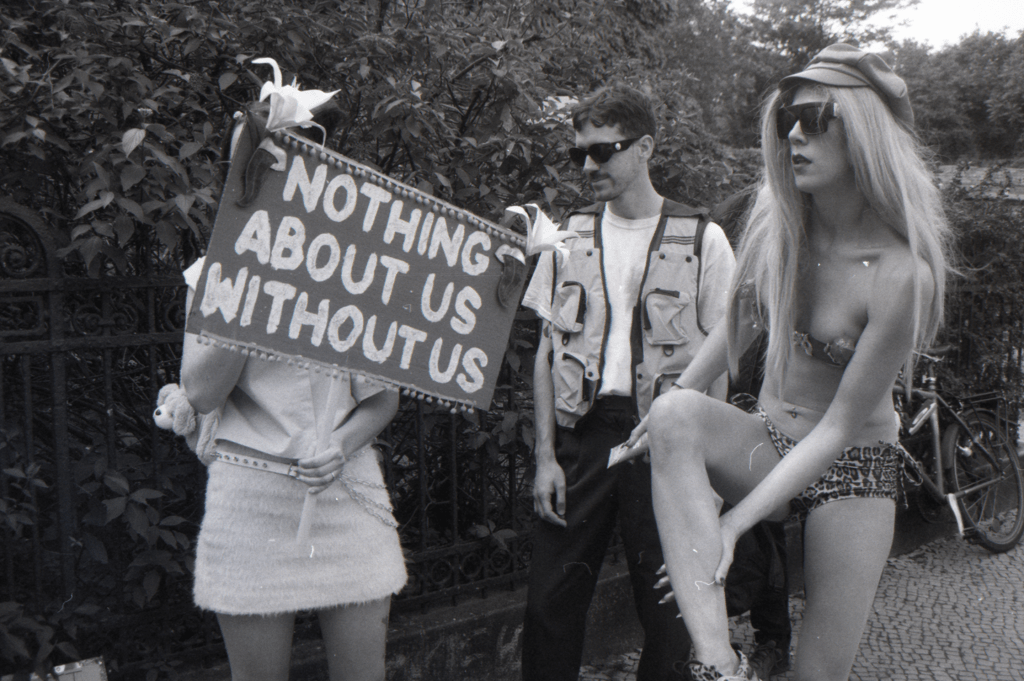
Chants erupted from the crowd, calling to dismantle the Prostituiertenschutzgesetze, which came into effect in Germany in 2017. The Netherlands and Germany utilise the legal model of regulationism, also known as legalisation or licensing, when it comes to sex work. This legal model severely restricts the parts of the sex industry it classifies as legal. However, if sex workers are unable or unwilling to adhere to numerous administrative requirements, including official registration as a sex worker, employment in specific establishments, or mandatory health tests, their work is deemed illegal (176).
Instead of dismantling existing laws, legalisation entails the creation of additional laws focusing on restrictions and penalties of sex work (176). Usually, changes in legislation regarding sexual labour are made without consulting the workers themselves. Based on the global map by NSWP, the Global Network of Sex Work Projects, there are only a handful of places in the world where sex work is decriminalised, including Belgium and parts of Australia (NSWP).
Across the world, there is a great diversity of oppression sex workers have and continue to face. The German government not only provides dire examples of exploitation and extermination during the Nazi Regime, but demonstrates continued ignorance through the passing of the Prostitutes Protection Act in 2017. History demonstrates that, despite the claims of policymakers to the contrary, the main objective of criminalisation and regulating laws has not been to protect sex workers but rather to protect society from them, by exerting control over sex workers through legislation at the expense of sex workers’ safety (Diego 57). Smith and Mac identify the roots of this oppressive political discourse and policy making as follows:
“This is, in part, because a mindset that advocates for legalizing sex work tends to see prostitutes not as workers but as anxiety-inducing vectors of disease or symbols of disorder who must be controlled” (Smith 176).
This systemic silencing of sex workers’ voices is also reflected in the public discourse, which is dominated by strong feelings and opinions that are not backed up by data (Schwules Museum Berlin). Opinions regarding sex work are divided within feminism. There is a danger to infantilise and silence sex workers even when the original goal of feminism as I understand it was equity for all. A person’s autonomy over their body should never be up for debate. The work one does, regardless of the reasons for it, should not be grounds for restriction of their rights and access in all aspects of life. Historically, this affected sex workers’ mobility within the city, their autonomy over their own bodies within healthcare and their living conditions. Violating the rules could result in forced labour, fines or imprisonment (Diego 56). The narrative was and remains clear: it was the responsibility of the government to protect its society from the dangers associated with sex workers by segregating and controlling them. This also included the restriction of movement throughout cities, such as Berlin, where at the beginning of the 20th century, sex workers were barred from certain streets and squares across the city. Theatres, zoos and museums were also off limits (56).
It is more important than ever to listen to sex workers, take them seriously, stand with them and support their struggle for human rights and safer working conditions. International Whores’ Day is thus not only a day for commemoration and celebration but a day of formidable protest. Regardless of the type of labour, you should be able to carry out your work in safety and under your own volition. I know where I will be on the 2nd of June next year, where will you be?
Nanette Ashby is currently pursuing a Research Master’s in Art and Visual Culture at Radboud University. She holds a Master in Museum Studies from Leiden University. Her academic interests span across the intersections of gender, sexuality, sex work and disability in arts and culture. She specialises in the curation and archiving processes of marginalised communities, specifically of the queer and sex worker community. Her research investigates how heritage institutions can support human rights struggles of minority groups through curating with care.
References:
Ashby, Nanette. “Objects of Desire: Curating and Archiving Sex Work with Rori Dior – Culturally Curious Ep.9” Raffia Magazine, 23 April 2025. Accessed 23 July 2025. https://raffia-magazine.com/2025/04/https://raffia-magazine.com/2025/04/23/objects-of-desire-curating-and-archiving-sex-work-with-rori-dior-culturally-curious-ep-9/
Berg, Heather. “Working for Love, Loving for Work: Discourses of Labor in Feminist Sex-Work Activism.” Feminist Studies, Vol. 40, No.3 (2014): 693-721.
Diego, Gómez, Jennifer Christy, Rori Dior, Valentin Rion, and Collin Klugbauer. With Legs Wide Open – A Whore’s Ride Through History. Berlin: Self-published, 2024.
NSWP, Global Network of Sex Work Projects. Global Mapping of Sex Work Laws. Accessed 15 June 2026. https://www.nswp.org/sex-work-laws-map
Schwules Museum Berlin “With Legs Wide Open – A Whore’s Ride through History.” Schwules Museum Berlin. Accessed 5 June 2025. https://www.schwulesmuseum.de/ausstellung/with-legs-wide-open-a-whores-ride-through-history/?lang=en
Smith, Molly, and Juno Mac. Revolting Prostitutes – The Fight for Sex Workers’ Rights. London, UK: Verso, 2020.
Stern, Scott W. “The Forgotten Role of Sex Workers at Stonewall.” Time, 27 June 2019. Accessed 15 July 2025. https://time.com/5604224/stonewall-lgbt-sex-worker-history/

 Raffia