
by Sadaf Javed
With the global rise in authoritarianism, civil liberties across democracies are taking a hit. While most democratic governments have historically tried to suppress dissent or systemic change, the threshold of the state’s tolerance to criticism has significantly lowered in the last decades. India was once heralded as the world’s largest democracy. This title has both motivated and challenged the ruling governments in the past, who usually reserved their undemocratic practices for the dark of the night. However, since the rise of the Bhartiya Janta Party (BJP), an ultra-right political party, in 2014, India has experienced a systematic erosion of democratic ideals and deconsolidation of its institutions in broad daylight, commonly via an outstanding use of legal loopholes and weaknesses in the constitution (Vaishnav 2025). Brahminical-Hindutva, a form of religious nationalism grounded in caste-supremacist political ideologies (Bala et al. 2025), is replacing constitutional ideals and foundations of liberal democracy. Under such a system, oversight by citizens—a constitutive element of a liberal democracy—becomes not only difficult, but also dangerous. The fractures within the population are also apparent. On one hand are those with an almost fanatical trust in the government, who therefore lose the ability to hold it accountable, and on the other are those deeply distrustful of the government, who are incarcerated for demanding accountability from it. In both cases, active citizens, those who question/distrust government actions and motives, are lost to undemocratic ideologies and policies of the ruling government.
In this essay, I frame India’s prisoners’ resistance, taking BK-16 as the case study, within Rosanvallon’s counter-democratic framework (Rosanvallon and Goldhammer 2008) and argue that counter-democracy and the characteristics of the vigilant citizen envisioned by Rosanvallon’s need to be revisited and revised if they are to remain relevant in the growing tide of imperialism and authoritarianism. Rosanvallon claimed vigilance, criticism, and judgement of the government to be fundamental pillars of liberal democracies. Consequently, his ideal citizens are those who constantly watch the government, forming a counter-democratic force that keeps a check on those in power thereby strengthening the democracy. In short, counter-democratic powers exercised by the citizens helps in maintaining a balance of powers in a liberal democracy and prevent it from becoming autocratic.
One of the major obstacles to India’s descent into fascism is the civil society—the aggregate of active citizens and non-governmental organisations—that questions and resists the suppression of their constitutional rights. Hence, one of the main goals of the BJP government has been to dismantle civil society. This has manifested itself in the increased targeting of journalists, activists, artists, and anyone else critical of the government and its policies (Khan 2026, Ahmed 2024). Social boycott, intimidation, and harassment by state authorities have become commonplace. Incarceration of activists, journalists, artists, and academics has made prisons some of the most intellectually rich and politically active spaces in the country. However, the government is not satisfied with mere imprisonment of the citizens who question it. It has also focused on systematically corroding the solidarity with those deemed an enemy of the state. This fracturing of solidarity networks is aimed to discourage the public from resisting the trampling of their constitutional rights, while further isolating those who stand up (Recchia and Vijayan 2023, Sharma 2025).
On 31st of December, 2017, in Pune, India, the Elgar Parishad convened. It was an event where about 260 organizations representing diverse parts of the civil society gathered to discuss the growing right-wing Hindu nationalism and strategize on how to best counter it. The next day was the 200th anniversary of the battle of Koregaon, which was fought between the Dalit community and the dominant caste Peshwai who ruled the region. The anniversary commemorated the 49 Dalits who died in battle. Some of those present at Elgar Parishad the day before joined the commemoration along with thousands of people from the Dalit community in a display of intersectional solidarity. But during the ceremony, violence broke out between the Dalit community and Hindutva groups, who claimed that the former gave incendiary speeches during the event. A later investigation revealed that the violence was orchestrated and initiated by the Hindutva groups. However, hundreds of Dalits along with sixteen Elgar Parishad participants were arrested in a case which came to be known as BK-16. The participants of Elgar Parishad pledged “that we will protect the Constitution and democracy. … We will not support those who speak against the Constitution or oppose the Constitution. We will never vote for opponents of the Constitution, the RSS (Rashtriya Swayamsevak Sangh), and BJP,” (Recchia and Vijayan 2023). Ironically, the Parishad was labelled as an anti-national gathering and the BK-16 were later accused of being part of a conspiracy to kill the Prime Minister Narendra Modi. As of March 2026, one of the BK-16, Surendra Gadling, still remains in jail after almost a decade. Father Stan Swamy died in custody and the other fourteen activists are out on bail but face severe restrictions by the carceral state (Shah 2024). Needless to say, the Hindutva groups walked away unscathed.
The BK-16 is an exemplary example of the extent to which the Indian government is willing to suppress dissent and uproot intersectional solidarity—the greatest threat to the homogenising identity politics of the far-right (Mudde 2019)—and of how civil liberties have been eroded and institutions emptied of anyone but the ideological foot soldiers of the regime (Recchia and Vijayan 2023). From planting false evidence, illegal raids, hacking of personal devices, to repeated denial of bail pleas and medical neglect, the government has left no stone unturned and used its considerable imagination and might to build a case against the BK-16 as a lesson to all those who try to question its policies (Recchia and Vijayan 2023, Shah 2024).
While prison is no doubt a harsh place, incarceration of watchful and active citizens has transformed prisons into places of resistance and learning. Political prisoners—those convicted of thoughtcrime, whose existence questions the very essence of liberal democracies—build new communities within and beyond the prisons. According to the accounts of BK-16, living in the harsh conditions of prison instils a sense of communitarianism among the inmates, where reaching out to others becomes easier (Recchia and Vijayan 2023). Prisons are rife with small gestures of care and kindness which build solidarity that reaches beyond them. The diverse community of Indian political prisoners shares a belief in constitutional values and equality. The imprisoned lawyers assist other inmates with their legal troubles, the educators teach, and political discussions are open to anyone willing to learn. As the inmates shuffle in and out of prison, the network expands further. Many released inmates connect with the families and loved ones of those in prison and mobilise to keep their memory and their work alive. As cliché as it sounds, in prison, change happens one person at a time.
Prisons have historically served as places where active resistance takes shape when other spaces to exercise civil liberties diminish. During the emergency years of 1975-77 in India, with mass arrests of student union and opposition leaders, prisons became a crucial site for organising resistance (Plys 2020). Student leaders organised and worked out the details of protests and direct actions from within the prison, where coalitions between left and right-leaning student unions formed and worked to mount pressure on Indira Gandhi’s government. The network of trade and student unions then communicated the plans and coordinated nationwide activities against the government.
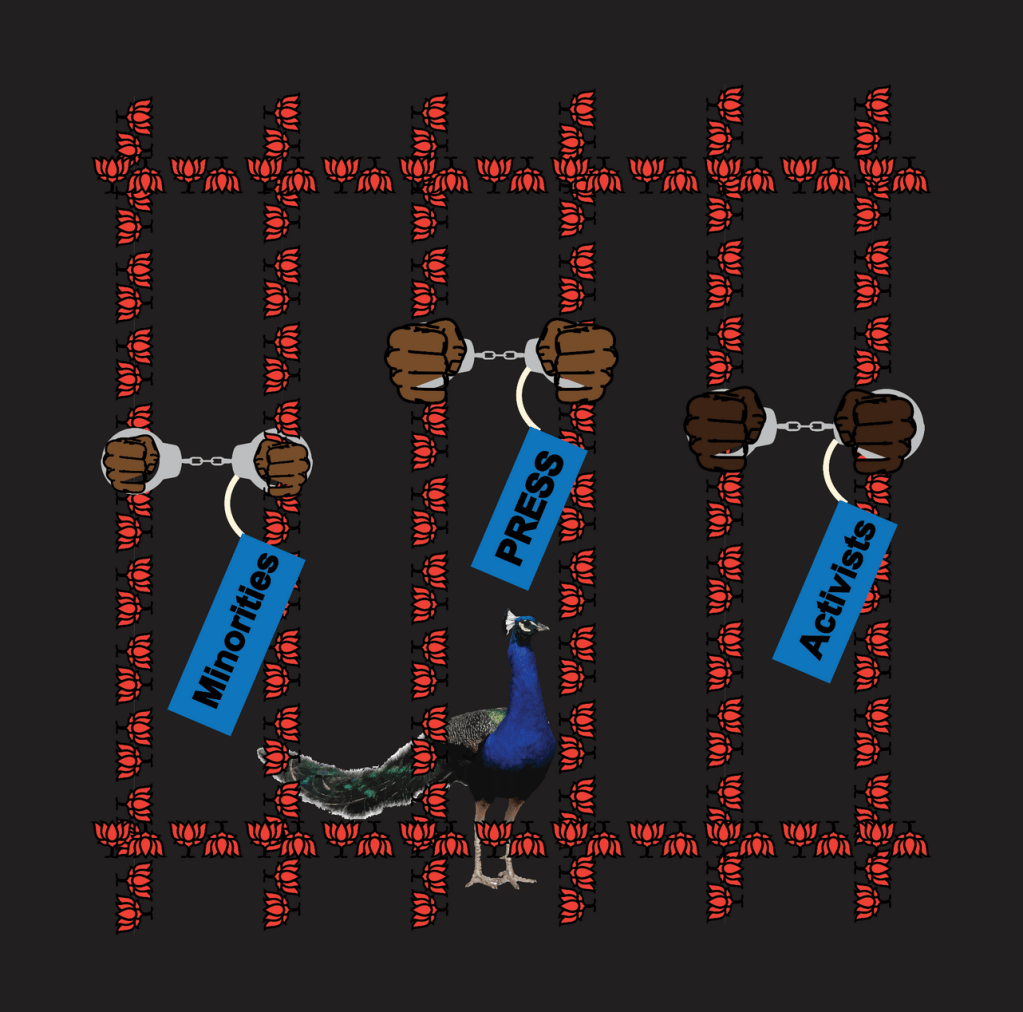
When a democracy experiences substantial erosion of the power vested in the people, incarceration of those who attempt to uphold their civil liberties becomes inevitable (Slipowitz and Lolj 2024). But if imprisonment of the torch-bearers of democracy would mean the death of democracy, then there is little preventing states inclined to autocratization to restrain themselves from filling up the prisons. However, while surveillance and abuses of power might temporarily scare people into silence, they rarely succeed in completely demolishing resistance to oppression. There are always cracks from which the light can filter through. Works of political prisoners have gone down in history as one of the sharpest and clearest critiques of the systems they lived in. The refusal to dissolve their identities and principles becomes their main form of resistance. The BK-16 diaries offer a collection of poems, essays, and articles written by the sixteen political prisoners and compiled by the Polis project (Polis Project 2021). ‘A caged bird can still sing,’ written by Father Stan Swamy, one of the BK-16 who died in prison due to medical neglect, has become a song of resistance for citizens pushing against the attack on democracy by the Modi government (Recchia and Vijayan 2023).
Rosanvallon’s vision of a vigilant citizen (Rosanvallon and Goldhammer 2008), who informs public opinion and the framework within which the government acts, has become difficult and dangerous in most states that call themselves democracies. As counter-democratic measures rely heavily on the civil liberties of the people, with the decline of the latter, the space for the former also shrinks. Moreover, no two flawed or hybrid democracies are the same, which requires one to assess the best counter-democratic strategies to use based on the material conditions around them. In the near future, it might become necessary to revolutionise counter-democratic means. As democracies weaken, acts aimed at sustaining democracy and exercising civil liberties may appear increasingly radical. While Rosanvallon’s idea of counter-democracy is set in less-than-ideal conditions, it appears increasingly idealistic given the current times.
One can argue that Rosanvallon’s theories of counter-democracy are still relevant for relatively good democracies, such as those deemed ‘Free’ according to Freedom House—a non-profit known for political advocacy on issues related to democracy, political freedom, and human rights (Freedom House 2025). One can also argue that as long as civil liberties are protected and people remain alert, like they are in good democracies, they can hold their governments accountable. However, even in the ‘Free’ countries, police repression of protests and other forms of dissent has become increasingly violent. The measures taken against dissenters and rebels often depend more on the point of critique rather than the freedom score of the country, as evident in many recent cases of anti-imperialist, anti-capitalist, and climate protests in the West (OHCHR 2025, du Teilleul 2025, Amnesty International 2026). Therefore, we see a selectivity in what actions of the government can be criticised and what are beyond the pale of accountability. The list is determined by the state, and citizens pushing its boundaries face repercussions. Moreover, with the deliberate weakening of unions, growing wealth inequality, and the constant pressure to keep up with the increasing costs of living, the active citizen has been conditioned or forced to depoliticise their existence and focus on maintaining the fickle stability of their life in this era of growing uncertainties (Madden 2022). This means that mobilising to exercise the preventive power of the public is becoming more difficult even in close-to-ideal democracies. The situation is direr in present-day flawed and hybrid democracies. But, as shown in the case of BK-16, counter-democracy can occur as long as there is a democracy, even one in severe decline. To include such regions within the counter-democratic framework, we need to make it more inclusive with localized definitions of what is counter-democratic, as solutions to democratic failures and decline cannot be one-size-fits-all. As we can see from the various examples of selective repression, there is no liberal democracy that is even close to ideal. They only appear so because the governments oppress the vulnerable and alienated communities, whether within or beyond their borders, and/or the citizens are convinced to stay within the permissible topics for critique.
Rosanvallon’s idea of radicalised counter-democracy is restricted to populism, something BJP and its various vigilante groups fall under. However, populism, if it does it at all, only represents one manner of what he calls the extreme form of counter-democracy. The growing uncertainties in the late-stage capitalist world render populist ideas appealing to those who cannot afford the time and energy required for critical analysis of their material conditions. Yet the radicalisation of counter-democratic powers can also give rise to an ‘evolved’ active citizen who is better equipped at countering the democratic decline. While resistance of political prisoners might be somewhere between counter-democratic and revolutionary, current definitions of counter-democracy completely exclude the struggles of indigenous people who are and have been in a constant struggle for their right to dignified existence in India and elsewhere. Strategies and their guiding theories must continue to evolve with changing conditions if they are to remain relevant. As measures to protect and strengthen democratic ideals seem increasingly radical, it is imperative that we learn from the experiences of those who have been systematically alienated from the so-called democratic societies in order to evolve into citizens prepared to resist the democratic backsliding with a well-equipped toolbox of strategies. In a revised, context-dependent counter-democratic framework, the active citizens will include the political prisoners, tribal resistance groups, and Dalit revolutionaries considered too radical in their demands for justice and equity.
As of now, the tide of populism and illiberal politics seems to be drowning the counter-democratic forces in India. There is a lesson for those of us who wish to fight against this tide. We face increasingly powerful and wealthy ‘elites’ and the interference of the big corporations and lobbies in governance only grows. Our society is divided by patriarchy and archaic rules and prejudices. The rapidly growing middle-class does so on the backs of the lower classes. We must speak up to power and acknowledge and empathise with the suffering of the marginalized as ignoring or denying these facts only alienates the masses and increases their sense of powerlessness, which can result in acts of desperation. One of populism’s biggest attractions is that it makes the masses feel understood when it addresses their suspicions (Mudde 2019). It creates an illusion of transparency while making politics more opaque and catering to power. The only way to counter this farce of populism is to acknowledge the true causes behind the public’s distrust and dissatisfaction and expanding, if not revolutionising, the arena of counter-democratic practices in a context-dependent manner.
Sadaf Javed is currently doing a PhD in physical-organic chemistry while studying philosophy and politics at Radboud University. She is interested in politics and how ideologies develop and their role in shaping societies, especially the world-building narratives that determine public perspectives on colonialism, capitalism, and imperialism and their effects on people and the planet.
References
Ahmed, Safa. 2024. “Release India’s Political Prisoners.” Jacobin. March 7, 2024. https://jacobin.com/2024/07/india-political-prisoners-modi-bjp.
Amnesty International. 2026. “Freedom of Expression Is Highly Selective.” Amnesty International. Amnesty International. https://cdn.amnesty.at/media/hytprvly/amnesty-bericht_austria_freedom-of-expression-is-highly-selective.pdf.
Bala, Sruti, Laila Kadiwal, Ashok Kumbamu, and Aninthitha Nath. 2025. “Ideas behind Bars: The Carceral State and Struggles for Academic Freedom in India.” Globalisation Societies and Education, April, 1–19. https://doi.org/10.1080/14767724.2025.2482230.
“BK-16 Prison Diaries – the Polis Project.” 2021. The Polis Project. The Polis Project. 2021. https://thepolisproject.com/read-category/bk-16-prison-diaries/.
Freedom House. 2025. ‘Freedom House’, Freedomhouse.org https://freedomhouse.org/
Khan, Saher Hiba. 2026. “Incarceration as Politics: A Timeline of Political Prisoners in Independent India.” Outlook India. January 23, 2026. https://www.outlookindia.com/national/incarceration-as-politics-a-timeline-of-political-prisoners-in-independent-india.
Madden, David. 2022. “Tired City: On the Politics of Urban Exhaustion.” City 26 (4): 559–61. https://doi.org/10.1080/13604813.2022.2084264.
Mudde, Cas. 2019. The Far Right Today. Cambridge: Polity Press.
OHCHR. 2025. “UN Experts Urge Germany to Halt Criminalisation and Police Violence against Palestinian Solidarity Activism.” The Office of the High Commissioner for Human Rights. October 16, 2025. https://www.ohchr.org/en/press-releases/2025/10/un-experts-urge-germany-halt-criminalisation-and-police-violence-against.
Plys, Kristin. 2020. “Spaces of Resistance: From Indian Coffee House to Tihar Jail.” Jamhoor. October 21, 2020. https://www.jamhoor.org/read/2020/10/21/spaces-of-resistance-from-indian-coffee-house-to-tihar-jail.
Recchia, Francesca, and Suchitra Vijayan. 2023. How Long Can the Moon Be Caged? Pluto Press.
Rosanvallon, Pierre, and Arthur Goldhammer. 2008. Counter-Democracy. Cambridge University Press.
Shah, Alpa. 2024. The Incarcerations. Harper Collins UK.
Sharma, Ashutosh. 2025. “India’s Undeclared Emergency: Political Prisoners and the Battle for Democracy (2025).” Frontline. October 27, 2025. https://frontline.thehindu.com/news/india-political-prisoners-democracy/article70207708.ece
Slipowitz, Amy, and Mina Lolj. 2024. “Visible and Invisible Bars.” Freedom House. https://freedomhouse.org/report/free-them-all/2024/visible-and-invisible-bars.
Teilleul, Flore du. 2025. “Silencing Dissent: The Crackdown on Peaceful Protest in Europe | Liberties EU.” Liberties. April 10, 2025. https://www.liberties.eu/en/stories/rule-of-law-2025-protests/45384.
Vaishnav, Milan. 2025. “Backsliding in India? The Weakening of Referee Institutions.” In Global Challenges to Democracy, edited by Valerie J. Bunce, Thomas B. Pepinsky, Rachel Beatty Riedl, and Kenneth M. Roberts. Cambridge University Press. https://www.cambridge.org/core/books/global-challenges-to-democracy/C50D0AC769FF0AA2C62DA9337F2C03E6.


