
by Júlia Vicente
I have these really cute brown boots.
The girl in the magazine has black boots.
Hers look newer, sharper. Mine are just fine,
but suddenly, I start to mind.
I scroll, I see, I want, I buy.
The thrill lasts hours. The waste, a lifetime.
Closets grow heavy with almosts and maybes,
while landfills bloom with forgotten maybes.
I wonder when “enough” stopped feeling enough.
When fabric turned to fleeting love.
This article may be, in part, hypocritical on my side. Because yes: I shop at Zara, I shop at Primark, and sometimes I buy things I do not need. But I also want to do it less, stop doing it altogether or at least become more aware of when I do it and why.
So, if you have ever felt guilty for overconsumption, I invite you to read this article. Not to judge ourselves, but to try to learn together how to consume less and take more responsibility. And to keep dressing well (don’t worry).
This reflection does not come from nowhere. I write from Barcelona, where the Sustainable Challenge 2025 debate took place in November at the Disseny Hub under the theme “Collective Mending.” At this event, the need to rethink fashion through repair, care, and shared responsibility was brought to the table. Looking at this issue from a female and feminist perspective is not accidental. Historically, fashion has been aimed at women, and tasks such as sewing and repairing have long been considered ‘socially expected’ skills for them. In turn, caring has been treated not as a task, but as a role that women are simply expected to fulfil. This role is so naturalised that it has gone largely unnoticed and undervalued.
A few years ago, Tamara Merino’s image of the Atacama Desert in Chile covered in tons of clothing went viral around the world. Bright dresses, logo sweatshirts, and jeans of every kind piled up under the Atacama sun, as if the planet had decided to throw up everything we had bought without thinking.
These mountains of clothing are just the most visible consequence of a system that feeds on a constant desire for novelty. Social media, especially TikTok, has turned clothing consumption into a spectacle: hauls (videos where influencers show off bags full of new pieces) rack up millions of views. Every purchase is seen as a way to express yourself, a temporary identity that can change every week.
The sector is responsible for between 2% and 8% of global CO₂ emissions, according to UNEP, and, according to National Geographic, an estimated three-fifths of all clothing ends up in landfills or incinerators within a year of production.According to the UN, every second the equivalent of a garbage truck full of clothes is incinerated or sent to a landfill. Fast fashion thus accelerates the environmental catastrophe that often remains out of sight.
The first major debates about sustainability in the textile industry emerged in the 1990s, when news of child labor in suppliers for brands like Nike reached the West. From that moment forward, NGOs such as Greenpeace and the Clean Clothes Campaign began demanding more responsible business practices. Talking about sustainability no longer meant just reducing waste, but taking into account the entire product life cycle: sourcing materials, production processes, design, consumption habits, and, finally, the disposal of garments.
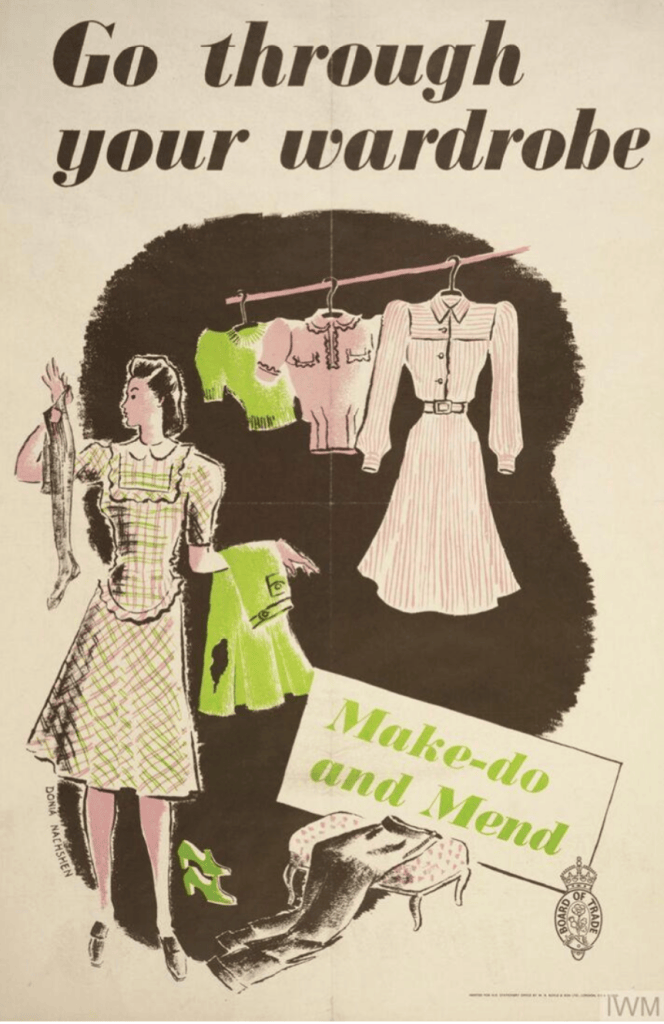
Faced with this scenario, more and more voices are calling for a silent revolution: the revolution of repair. Experts estimate that doubling the lifespan of clothing could reduce greenhouse gas emissions by 44%. Repairing today is a political act. Sewing a hem, fixing a hole, or giving a shirt new life is not just a domestic chore, it’s a way to resist the fast pace of fast fashion.
For decades, these tasks have been associated with women’s labour and an invisible care that sustains everyday life. Reclaiming them through design or art is also a form of feminist appropriation: repair as a symbol of resistance, care and community.
This idea inspires movements around the world. From small mending workshops in Amsterdam to initiatives like the FAD Sustainable Challenge in Barcelona, young designers and fashion students are experimenting with new materials and circularity processes. It’s not just about recycling, but about radically changing how we understand clothing.
In its seventh edition, the Sustainable Challenge 2025, under the title Collective Mending, proposes precisely this shift in perspective. In the context of a creation marathon, thirty students from schools across Europe work together to explore the creative possibilities of repairing, mending, and patching clothing, centering on a single discarded garment. Organized by the Barcelona City Council and the Disseny Hub Barcelona, with the collaboration of the Embassy of the Netherlands and the British Council, the project presents repair not as a temporary solution, but as a story that can be rewritten.
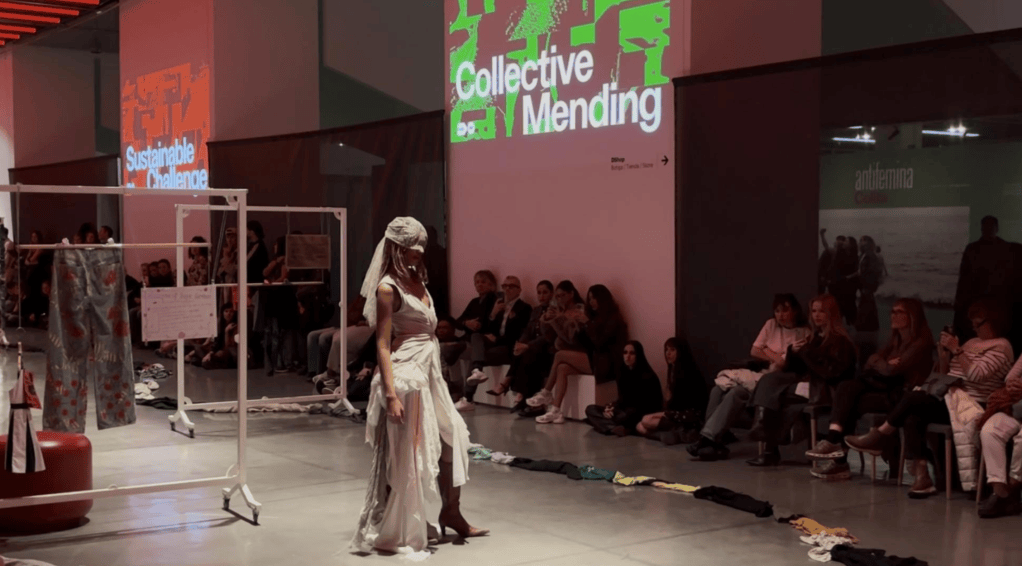
Some of the proposals reinterpreted repair through cultural respect and handiwork, like Shuri, a studio that transforms second-hand pieces into new silhouettes inspired by kimono draping, integrating traditional Japanese techniques like boro and sashiko with contemporary processes. Others emphasized the emotional bond with clothing, such as Healed by Yarn, which only repairs wool pieces laden with memories, turning each intervention into an act of memory preservation.
There were also proposals centered on specific materials, such as denim, which is reworked and patched to create new pieces without erasing its imperfections. Others opted for an optimistic, expressive repair, like Glimpse of Hope, which transforms broken pieces into outfits full of color and symbolism, prioritizing natural fibers and reclaiming clothing as a space for play, joy, and connection with nature.
Some projects even questioned the very idea of “fixing.” Intrusive Thoughts proposes not hiding or correcting the marks of time, but rather using techniques like quilting, embroidery, or graphics to turn clothing into a channel for expressing one’s most intimate thoughts. And initiatives like Motion bring repair into the realm of volume and movement: through draping, they alter the shapes of garments and amplify the damage instead of hiding it, letting the clothes speak for themselves.
These proposals show that repairing is not looking back, but imagining possible futures. A future where fashion is not measured by constant novelty, but by the ability to transform and give meaning to what already exists.
Meanwhile, the industry is trying to adapt. Brands like Patagonia and Stella McCartney promote repair and reuse programs, but they coexist with fast fashion giants that launch new collections every two weeks. This contradiction raises a key question: can an industry based on constant consumption truly be sustainable?
Young people seem to be clear that something has to change. In Europe, second-hand platforms like Vinted and Depop are growing, and more and more people prefer to buy less and better. Even so, the impact of hauls and viral trends remains enormous. The pressure to show a new version of yourself every week, a bit more trendy and aesthetic, falls especially on women.
That’s why talking about sustainable fashion is also about feminism. It means questioning a system that turns the female body into a display window and the workers of the Global South into depersonalized labor. It means valuing creativity and repair as acts of freedom. And, perhaps, also reconciling ourselves with the pieces we already have.
As British designer Amy Twigger Holroyd wrote, “sewing is a way of inhabiting the world.” Every stitch is a way of saying enough: enough of overproduction, enough of dependency, enough of exploited bodies and manipulated desires. Fashion can once again be a tool of expression and not oppression, if we are able to unravel the thread and reweave it with consciousness.
In the end, perhaps the future of fashion is less about buying less and more about loving more. Loving the pieces more, the hands that make them, the bodies that wear them and the planet that sustains them.
I still have those brown boots.
They are not the newest, not the sharpest, not the ones the algorithm would choose for me. They carry small scratches, softened leather, the memory of rainy days and long walks. But now, when I look at them, I see something else. I see time, care, and choice.
Maybe the future of fashion starts with asking ourselves why we want what we want, and what we already have waiting in our wardrobes. Repairing a garment does not make it less valuable; it makes it more ours. It turns clothing into something lived, not consumed.
In a world that constantly pushes us to replace, choosing to mend is a quiet form of resistance. A feminist one. One that values care over novelty and connection over accumulation. Perhaps “enough” stopped feeling like enough when we forgot how to stay with things.
So no, this is not about never buying again or dressing badly. It is about learning to love our clothes a little longer, a little deeper. Because in the end, the most radical thing we can do in an overfilled wardrobe is to not add more.
Júlia Vicenti has just finished her Journalism degree at the University Autonoma of Barcelona, her home city. She has completed internships at the National Radio of Spain, as well as at cultural and design foundations and magazines, where she wrote about current affairs. She has a particular interest in culture, arts and cinema, fashion, feminism, social rights and travelling.
References:
Bartlett, J. (2024). National Geographic. (2022). Chile’s fashion pollution problem.
https://www.nationalgeographic.com/environment/article/chile-fashion-pollution
Iverraeco. (s. f.). The clothing graveyard: Inside the world’s largest fashion waste dump in Chile’s Atacama Desert.
https://iverraeco.com/blogs/news/the-clothing-graveyard-inside-the-worlds-largest-fashion-waste-dump-in-chiles-atacama-desert
Carbon Literacy Project. (s. f.). Fast fashion’s carbon footprint.
https://carbonliteracy.com/fast-fashions-carbon-footprint/
Environment + Energy Leader. (2023). 85% of clothes discarded annually: A wake-up call for fashion’s waste crisis.
https://www.environmentenergyleader.com/stories/85-of-clothes-discarded-annually-a-wake-up-call-for-fashions-waste-crisis,60850
United Nations. (2025). Fast fashion and the environment.
https://news.un.org/en/story/2025/03/1161636
The Fashion Law. (2023). Visibility is central to a successful supply chain.
https://www.thefashionlaw.com/visibility-is-central-to-a-successful-supply-chain-heres-what-brands-need-to-know/
Sacred Ceremony. (2024). Sustainable fashion: 15 brands leading the eco-friendly revolution.
https://sacredceremony.co/en-es/blogs/fromthejournal/sustainable-fashion-15-brands-leading-the-eco-friendly-revolution
CFI. (2024). The booming second-hand economy: Platforms like Wallapop and Vinted transforming markets.
https://cfi.co/lifestyle/2024/12/the-booming-second-hand-economy-platforms-like-wallapop-and-vinted-transforming-markets/
Clean Clothes Campaign. (s. f.). Quiénes somos / qué hacemos.
https://cleanclothes.org/
Foment de les Arts i del Disseny (FAD). (2025). Sustainable Challenge.
https://www.fad.cat/es/projects/13333/sustainablechallenge
FAD. (2025). Collective Mending: Cap a un món centrat en la reparació.
https://www.fad.cat/es/agenda/13755/collective-mending-cap-a-un-mon-centrat-en-la-reparacio
FAD. (2025). Sustainable Challenge 25: La nova generació que transforma la moda a través de la reparació.
https://www.fad.cat/es/news/13879/sustainable-challenge-25-la-nova-generacio-que-transforma-la-moda-a-traves-de-la-reparacio
UNEP and UN Climate Change provide fashion communicators with practical guide to contribute to sustainable change. (2023, June 28). UN Environment Programme. https://www.unep.org/news-and-stories/press-release/unep-and-un-climate-change-provide-fashion-communicators-practical
The National Archives. (s. f.). Home Front 1939–1945: Make Do and Mend. https://www.nationalarchives.gov.uk/education/resources/home-front-1939-1945-part-two/make-do-and-mend


