
by Dagne Bagdonaviciute
Imagine being back in the Savoy Ballroom in 1930s Harlem, New York, nicknamed “home of Happy Feet” (Manning & Millman, 2007). Up to four thousand people packed the hall, mostly Black Americans alongside some white dancers, all moving together to the sound of a live jazz band. The music never stopped, and neither did the dancing. Lindy Hop, born right here on this dance floor, was more than entertainment; it was a form of expression, community, and joy for Black Americans living under the harsh realities of Jim Crow segregation.
Fast forward to a contemporary swing festival in Europe, and the picture looks strikingly different. The band is usually made up of white musicians, and the dance floor is overwhelmingly white. How did this Black American art form become a predominantly white global subculture, and can the community do anything to restore what was lost?
A black art from
Under Jim Crow laws, racial segregation dictated where Black Americans could eat, study, and socialize. Yet in the middle of Harlem, New York, the Savoy Ballroom offered something rare: a space where people danced together regardless of skin colour (Manning & Millman, 2007). It was here that Lindy Hop was born, notably the first African American dance to originate in the North, rather than migrating from the South to the North (Unruh, 2020). Its roots run deep into African dance traditions. The breakaway step, in which the distance between partners increases and one or both hands are released, allowing each dancer to move more freely, was a defining feature of Lindy Hop that rejected the rigid European tradition of couple dancing. Instead, it favoured solo improvisation, reflecting movement practices deeply rooted in African dance heritage (Unruh, 2020). This African influence is also visible in the dance’s hip movements (its orientation toward the ground rather than upright European posture) and the emphasis on improvisation and community (Unruh, 2020). Together, these characteristics connect Lindy Hop to a broader African cultural tradition.
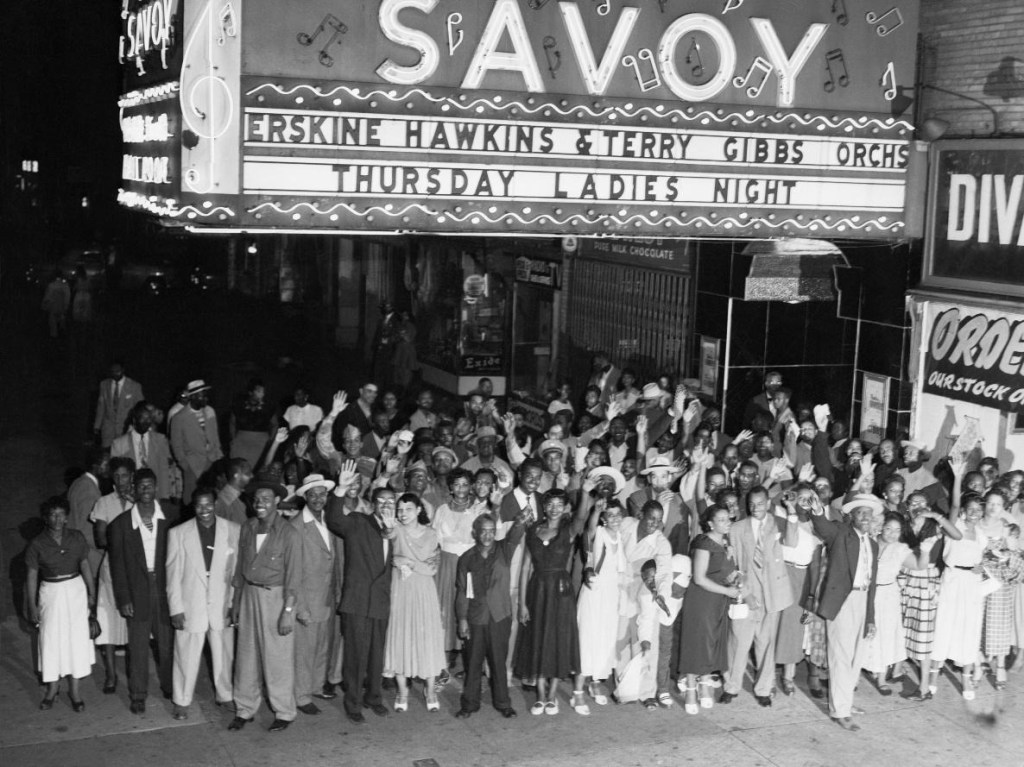
For Black working-class communities living under the weight of discrimination, Lindy Hop was more than entertainment. The Savoy Ballroom was one of the few integrated social spaces in New York at the time, a place where Black and white dancers shared the same floor, judged not by the colour of their skin but by the quality of their movement (Manning & Millman, 2007). As Frankie Manning, one of the dance’s founding figures, captured it:
”It was an extraordinary place. At the Savoy, it didn’t matter what color you were, black, white, green, yellow, or whatever. I don’t even remember noticing people’s skin color. The only thing they asked when you walked in was, “Can you dance?” They never looked at your face, only at your feet.” (Manning & Millman, 2007, p. 71)
This resonates with what hooks (1989) describes as the radical potential of marginal spaces: places that exist outside dominant structures and become sites of resistance, joy, and community-building. However, the Savoy Ballroom suggests something even more complex: a space in which the category of the “other” was temporarily suspended, where the usual dynamics between coloniser and colonised were momentarily disrupted through shared participation in a dance. The Savoy Ballroom was precisely such a space, and Lindy Hop was its most powerful expression, one of the few integrated social spaces in New York at the time where people could dance together (Manning & Millman, 2007). Here, value was not assigned by race but by movement, rhythm, and skill.
The dance floor became a space in which Black dancers could feel the dignity and humanity that the world outside refused to grant, what Unruh (2020) describes as a “spiritual antidote to oppression”, transforming participants, even if only for the duration of a song, into “jubilant spirits of freedom”.
From Black Dance Floor to White Mainstream
The growing popularity of Lindy Hop inevitably attracted commercial interest, and with commercialization came appropriation. As the dance spread through film, radio, and performance, white audiences became increasingly fascinated, yet the version of Lindy Hop they consumed was rapidly being stripped of its Black origins, including its musicianship and movement traditions (Crease, 1995). White dance teachers simplified the moves, removing the hip movements and triple steps that carried African American heritage, while jazz bands were gradually replaced by white musicians (Crease, 1995). What had once been an explicitly Black, working-class dance was rebranded as “America’s national dance”, showing an erasure of its origins and creators (Unruh, 2020).
Hollywood accelerated this process. Black dancers from Whitey’s Lindy Hoppers, who had originally brought the dance to the screen, were progressively replaced by white performers, and a smoother, more “respectable” Hollywood style became what audiences understood as the authentic Lindy Hop (Crease et al, 1995). This pattern, in which Black cultural forms are adopted, modified for white tastes, and then presented as universal, can be linked to what Quijano (2007) identifies as the coloniality of power: a system in which racial hierarchies persist beyond formal colonialism and continue to shape culture, knowledge, and representation.
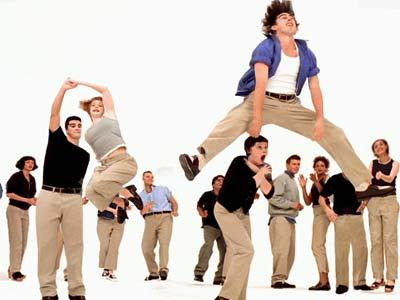
During the 1990s, swing revival completed this transformation. When the Gap’s “Khakis Swing” commercial aired in 1998, featuring exclusively white dancers, it helped frame lindy hop as a white dance (Unruh, 2020). As dancer Ryan Francois observed, these white-centred commercials transformed Black cultural expression, once perceived as threatening or aggressive, into something “safe” and accessible for mainstream audiences (Unruh, 2020).In this sense, Lindy Hop did not simply spread globally; it was transformed in ways that aligned with dominant white cultural norms, rendering its Black origins invisible, perhaps the clearest demonstration of the coloniality of power.
Disappointingly, when the Lindy Hop community is confronted with this history, the response has often been defensive. When Norma Miller, one of the original Lindy Hoppers, spoke openly about cultural appropriation at dance camps, she was dismissed as too intense and too political; her presence eventually became unwelcome at some of the events where people simply wanted to “have fun” (Unruh, 2020). This reaction is telling. It reflects what Hancock (2008) describes as a discourse of “blaming the victim,” in which the absence of Black dancers in contemporary Lindy Hop scenes is explained as a matter of personal choice or lack of interest, rather than the result of structural exclusion and historical erasure. By framing the problem as one of individual preference rather than power, the community avoids confronting an uncomfortable question: not why Black dancers are absent, but how a dance they created became a space in which they no longer felt welcome.
Reclaiming the Dance Floor
Yet the story does not end with erasure. Following the death of Frankie Manning in 2009, one of Lindy Hop’s founding figures, who dreamed of returning the dance to its community, a slow but growing consciousness began to emerge (Unruh, 2020). Festivals started hosting history talks, scholarship programmes were established to bring Black American dancers back into the scene, and voices from within the community began publicly naming what had been lost (Unruh, 2020).
And yet, why does the dance floor still look so white? Why do so many participants respond to these conversations with “but we just want to have fun”? It is worth pausing on this, since escape and joy were, after all, the original purpose of Lindy Hop for the Black working class who created it. However, there is a profound difference between dancing for freedom within oppression, and dancing without ever acknowledging the oppression at all. As Fanon (1952) argues, colonial domination works not only by erasing cultural origins but by producing an internalised sense of inferiority, in which the loss of one’s own cultural identity comes to be accepted as natural. The racial erasure of the swing revival was so thorough that many Black Americans no longer recognise Lindy Hop as part of their own history (Unruh, 2020). The dance was not just taken; the sense of ownership was erased alongside it.
The lived consequences of this are real. Armstrong (2023) documents the experiences of Black dancers who describe feeling unwelcome, being passed over for dances, and eventually leaving the scene altogether, driven out not by lack of interest, but by a community that had structurally shaped itself around white participation. This exclusion is not always obvious, but it is deeply felt by those it affects.
As a white dancer myself, I recognise this uncomfortably. The space I thought was safe and inclusive, a place of joy and connection, is, for many Black dancers, a space of exclusion and erasure of their own cultural heritage. For the first years of dancing, I knew Lindy Hop was a Black American dance, but little beyond that. I was naive about the conflict beneath the surface, and perhaps I still am, in some ways. Learning how much whiteness contributed to the erasure of this dance forces an uncomfortable question: how much am I, simply by participating, contributing to the same problem?
I do not think the answer is to walk away. Guilt and discomfort have a way of making people exit spaces rather than transform them, but I believe the only path toward change runs directly through those feelings, not around them. For me, that has meant recognising my own assumptions about who I choose to dance with, staying open to dancing with everyone, and genuinely listening when Black dancers share their experiences rather than retreating into defensiveness. It has meant sitting with the discomfort rather than resolving it too quickly.
Having danced for some years now, I have noticed a shift. When I started, there was little conversation about Black heritage at festivals. Today, more space is being given to Black dancers, teachers, and the origins of the dance. But is that enough?
There is a crucial difference between postcolonial acknowledgement, naming what was lost, and genuine decolonial action, which requires dismantling the structures that caused the loss in the first place (Bhambra, 2014). As dancer and educator LaTasha Barnes argues, reclamation means increasing visibility: putting Black faces on festival flyers, platforming Black teachers, and fundamentally changing who the dance visibly belongs to (Unruh, 2020). Reclaiming Lindy Hop is not a single moment; it is an ongoing, uncomfortable, and necessary process.
What Frankie Manning wanted, ultimately, was for the dance floor to be a space where only one thing mattered: can you dance? I believe that is still possible. But it starts with each of us, those who have benefited from the whitening of this space, being willing to show up differently. Only then can we create something new together, an open floor built by everyone, carrying that Savoy spirit forward.
References
Armstrong, G. (2023, April 6). Let’s talk about Lindy hop and blackness—Part 1. iLindy. https://ilindy.com/blog/lets-talk-lindy-hop-and-blackness/
Atlantic Lindy Hopper: Image. (n.d.). https://atlanticlindyhopper.wordpress.com/wp-content/uploads/2015/10/savoy-harlem-1952.jpg
Bhambra, G. K. (2014). Postcolonial and decolonial dialogues. Postcolonial Studies, 17(2), 115–121. https://doi.org/10.1080/13688790.2014.966414
Crease, R. P. (1995). Divine frivolity: Hollywood representations of the Lindy Hop, 1937–1942. In K. Gabbard (Ed.), Representing jazz (pp. 207–229). Duke University Press.
Duncan. (2020, August 4). Gap khakis in swing dance. Postkiwi. https://www.postkiwi.com/2005/gap-khakis/
Fanon, F. (1986). Black skin, white masks (C. L. Markmann, Trans.). Grove Press. (Original work published 1952)
Hancock, B. H. (2008). “Put a little color on that!” Sociological Perspectives, 51(4), 783–802. https://doi.org/10.1525/sop.2008.51.4.783
hooks, b. (1989). Choosing the margin as a space of radical openness. Framework: The Journal of Cinema and Media, (36), 15–23.
Manning, F., & Millman, C. R. (2007). Frankie Manning: Ambassador of Lindy Hop. Temple University Press.
Quijano, A. (2007). Coloniality and modernity/rationality. Cultural Studies, 21(2–3), 168–178. https://doi.org/10.1080/09502380601164353
Unruh, K. (2020). May we have this dance?: Cultural ownership of the Lindy Hop from the swing era to today. Atlantic Studies, 17(1), 40–64. https://doi.org/10.1080/14788810.2019.1698241
Dagne Bagdonaviciute is a Research Master’s student in Behavioural Science at Radboud University, where she explores the role of creativity in supporting people living with Parkinson’s disease, a field that has taught her how deeply movement is tied to identity and wellbeing. Outside the lab, she stumbled into Lindy Hop almost by accident, and never quite found her way out. What started as curiosity became an obsession, and then something more: a community, a home, and a reminder that art has a unique power to connect people to each other and to themselves, regardless of who they are or where they come from. Lindy Hop has been many things for her including joy, challenge, and at times, a lifeline for her mental health. It was precisely that love for the dance that made writing this article both necessary and uncomfortable.


