
by Noa de Kievit
Trigger warning. This review features a book that focuses on intimate partner violence. The review makes only brief and sparse references to the violent scenes (concerning both physical and verbal forms of abuse) depicted in the book. Especially compared to how heavily the book itself features them. Yet, if you are not in the right headspace to engage with such heavy subject matter, or if you would prefer to not be reminded of past experiences, please set this review aside—for now, or forever; do whatever feels right for you. In addition, should you need them, you can also find support services and helplines at the bottom of this page.
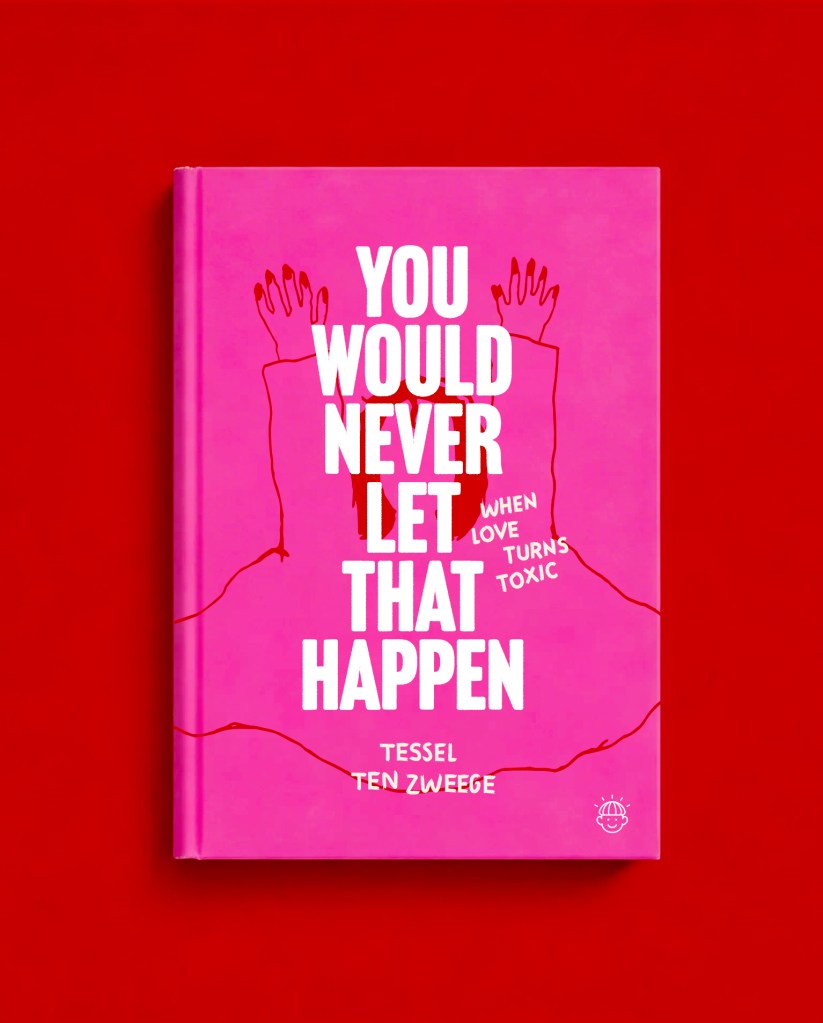
The Story: When the Promise of Love Turns Toxic
That being said, let’s start with discussing this incredibly important book. Tessel ten Zweege is a Dutch feminist writer, journalist, illustrator, and programme maker who recently published two books addressing two important topics: Femicide: Tot de dood ons scheidt (2023) en Lik (2026). Before this, she published her debut Dat zou jij nooit toelaten: als liefde giftig wordt in 2022 with De Geus. This November, her debut finally made its way to an English speaking audience as You Would Never Let That Happen, published by This is Us Books. And what a book this is…
‘‘Every ten minutes a woman is murdered by her (ex)partner or a family member. In the Netherlands, where I’m from, every ten days a woman is murdered by her (ex)partner’’ Tessel tells us in the book’s introduction (Ten Zweege 7).
Yet, following the sobering warning that opens the book, it initially strikes an optimistic note. It takes us back to Tessel’s transition from her parents’ home to her first small studio apartment in Amsterdam, where she begins her bachelor’s studies in what she describes as ‘‘a leftish English degree’’ (18). At this point in her life, as she puts it herself, she is someone gradually falling into ‘‘the habit of stumbling over [her] own big dreams’’ (Ten Zweege 18). As a young bisexual feminist who contributes to a feminist zine, she feels as though the world is at her feet. And, honestly, it seems to be: she has great friends, an enjoyable course of study, and an exhilarating sex life—for what could be more emancipatory than the latter, young Tessel wonders (Ten Zweege 19). Armed with a longing for ‘‘true love’’–modelled on the romance she witnessed in the endless series of chick flicks she used to watch with her family every Friday night–she sets out to explore the big city (Ten Zweege 13).
It is during a trip to London that Tessel’s search for romance takes an unexpected and undesirable turn. Feeling ‘‘just a little blue’’ (Ten Zweege 22), she and her friend Fien decide to embark on a ‘‘Gen-Z trip’’ to the English capital (Ten Zweege 24). There, they run into a British guy named Luis–and what follows gradually develops into a true nightmare. What begins as a fleeting romance between Tessel and Luis at the hostel where they are both staying, takes a more serious turn when Luis soon visits Tessel in Amsterdam. Upon his arrival, he casually mentions that he has found a job in the city and asks to–or rather assumes he can–stay at Tessel’s until he finds accommodation of his own (Ten Zweege 34).
This accommodation, however, does not seem to materialize anytime soon, and Tessel quickly finds herself entangled in an increasingly abusive relationship, characterized by persistent humiliation and psychological manipulation. Luis subjects her to a steady stream of insults, telling Tessel, among other things, that she is ‘‘disgusting, dumb, and childish’’ and that she should be grateful he is even with her, as no one else would want her (Ten Zweege 190), continuing to comment on everything about her; her looks, her walk, her dances. As Tessel describes it:
‘‘He knows exactly how to hurt me, as if he’s jotted down all my insecurities in a detailed list, rotating them all in his wheel of insults so that I’m constantly reminded of every single one’’ (Ten Zweege 209).
As if this situation was not harmful enough, Luis starts to notice that his cruel words no longer even cause Tessel pain, as he has damaged her so severely on a mental level, the abuse starts to extend far beyond verbal humiliation. It is only a matter of time before he begins to socially isolate her, physically abuse her, and eventually rapes and threatens her. There are, at times, moments that seem to offer some prospect of change. On one occasion, Luis ‘‘trauma-dumps’’ on Tessel, revealing that his behavior stems from a childhood trauma–though he acknowledges that this is no excuse to behave as he does (Ten Zweege 131). Nevertheless, despite Tessel’s persistent hope, the relationship does not improve–it only deteriorates.
When Feminism Meets Lived Experience
What makes Tessel’s situation particularly difficult to handle for her is that the terminology available proves inadequate: the term ‘‘domestic abuse,’’ with which she is familiar, does not quite fit her situation, since she and Luis are neither officially living together nor in an established relationship. Furthermore, she does not initially experience the abuse as something that is simply ‘‘happening’’ to her. That is, if she were to acknowledge that Luis’ actions indeed fall under the category of violence–instead of something that she brought upon herself–this might imply something about her own identity as well. She even fears that ‘‘letting it all happen,’’ would make her a ‘‘fake feminist’’ (Ten Zweege 204). As she reflects, ‘‘It was hard for me to believe that I, a feminist author, student and all-round baddie, could let myself be treated that way’’ (Ten Zweege 6). After all, usually, she is not reluctant to speak out against gender-based violence.

This perceived contradiction between her feminist convictions and her own experience of abuse makes it difficult for her to recognize and articulate what is happening. Nor does she feel immediately understood by all her friends–some of whom explicitly tell her ‘‘You would never let that happen, of course’’ (Ten Zweege 214)–fearing that she might disappoint them or even cause them pain. Fortunately, Tessel comes to realize herself, over the course of the book, that, of course, she is not a fake feminist because of what happened to her. In fact, writing this book may be one of the most powerful things she could have done: creating comparative material for everyone going through similar situations, while informing readers–also those who are less familiar with the subject matter–about the underlying structures of it, as well as possible ways out.
It is exactly for this reason, to be honest, that the book is a terribly difficult one to review. Anyone trained in literary or cultural analysis–like Tessel herself, so the book teaches us–knows that a review should contribute something new: advance an argument, offer a fresh perspective, or otherwise add to the conversation surrounding the work. Yet Tessel seems to have already done all of this herself beautifully, neatly contained between the covers of her book. That is, although Tessel is careful to emphasize that she writes from her own perspective, and that the book should thus not be understood as an encyclopaedia of all toxic relationships out there (Ten Zweege 10), she nevertheless manages to capture a small part of the world in these pages in its heartbreaking totality. By supplementing her personal narrative with ‘‘dictionary-style’’ definitions of key themes and terms highlighted in the book—such as love bombing, gaslighting, social isolation, intersectionality, etc.—as well as ‘‘the story of…’’ segments that bring to light the personal experiences of others, all accompanied by relevant statistics and facts, she has created a truly comprehensive work on the topic. Additionally, she offers practical advice on how, when, and where to speak up as a victim/survivor, as well as how to talk to someone who has experienced such abuse. In other words, the personal is made political by bringing abstraction from lived experiences together with social theories and cultural analyses.
Between Personal and Political Responsibility
And perhaps, this is where another, more complicated question that subtly surfaces in the last part of the book emerges: if the personal is political, to what extent is the political also personal? Tessel’s story is, after all, never just about one relationship. It is about the social structures, gendered expectations, and power relations that make such relationships possible in the first place. Yet, recognizing these structures can also mean carrying the weight on a deeply personal level. An important moment in the book regarding this topic occurs when Tessel, having temporarily left Amsterdam to recover from everything that has happened, shares these doubts with someone she meets while on exchange. When she questions how she can be a feminist after everything she has ‘‘allowed,’’ this person offers her a simple but powerful reminder:
‘‘You can’t do this to yourself […] you’re not responsible for everything that’s good and bad in the world […] Or for your friends’ deadbeat boyfriends or for the state of women globally’’ (Ten Zweege 300).
Perhaps this is precisely what the book wants to tell us in the end: we can recognize the structures that shape and perpetuate gender-based violence without making ourselves personally responsible for dismantling every single one of them.
There is something especially striking about this in relation to Tessel’s earlier declaration that, even after her awful experience, she would rather be ‘‘loving and naïve than a bitter ‘man-hater’’’ (Ten Zweege 11), a sentiment that some feminist can–and understandably so–conceive as problematic. After all, why should women have to remain loving, or why should their anger be framed as bitterness? However, I think there is also another way of reading this statement. If Tessel is, as she describes herself, someone who is simply very much ‘‘in love with love’’ (Ten Zweege 13), is it not also a radical feminist act to refuse to let an experience of violence take that capacity away from her? To keep believing that something beautiful is possible, without denying the ugliness of what has happened?
Tessel knows that the past does not simply disappear.
‘‘No matter how far I run, there will always be things reminding me of my secret toxic relationship. Wherever I go, there will be faces and violences that raise the hairs on my neck; everywhere I dance, I’ll hear his voice in my ear, telling me I shouldn’t’.’ (Ten Zweege 283).
But dancing she does. As such, the book is not all sorrow. As Tessel herself reminds us, ‘‘I’m quite funny at times’’ (Ten Zweege 9). It is through therapy that Tessel—although very gradually—learns to live with what has happened to her, though she is careful not to present recovery as a matter of simply moving on or leaving the past behind. She knows the pain will never disappear, and certain places, voices, and experiences will continue to bring it back.
Yet, as she writes, strangely, ‘‘there’s some comfort in this, too’’ (Ten Zweege 316). Namely, even when something triggers her, she has come to understand that the feelings it brings back are temporary. And I think this is where the book’s most powerful and moving contradiction lies: in recognizing how deeply violence can shape a person’s life, while refusing to let it have the final word. As the book’s epigram by bell hooks reads: ‘‘Contrary to what we may have been taught to think, unnecessary and unchosen suffering wounds us but need not scar us for life. It does mark us. What we allow the mark of our suffering to become is in our own hands’’ (Ten Zweege, n.p.).
Beyond the Pages: From Awareness to Action
This commitment to making intimate partner violence visible and giving people the language to recognise and speak about their experiences does not end with the book itself. Coinciding with its international release, Tessel, together with Sebastian Kersten and Sam Hil Atalanta, is developing youwouldnever.org, an online platform that seeks to make information about intimate partner violence and coercive control more accessible across national borders. Bringing together educational resources, practical tools, and information about support services, the platform seeks to extend the book’s central aim: helping people recognise harmful relationship dynamics and find the language to describe them.
To find direct help and support: If you recognise something of your own experience in Tessel’s story, or are concerned about someone close to you, some organisations can offer advice and support. In the Netherlands, you can contact, among other helplines, Veilig Thuis (telephone: +31800-2000), for free confidential advice and support. If you are based elsewhere, you can visit, among other platforms, NO MORE Global Directory to find local support services and helplines in your country: https://nomoredirectory.org/get-help/
Works Cited
Ten Zweege, Tessel. You Would Never Let That Happen. 2026, This is Us Books. https://youwouldnever.org/en/book
Noa de Kievit is currently pursuing a research master’s in Literary Studies at the University of Amsterdam, where her work explores how literature engages affect, embodiment, and relationality to imagine social transformation. Her research examines the ways texts create possibilities for imagining solidarity, agency, and resistance across diverse social and geographical contexts. She has a particular interest in feminist methodologies, gender- and class-based inequalities, and the practice of knowledge production and dissemination.


